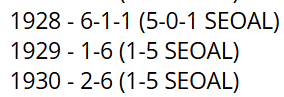
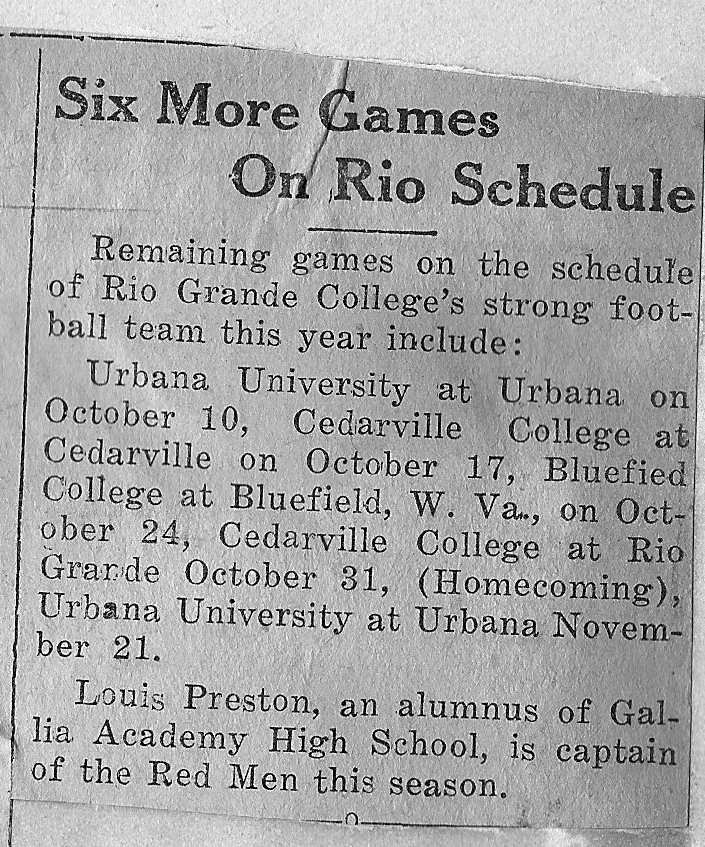
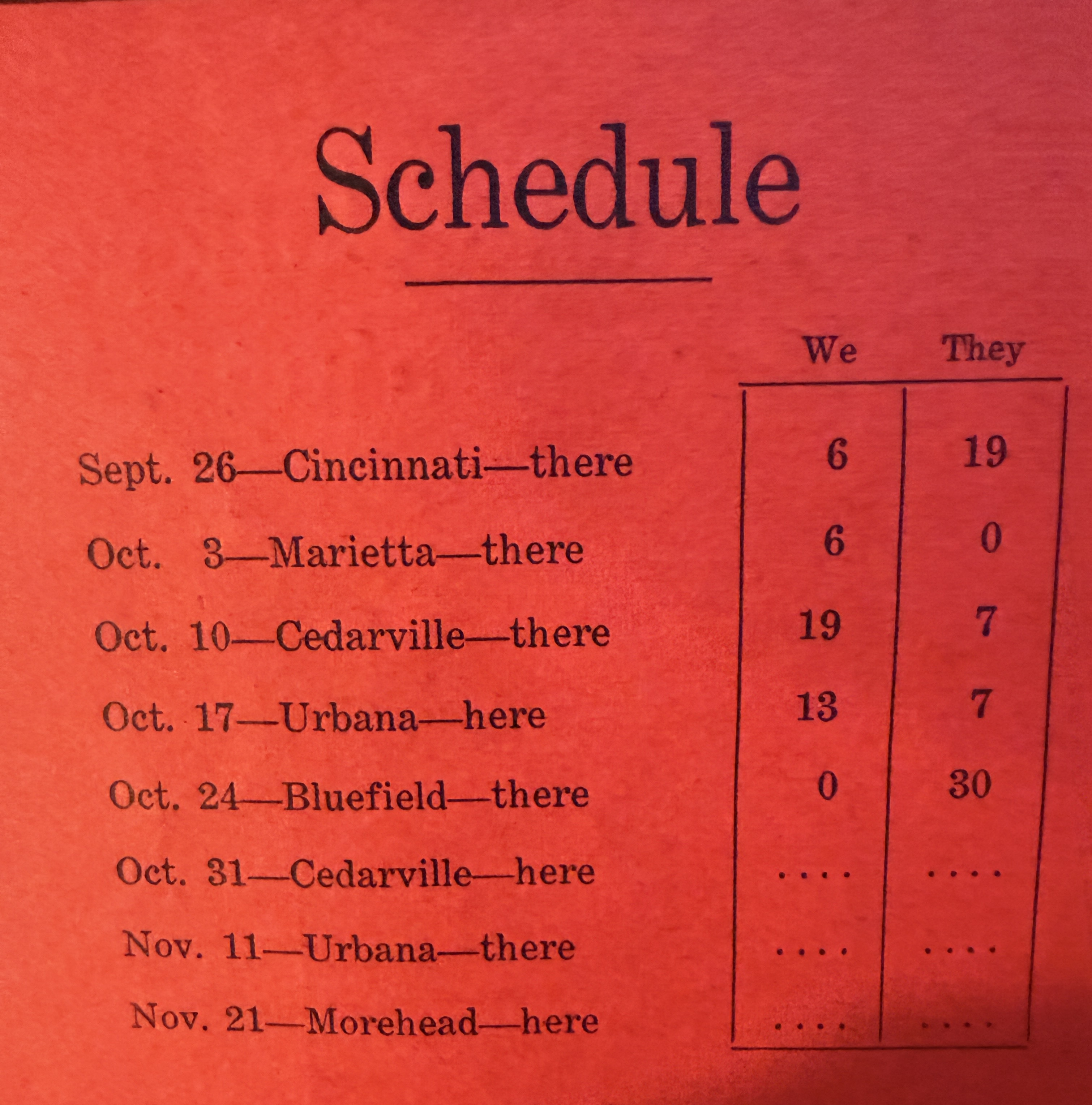
Charles Leo McGarvey’s surviving football record begins at Wellston High School, where he reached the varsity team as a sophomore in 1928 and played on a championship squad that finished 6-1-1 and won the Southeastern title. The high school materials show that he was already a significant presence on the line at an early age. The 1929 Wellston yearbook identifies him as a left tackle, describes him as one of the largest men on the team, and notes that he earned All-South-eastern second-team recognition, suggesting that his value rested not only in size but also in his ability to hold a major varsity role against older competition. Even though the surviving evidence for 1929 and 1930 is thinner, the team record cards show that he remained part of the varsity program through those final high school seasons.
By the time McGarvey reached Rio Grande, the surviving newspaper coverage presents him as much more than a steady lineman. In 1931 he appears as a physical, game-changing player capable of affecting momentum on both defense and offense. The clearest example comes in Rio Grande’s 18-7 win over Cedarville, where he blocked and recovered a punt deep in enemy territory and later scored a touchdown himself. That same season coverage also places him on a Rio Grande team that was rapidly gaining regional attention, with articles emphasizing the strength of Coach Spooner’s squad and the way former high school stars from towns like Wellston helped power the program’s rise. Together, these clippings show McGarvey emerging as a tough and versatile player whose impact could be felt in decisive moments.
The fullest portrait of McGarvey’s athletic ability comes in the transition from 1931 to 1932, when the record shifts from describing him as an important contributor to identifying him as one of the team’s central figures. The season summaries on the page portray him as a player who could block kicks, run with power, fill in effectively at fullback, and help carry the offense in crucial stretches. By the end of 1931 he had been elected captain of the 1932 team, and the 1932 coverage presents him as a star fullback and leader whose running, toughness, and late-game determination were central to Rio Grande’s identity. Taken together, the surviving high school and college sources present Charles Leo McGarvey as a strong, durable, and adaptable football player whose athletic reputation grew from early varsity promise at Wellston into leadership and prominence at Rio Grande.
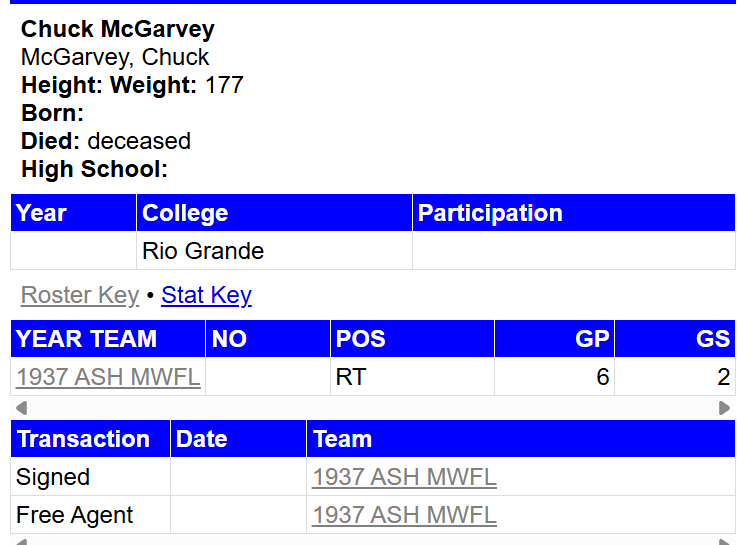
Charles McGarvey’s football career did not end with college. Family stories had long held that “Chuck” went on to play semi-pro football, and surviving roster evidence now confirms that tradition. In 1937, McGarvey appeared on the roster of the Ashland Armcos of the Mid-West Football League, where he was listed as a right tackle from Rio Grande, weighing 177 pounds. The team finished 5-3-1 and placed third in the league under Head Coach Fayne Grone, giving documentary proof that McGarvey extended his playing career beyond high school and college into the semi-pro ranks.
1937 Ashland Armcos roster
Wellston High School Athletic Career
Charles Leo McGarvey at Wellston High School, 1928 to 1930
Family stories remember Charles McGarvey as a four-year varsity football player at Wellston, but the surviving school evidence needs to be read carefully. The 1928 Wellston yearbook's record for the 1927 season does not list him on the football roster, so the documented varsity trail presently begins in 1928, his sophomore year. The 1929 Wellston yearbook identifies him as a left tackle, describes him as one of the largest men on the team, and notes that he made the All-South-eastern second team. That same yearbook also preserves a game-by-game retrospective of Wellston’s 1928 football season, a year in which the team finished 6-1-1 and won the school’s first Southeastern championship. Evidence for the 1929 and 1930 seasons is presently thinner, but the overall varsity record card shows that Wellston went 1-6 in 1929 and 2-6 in 1930 during McGarvey’s remaining high school football years.
1927 season roster note
1928 Season Overview
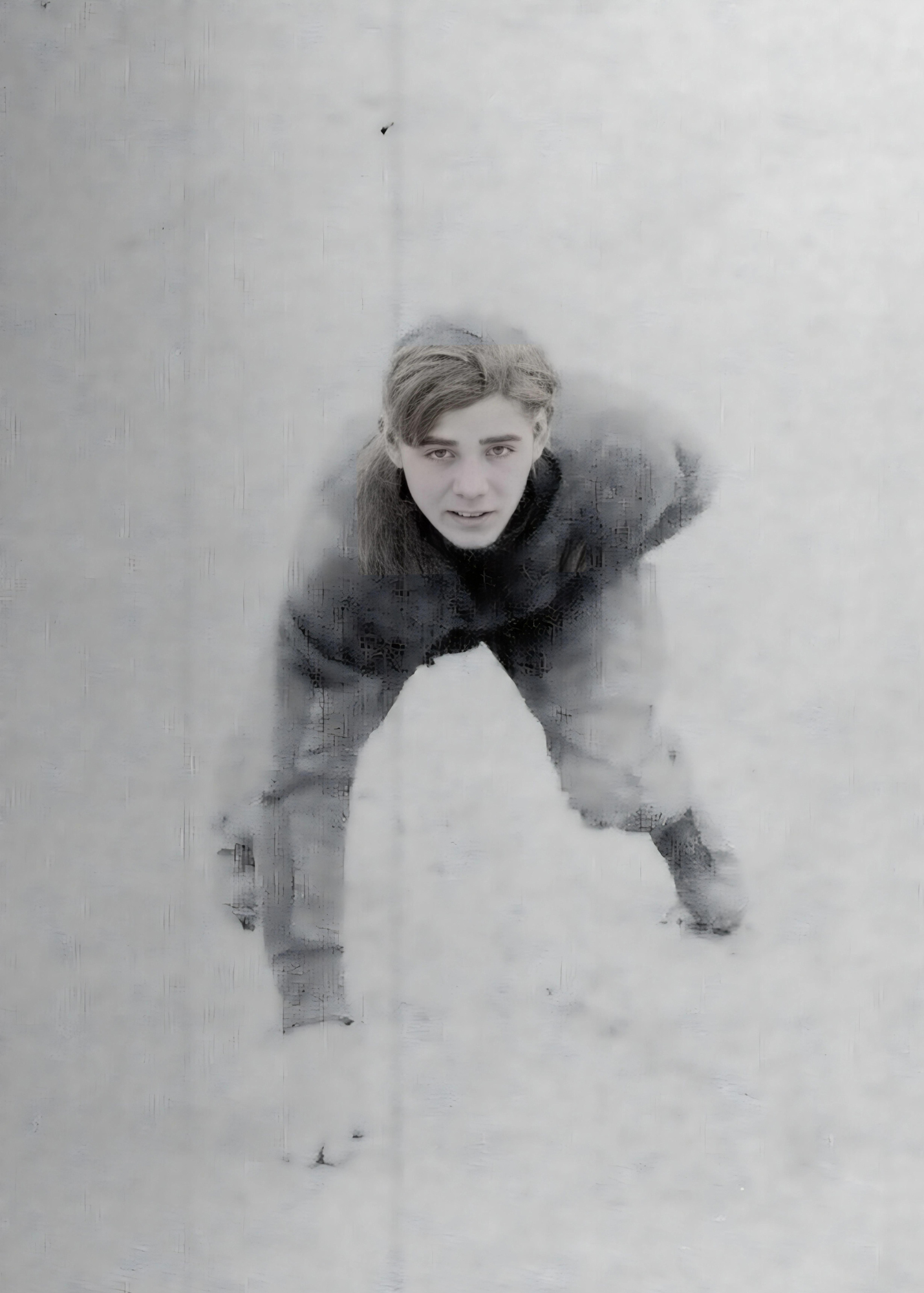
Charles Leo McGarvey during his first varsity season in 1928 at Wellston.
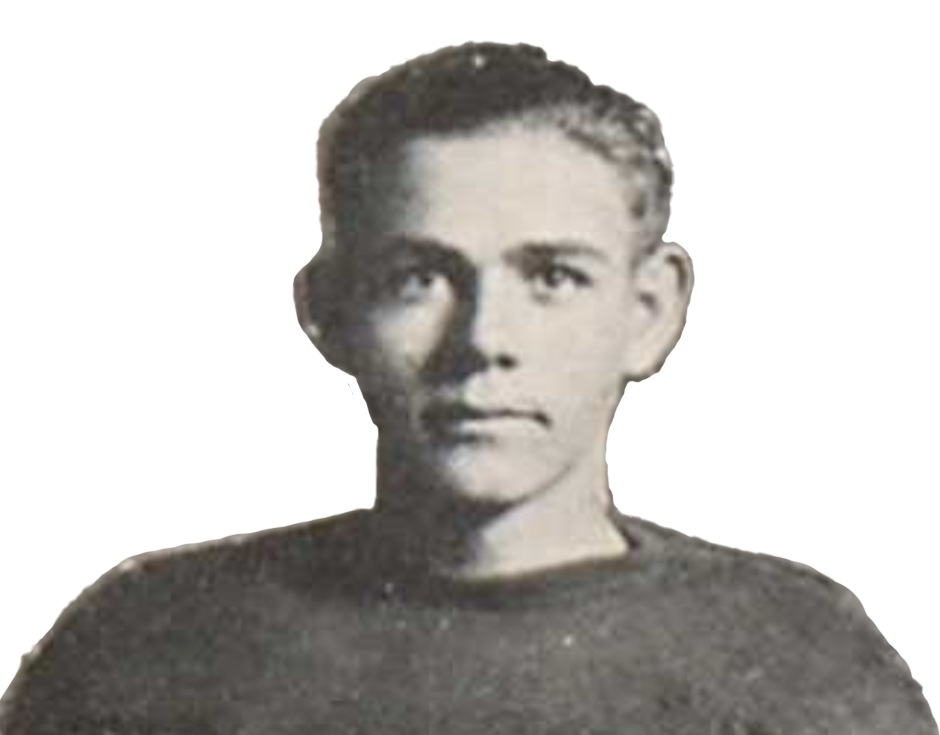
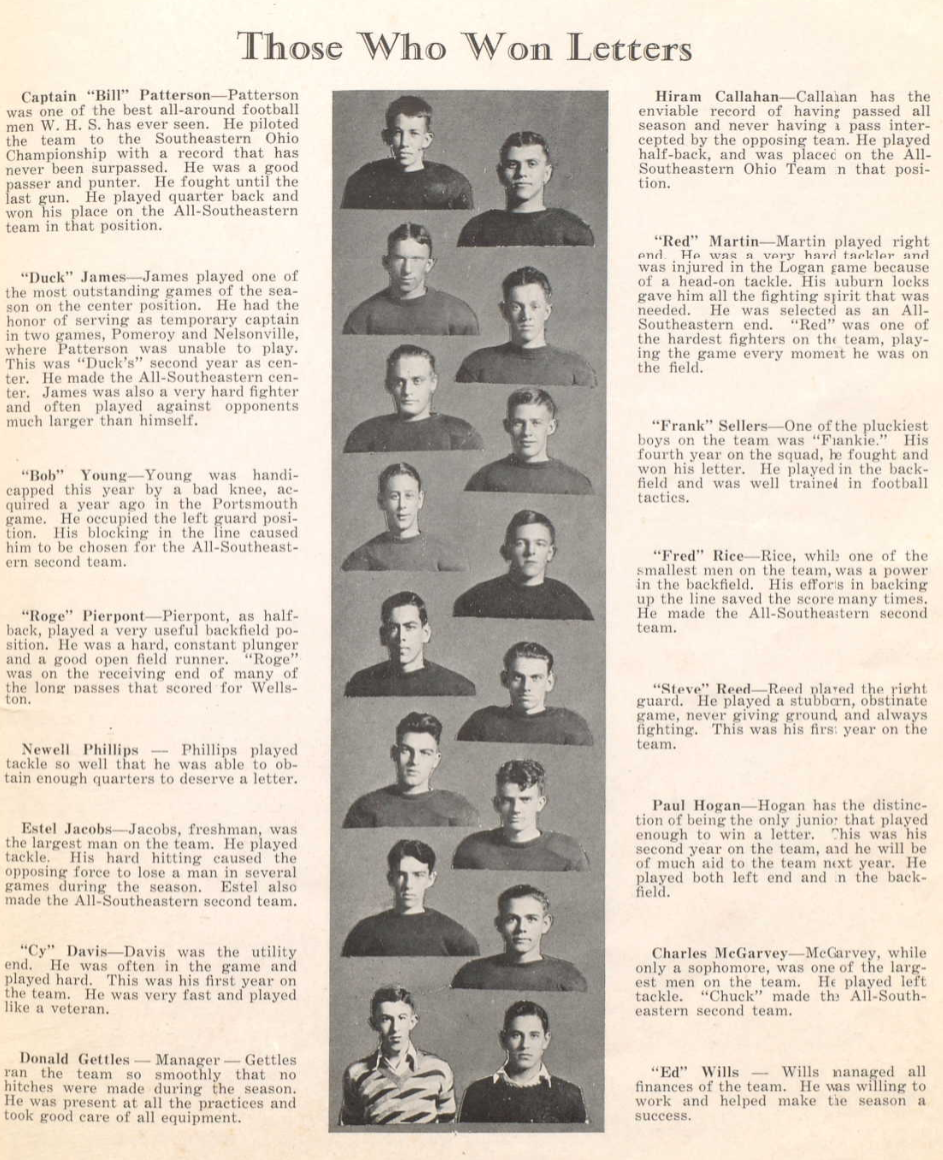
Charles McGarvey’s earliest clearly documented varsity season came in 1928, when he was still only a sophomore at Wellston High School. The yearbook’s player profile shows that he had already earned a place on the varsity line at left tackle, where his size and play made him stand out even among older teammates. The same source notes that McGarvey, “while only a sophomore, was one of the largest men on the team,” and that “Chuck” made the All-South-eastern second team. That combination of size, position, and recognition makes 1928 the first season in which his football ability comes into clear focus.
McGarvey profile
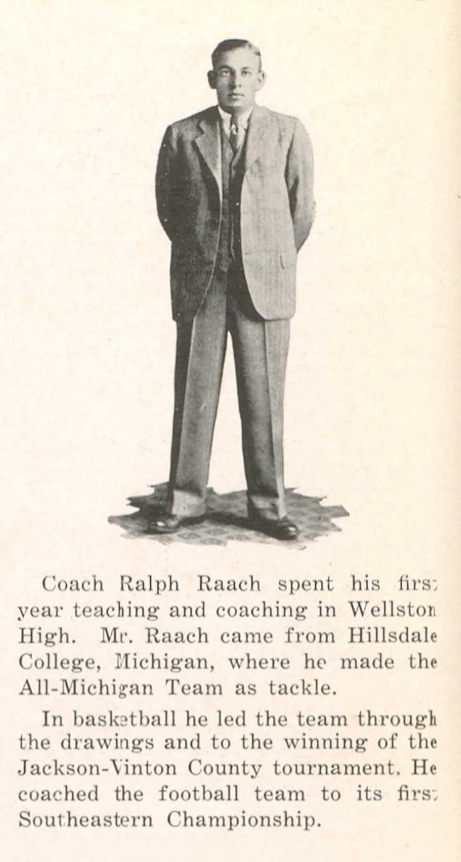
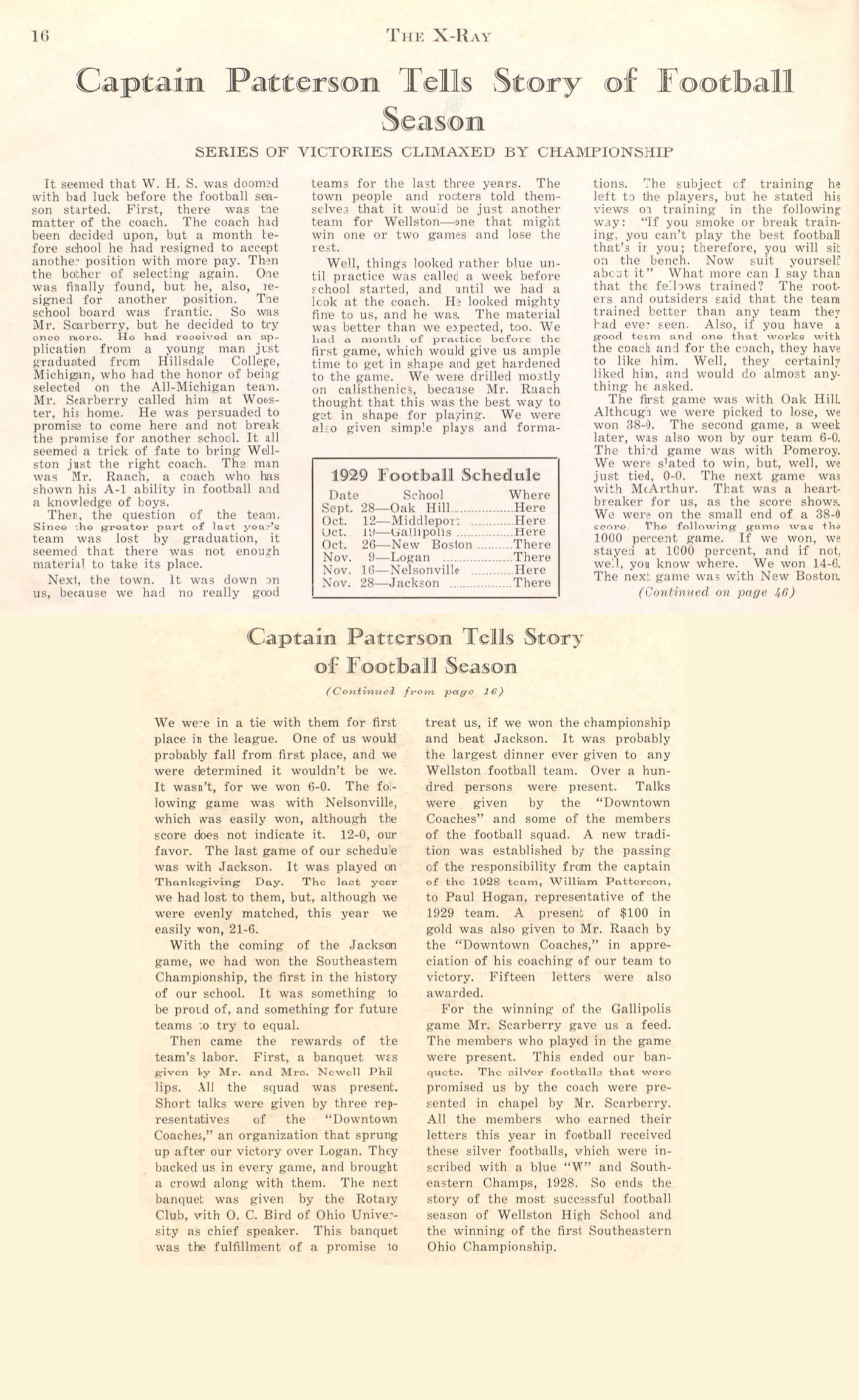
The broader story of the season survives through Captain William Patterson’s yearbook account, which presents Wellston’s championship run as unlikely from the beginning. Patterson recalled that the school’s coaching search had nearly collapsed before Mr. Scarberry secured Ralph Raach, whom he praised as “a coach who has shown his A-1 ability in football and a knowledge of boys.” Patterson also described a team that entered the year with doubts hanging over it, since graduation had taken away much of the previous squad and townspeople expected another losing season. Instead, practice under Raach quickly changed the mood. Patterson remembered that the coach emphasized conditioning, drilled the team on simple plays and formations, and laid down a blunt standard for discipline: “If you smoke or break training, you can’t play the best football that’s in you.” In Patterson’s telling, the players responded fully, and the town soon discovered that this team was different.
Patterson season storyCoach Raach card
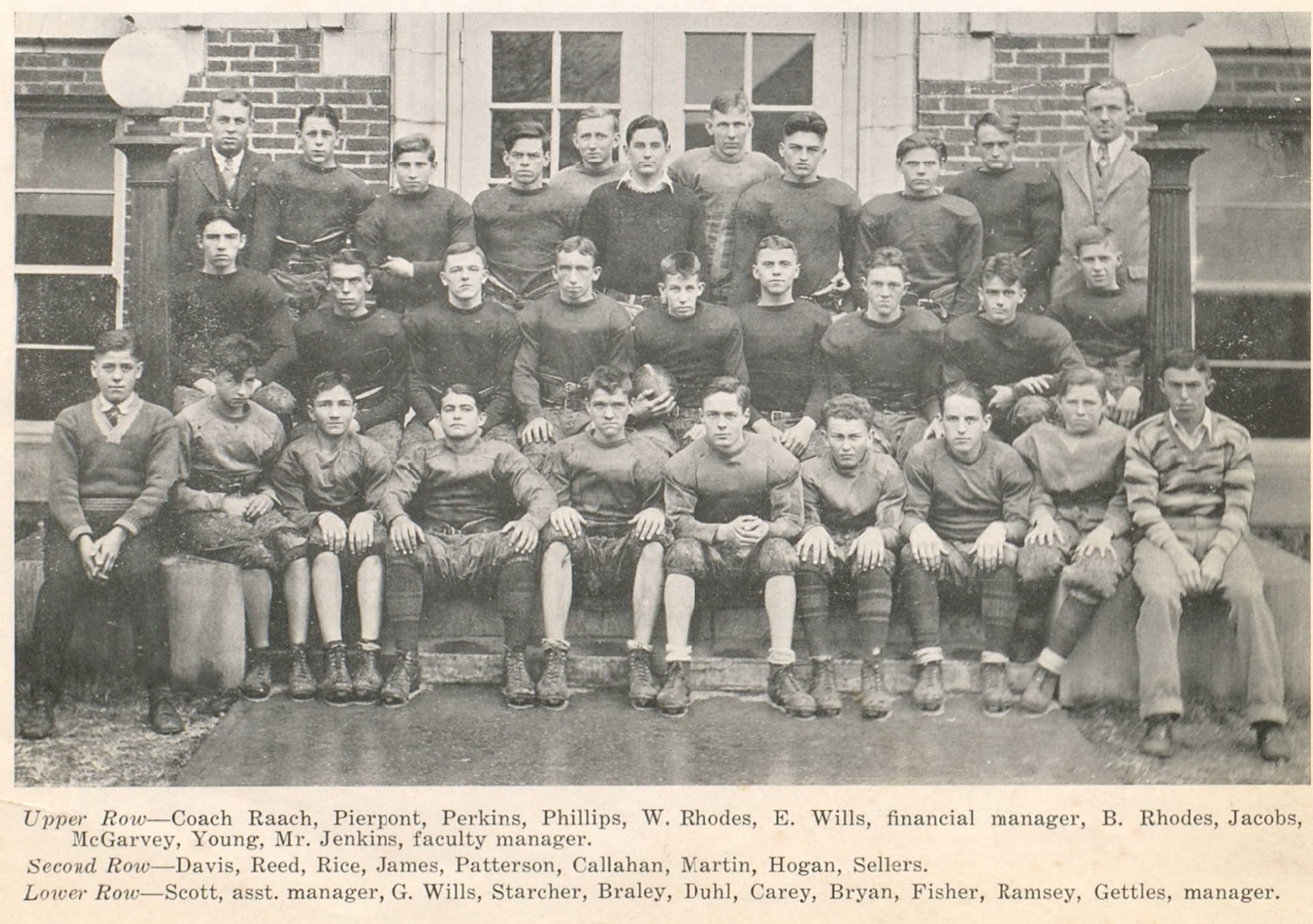
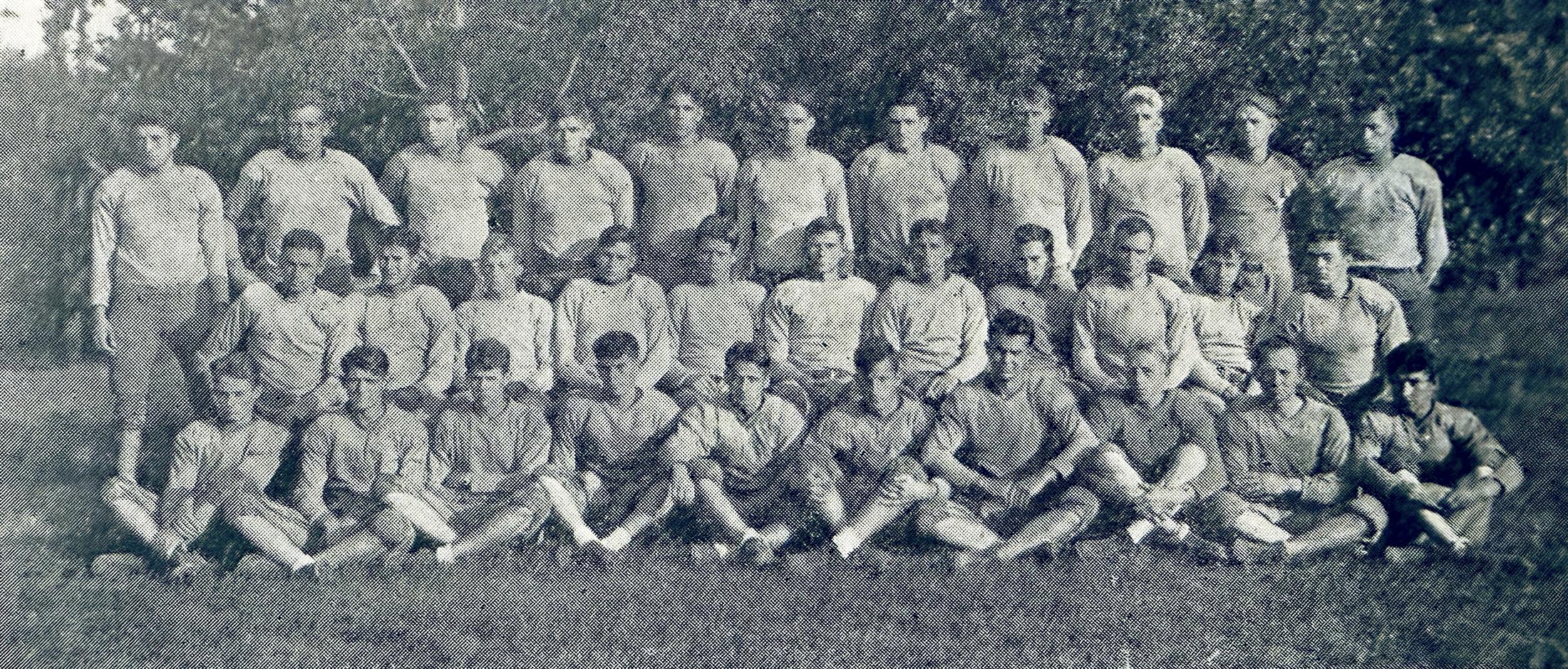
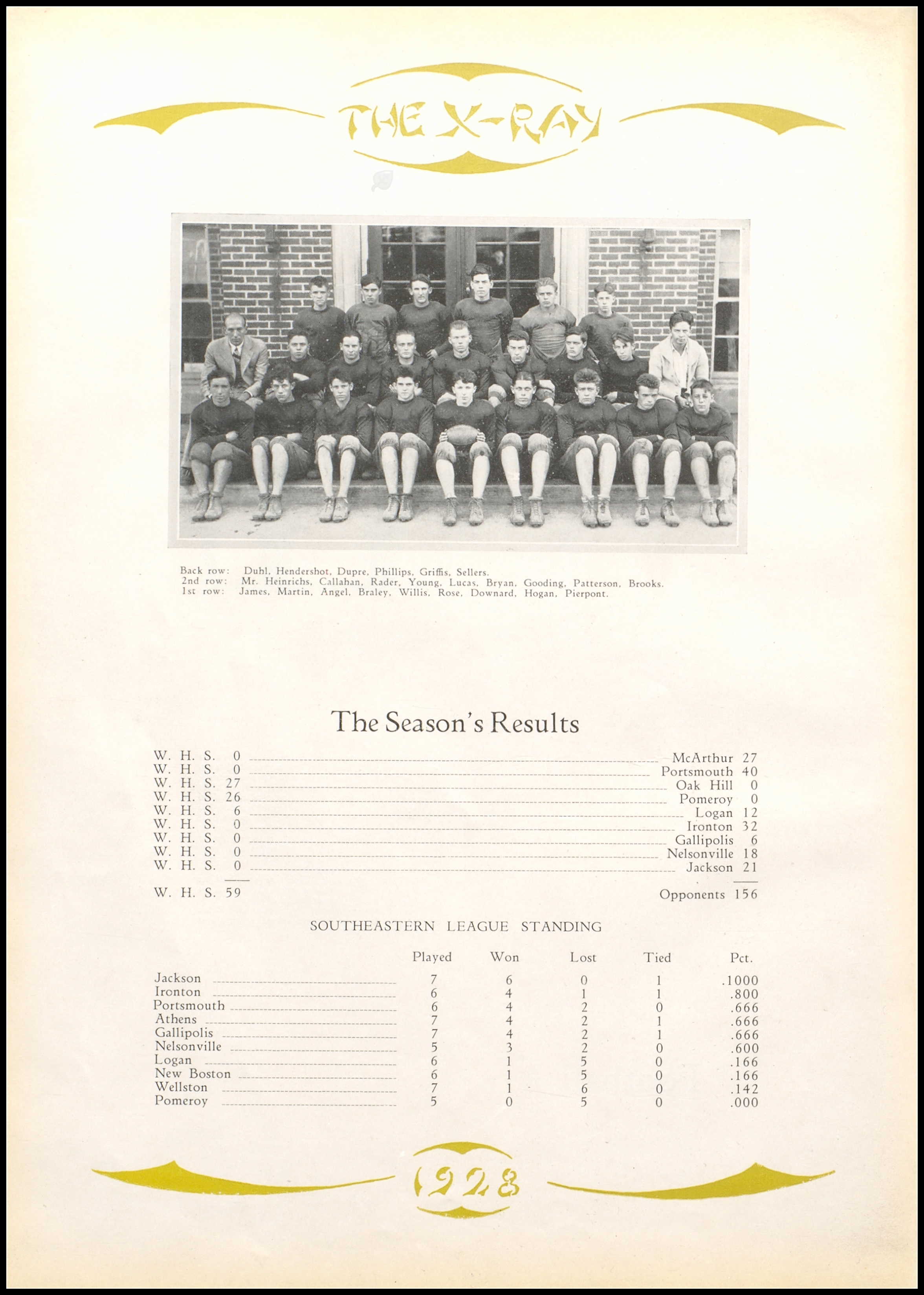
1928 Wellston High School varsity football team, including Charles Leo McGarvey.
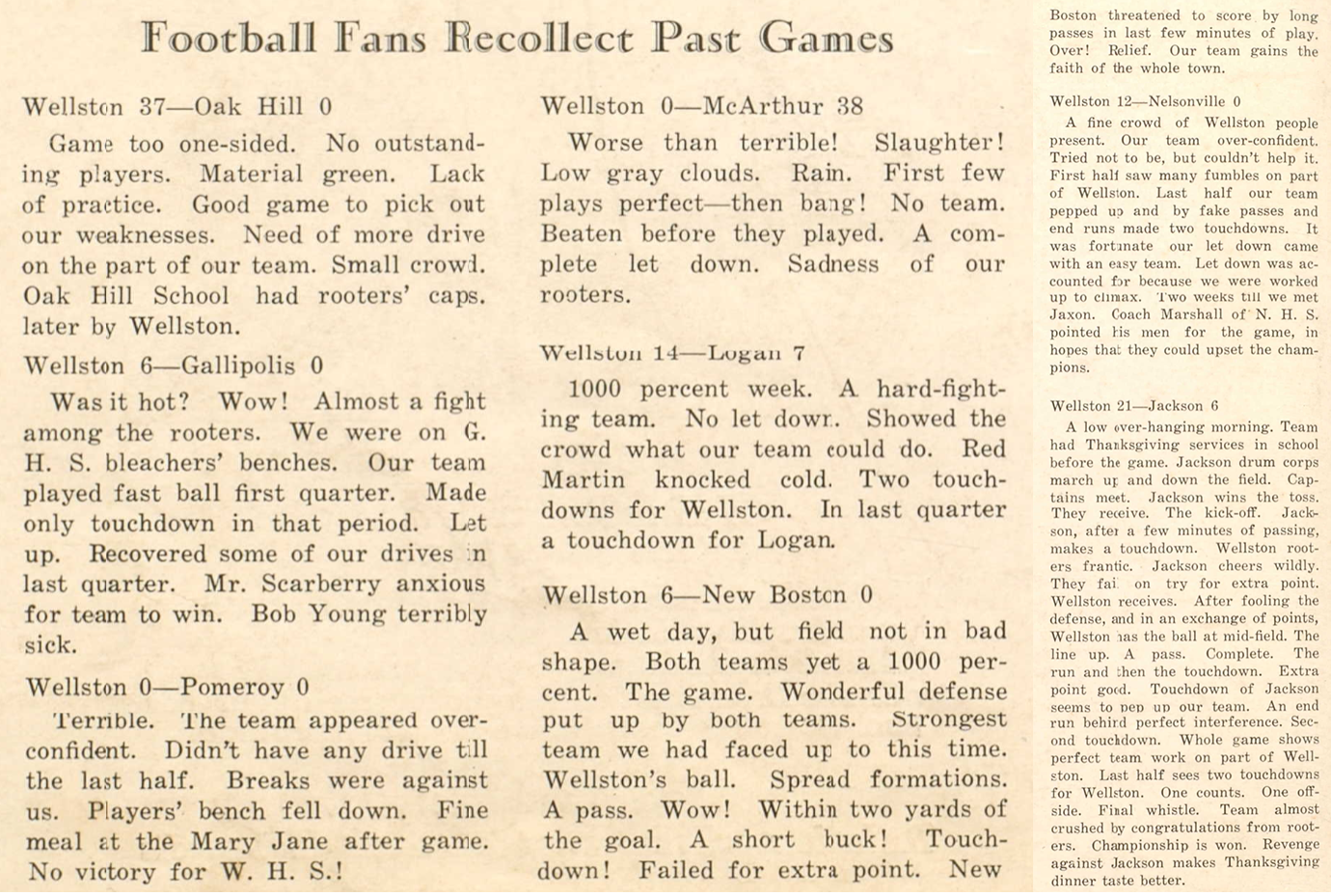
The season itself unfolded through early unevenness and then steady growth. Wellston opened with a one-sided win over Oak Hill, slipped into a scoreless tie with Pomeroy, and absorbed a crushing 38-0 defeat against McArthur before recovering with harder, sharper football. The yearbook game summaries show the team regaining confidence in a 14-7 victory over Logan, winning the town’s faith with a 6-0 defensive struggle against New Boston, and then closing strongly against Nelsonville and Jackson. The 21-6 Thanksgiving victory over Jackson secured the Southeastern championship, and the yearbook remembered it as a performance of “perfect team work on part of Wellston.” McGarvey is not singled out play by play in those summaries, but his position on the varsity line, his all-conference recognition, and his place among the letter winners show that he was part of the core group that helped carry the team through that climb.
Season record pagePatterson season storyMcGarvey profile
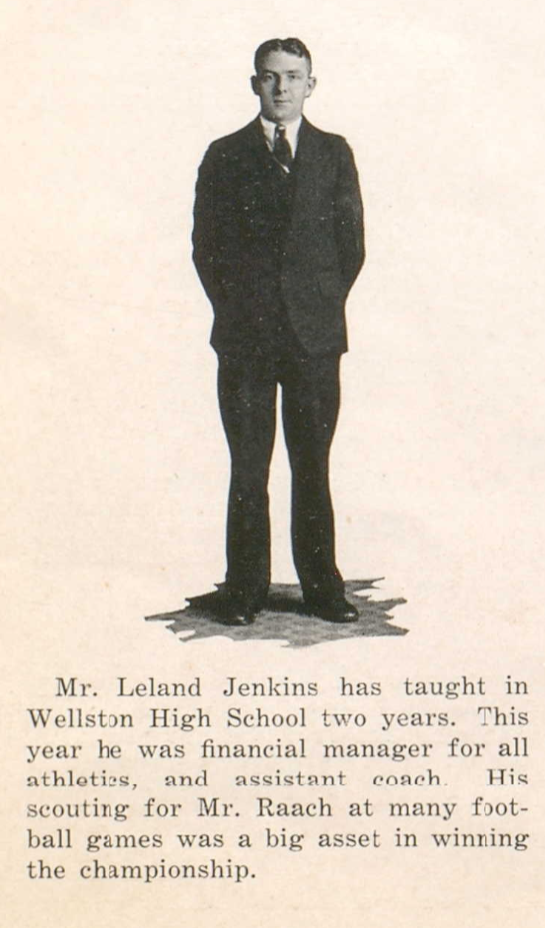
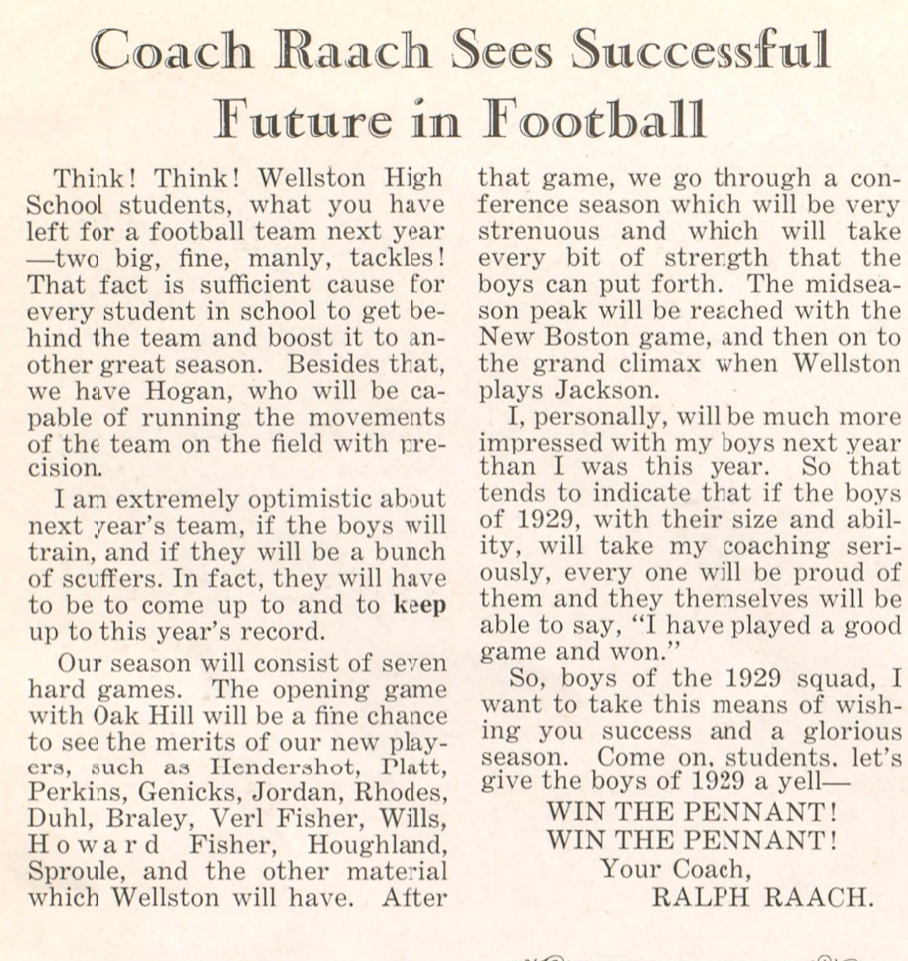
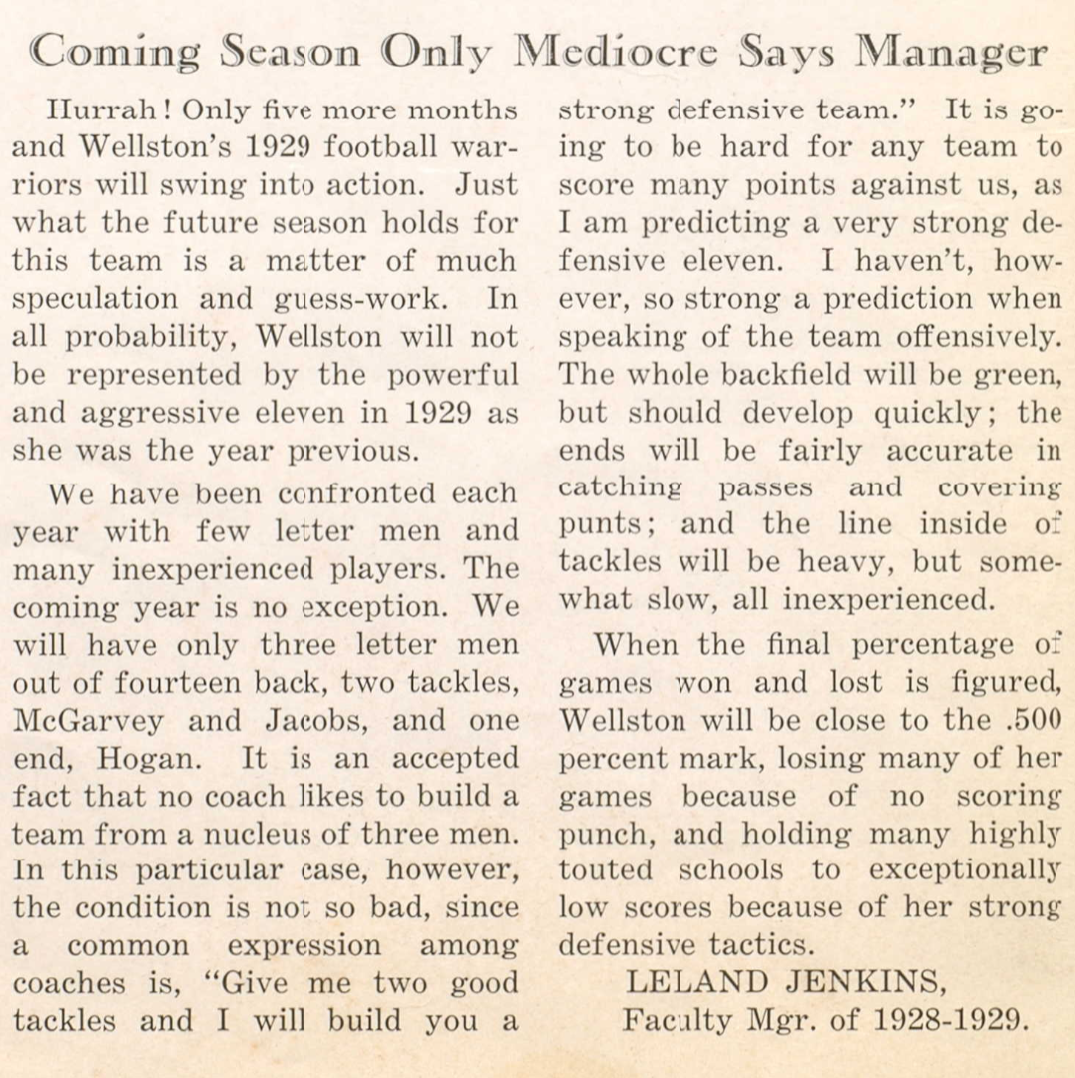
The importance of McGarvey’s sophomore season becomes even clearer in the yearbook’s retrospective comments from those around the program. Leland Jenkins, who served as financial manager for athletics and assistant coach, was credited with scouting work that was “a big asset in winning the championship.” Looking ahead to 1929, Jenkins specifically identified McGarvey and Jacobs as the two returning tackles around whom the coming team could be built, repeating the coaching maxim, “Give me two good tackles and I will build you a strong defensive team.” Coach Raach likewise emphasized that Wellston still had “two big, fine, manly, tackles” returning for the next year. Read together, those remarks show that McGarvey’s 1928 season was not simply an early appearance on a title team. It established him as one of the program’s important young foundation pieces, a sophomore already trusted on the varsity, recognized across the league, and expected to anchor Wellston’s line after the championship year.
Jenkins assistant coach cardJenkins manager messageCoach Raach card
Coach Ralph RaachHead coach, 1928 championship season
“Wellston High School students, what you have left for a football team next year, two big, fine, manly, tackles! That fact is sufficient cause for every student in school to get behind the team and boost it to another great season.”
Sophomore Charles McGarvey played left tackle on a Wellston team that finished 6-1-1, won the Southeastern championship, and provided the earliest strong evidence of his football prominence. By season’s end, both the coaching staff and the faculty manager were already treating him as one of the key returning linemen around whom the next team could be built.
McGarvey profileSeason record pageJenkins manager message
Basketball
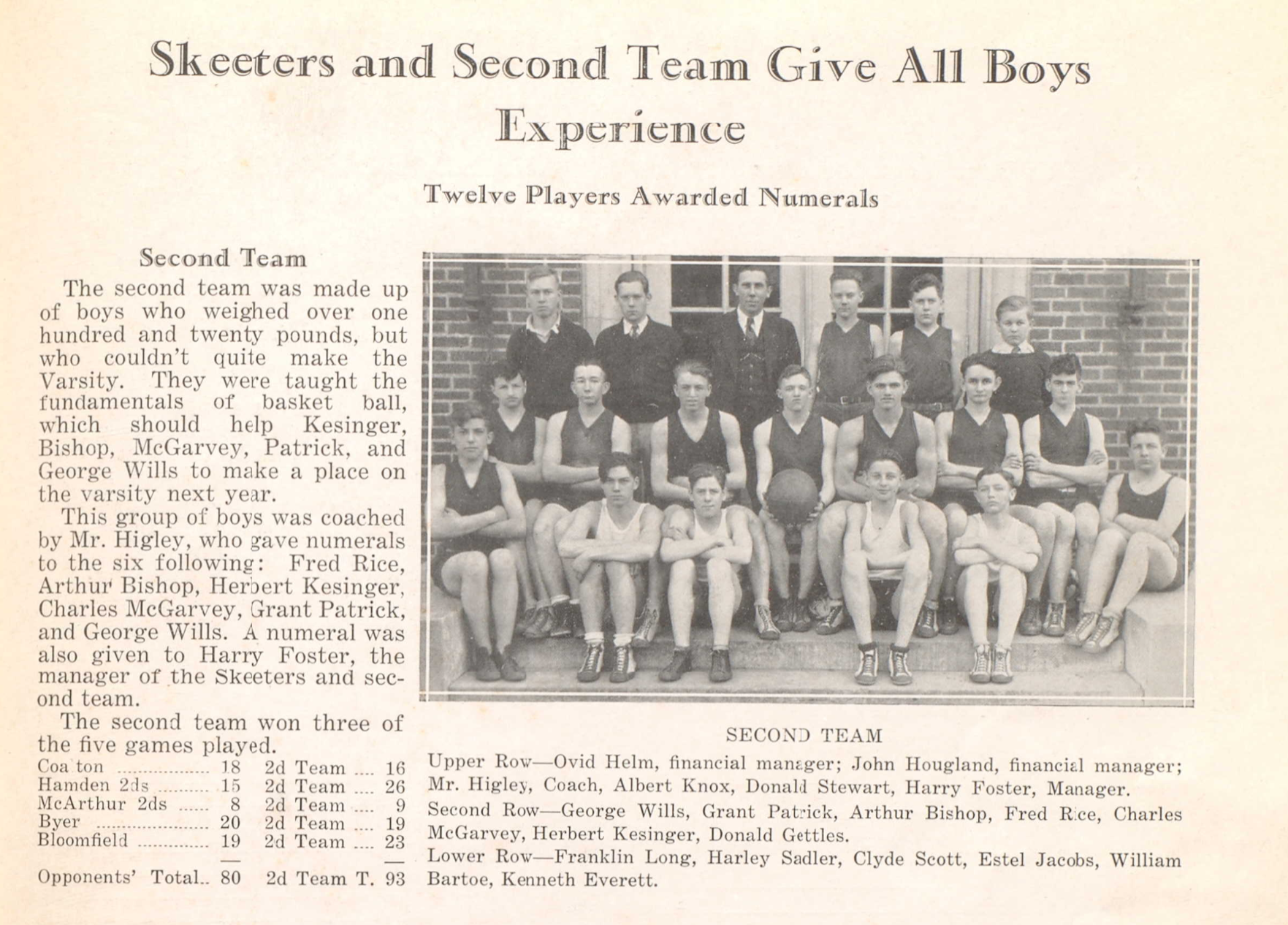
McGarvey’s 1928 to 1929 school year athletic record was not limited to football. Yearbook evidence also places him on Wellston High School’s second team in basketball, showing that he contributed in another major sport during the same period. The second team article lists Charles McGarvey among the boys who were taught “the fundamentals of basket ball,” specifically as part of a group expected to help make places on the varsity the following year. He was also among the players awarded numerals, suggesting that his role in school athletics extended beyond the football field and into the developing basketball program.
Second team basketball page
1928 Wellston High School basketball team, including Charles Leo McGarvey.
1929 Season Overview
The surviving evidence for 1929 is much thinner than for the championship season that came before it, but the available record still helps place Charles McGarvey’s junior year in context. The team record summary shows that Wellston fell to 1-6 overall and 1-5 in conference play, a sharp decline from the 1928 title run. That downturn seems to have reflected the difficulty of following a championship team after graduation had stripped away much of the earlier core. Even so, the yearbook’s forward-looking football commentary makes clear that McGarvey remained one of the important pieces left in place. Leland Jenkins specifically named McGarvey and Jacobs as the returning tackles around whom the next team could be built, while Coach Raach likewise emphasized the value of the two big tackles still in school.
Read together, those remarks suggest that McGarvey’s junior season should not be viewed simply through the team’s losing record. Instead, 1929 appears as a transitional year in which Wellston struggled collectively while McGarvey continued to hold a meaningful place in the program’s future plans. The surviving record does not yet provide the game-by-game detail available for 1928, but it does show that McGarvey entered the season not as an unknown underclassman, but as one of the returning linemen the coaching staff believed could stabilize the team after its championship losses. In that sense, 1929 forms an important bridge between his early prominence at Wellston and the more fully documented leadership role he would later assume at Rio Grande.
1930 Season Overview
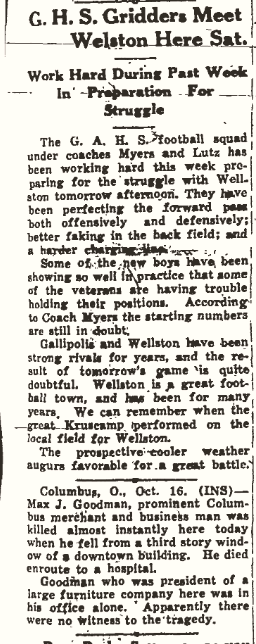
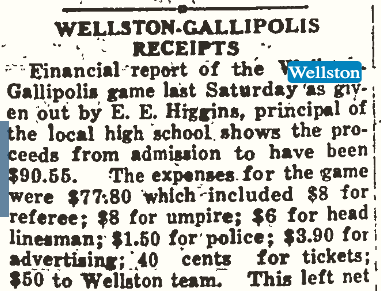
The surviving record for 1930 is still less complete than the 1928 championship account, but the newly gathered Gallipolis Daily Tribune clippings add useful texture to Charles McGarvey’s senior football season. The team record card shows that Wellston finished 2-6 overall and 1-5 in conference play, while the October Gallipolis preview places the Wellston game inside a long-running rivalry and describes Wellston as a “great football town.” A later financial notice also shows that the Wellston-Gallipolis game drew enough local attention to produce a formal receipts report, preserving a small but concrete glimpse of the season’s community setting.
Gallipolis-Wellston preview, Oct. 17, 1930Wellston-Gallipolis receipts, Oct. 24, 1930
Most importantly for McGarvey himself, the December conference selections show that his senior year was not simply a quiet closing season on a struggling team. The Gallipolis Daily Tribune reported that conference coaches selected McGarvey of Wellston for one of the mythical elevens, identifying him among the guards. Read beside his senior football photograph, that notice gives McGarvey a final high school honor before the record shifts to Rio Grande, where his toughness, versatility, and leadership would emerge far more clearly in newspaper coverage.
Conference coaches selection, Dec. 23, 1930
Basketball
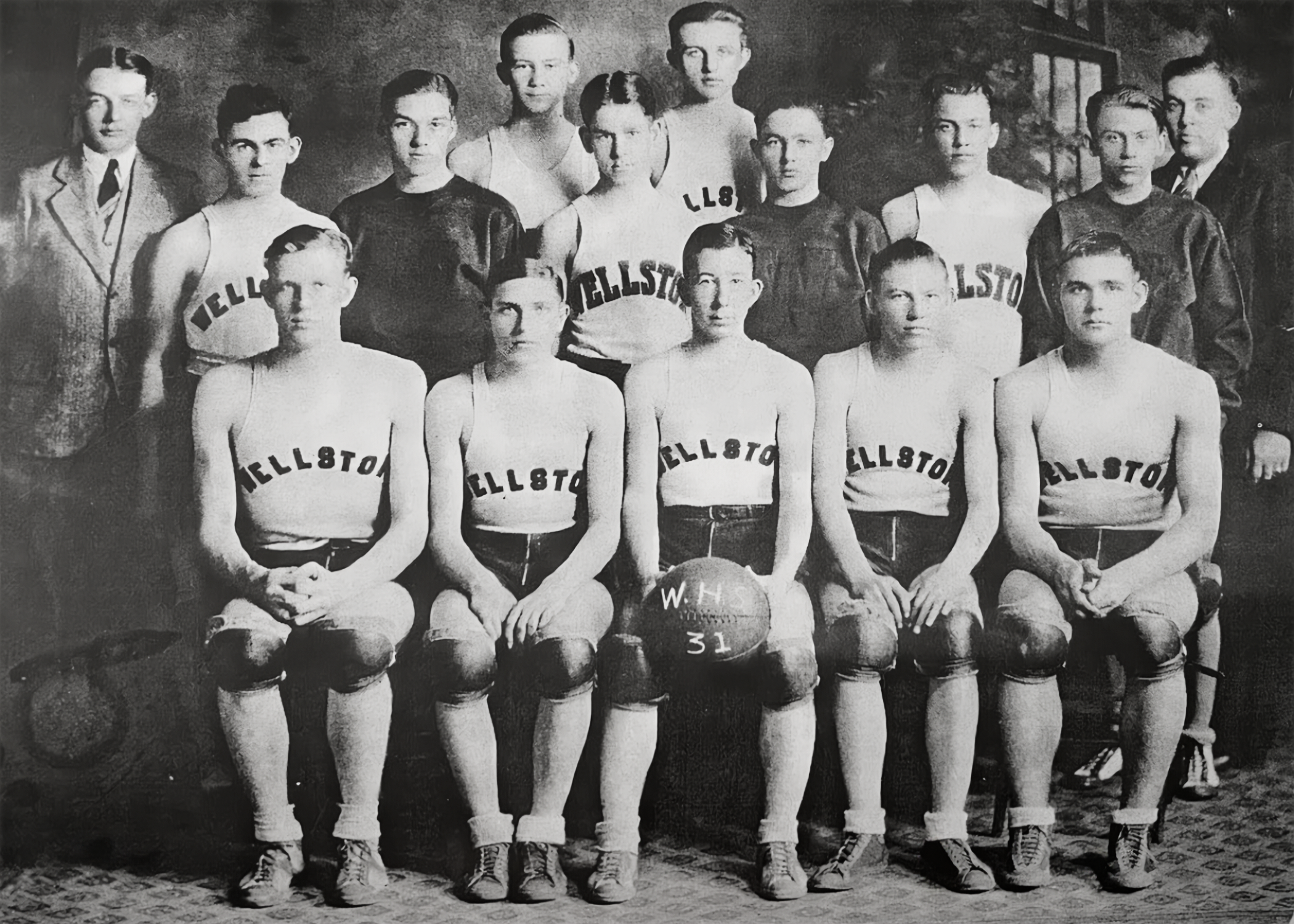
McGarvey’s senior year athletic record at Wellston was not limited to football. A surviving 1931 basketball team photograph shows him as part of the school’s varsity basketball program as well, offering further evidence of his broad athletic involvement during his final year in high school.
1931 Wellston basketball team photograph
1931 Wellston High School basketball team photograph. Charles McGarvey is pictured in the lower right.
Pictured in the lower right of the team image, McGarvey appears not simply as a football player passing through a winter season, but as a multi-sport athlete whose place in Wellston athletics extended across the school year.
1931 Wellston basketball team photograph
Rio Grande College Athletic Career
Charles Leo McGarvey at Rio Grande, 1931 and 1932
The surviving newspaper coverage shows Charles Leo McGarvey emerging first as a tough,
impact player in Rio Grande’s successful 1931 season, then as captain and star fullback
during the 1932 campaign. Across these two years, the clippings portray a player who could
change games with blocked kicks, power running, leadership, and late-game determination.
1931 Season Overview
The 1931 season marked a major turnaround for Rio Grande. Early preseason coverage from
September 10 reported that thirty men had already reported to Coach Spooner for football
practice and described prospects as “exceptionally bright,” with returning lettermen and
additional talent expected from surrounding high schools. The schedule also showed Rio
opening against Cincinnati before meeting Marietta, Urbana, and Bluefield.
Preseason report, Sept. 10, 1931
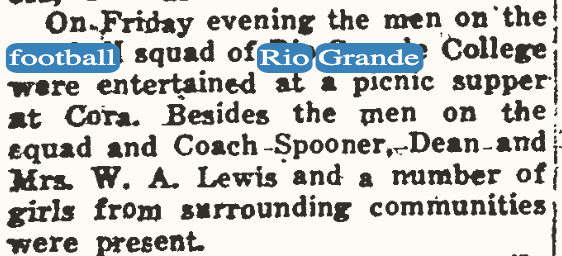
A week later, a brief social notice showed another side of the team's early-season life,
reporting that the football squad was entertained at a picnic supper at Cora with Coach
Spooner, Dean and Mrs. W. A. Lewis, and guests from surrounding communities. Though small,
the item helps place the team within the college and local social world that supported it:
Rio Grande football was already becoming a campus project as well as an athletic schedule.
Football picnic, Sept. 19, 1931
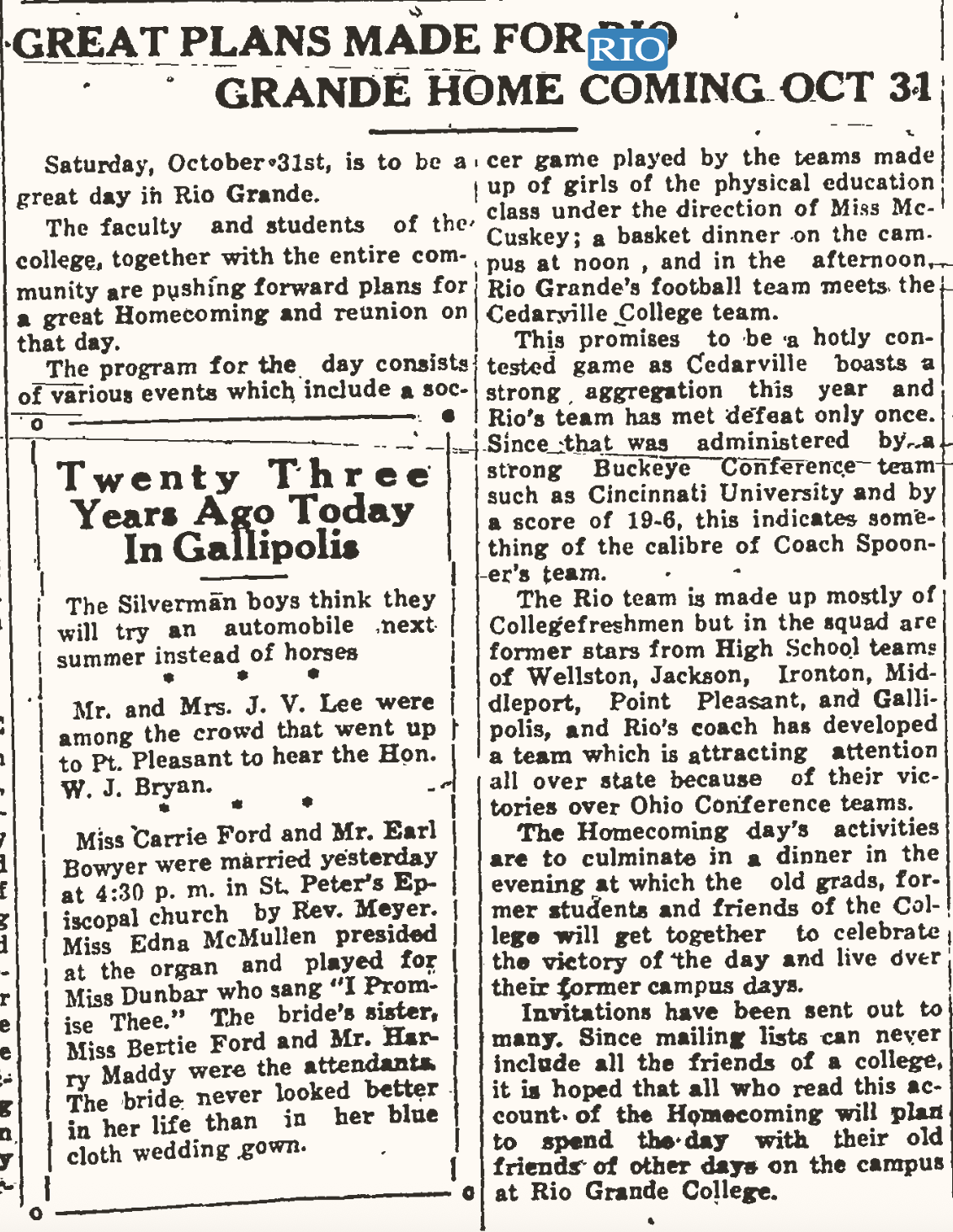
By late October, that early campus interest had grown into public excitement around
Homecoming. A Gallipolis preview for the October 31 celebration described Rio Grande as
having met defeat only once, against Cincinnati, and emphasized that Coach Spooner had built
a mostly freshman squad that still drew former high school stars from Wellston, Jackson,
Ironton, Middleport, Point Pleasant, and Gallipolis. The article shows how quickly the team
had become a source of campus and community pride.
Homecoming preview, Oct. 22, 1931
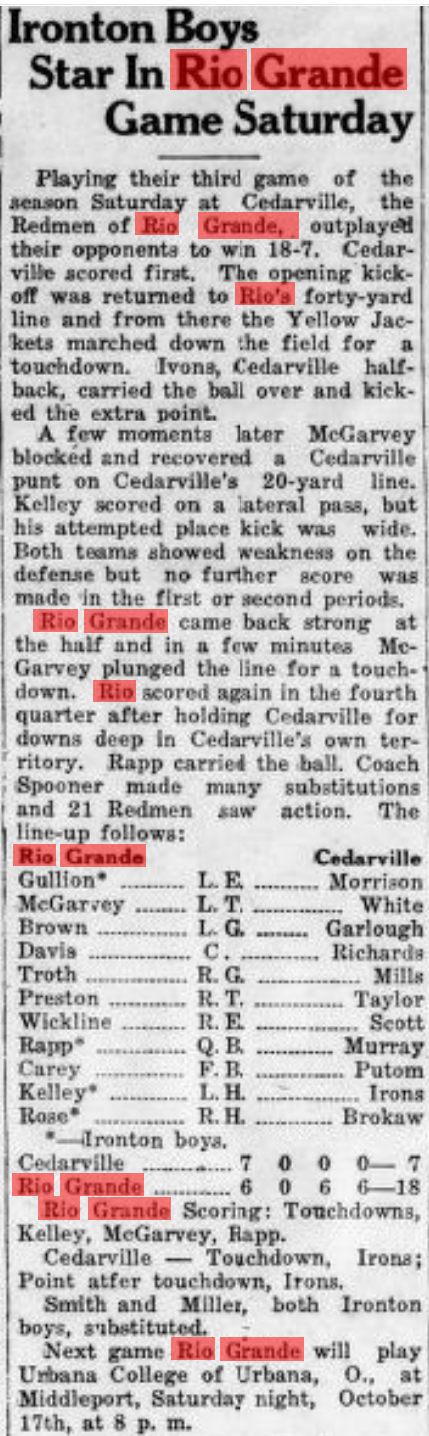
McGarvey first emerges clearly inside that rising season in Rio Grande's
18-7 win over Cedarville. The game account gives him two decisive moments, one
before the score and one after halftime, and both show why he mattered to the team's change
in momentum.
Cedarville game, Oct. 12, 1931
First, Cedarville was forced into trouble deep in its own territory, and McGarvey turned that
pressure into field position for Rio Grande.
"A few moments later McGarvey blocked and recovered a Cedarville punt on Cedarville's 20-yard line."
The Cedarville game therefore gave McGarvey more than a single box-score moment. He affected
the game in different phases, helping explain why later coverage treated him as one of Rio
Grande's most useful and adaptable players.
The season closed with one of the strongest surviving McGarvey references in the collection.
In the Gallipolis account of Rio Grande's 20-12 win over Morehead, his role expanded after
regular fullback Carey left with an injured knee. McGarvey did not simply fill an empty
position; the account presents him as one of the men who carried the offense through the win.
Season-ending victory, Nov. 24, 1931
The first detail explains how McGarvey entered the fullback role in the game's flow.
"Carey, regular full back, was early forced from the game by an injured knee, but McGarvey, substitute, ably filled his shoes."
The next detail shows that this was not a minor substitution. Once in that role, McGarvey was
part of the rushing core that produced Rio Grande's gains.
The Morehead game became an important bridge between McGarvey's 1931 role and his 1932
captaincy. He was not merely present in the season finale; he was one of the players who
carried Rio Grande through the closing win.
The end-of-season summaries confirmed that Rio Grande finished 6 wins and 2 losses,
scored 122 points, and emerged from a winless 1930 to become one of the stronger
small-college teams in the region. Just after the season, McGarvey's growing stature was
confirmed when he was elected captain of the 1932 team. The Gallipolis account of that
banquet adds more institutional context than the shorter Ironton notice, preserving remarks
from trustees, Dean W. A. Lewis, Coach Dewey Spooner, and graduating players.
Season summary, Dec. 2, 1931Gallipolis captaincy article, Dec. 5, 1931Ironton captaincy article, Dec. 9, 1931
The captaincy report gives the season its final turn: McGarvey moved from useful contributor
and emergency fullback to the teammate chosen to lead the next Rio Grande squad.
"Charles McGarvey of Wellston was elected captain of the 1932 Rio Grande College football team..."
Rio Grande finished the 1931 season with a 6-2 record, a dramatic reversal from
the winless 1930 campaign described in the later season summaries. Historically, that makes
the year more than a collection of isolated clippings: it marks the moment when Coach
Spooner's young squad became a credible small-college football team in the region. McGarvey's
surviving mentions fit directly into that larger turn. He blocked and recovered a punt,
scored against Cedarville, filled in effectively at fullback against Morehead, helped produce
the team's late-season gains, and then emerged as captain-elect for 1932. Read as a season,
1931 is the year McGarvey moves from documented contributor to recognized team leader.
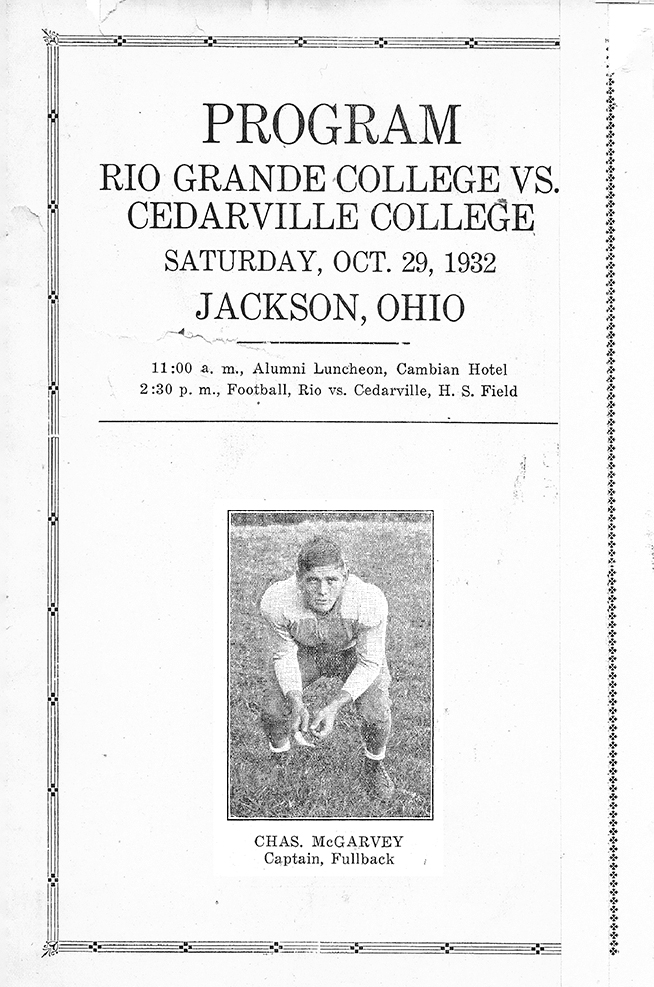
1932 Rio Grande Homecoming program cover featuring Charles McGarvey.
Program cover
McGarvey's role in the early 1932 season becomes clearer when the Cedarville and Homecoming
previews are read together. After Rio Grande's 14-7 win over Cedarville, one account did more
than record the final score. It singled him out as a fullback whose 25-yard run helped move
Rio Grande into scoring position, showing that he was being used as more than a stationary
lineman or occasional substitute.
Cedarville game, Oct. 3, 1932Homecoming preview, Oct. 7, 1932
The Cedarville account gives one concrete example of that expanded role. In the scoring
sequence, McGarvey appears not as background line support but as the runner who broke loose
for the gain that helped set up Rio Grande's touchdown.
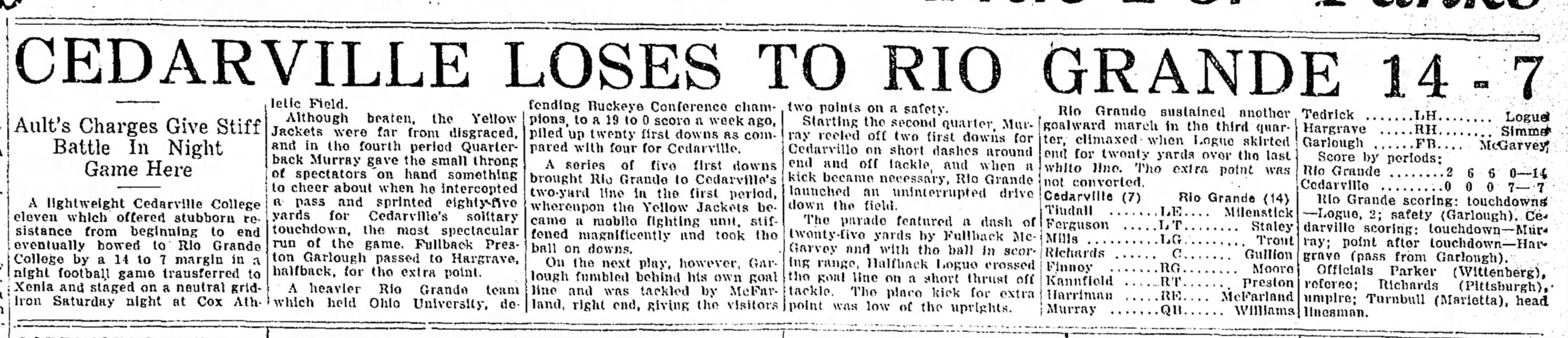
“The parade returned a dash of twenty-five yards by Fullback McGarvey...”
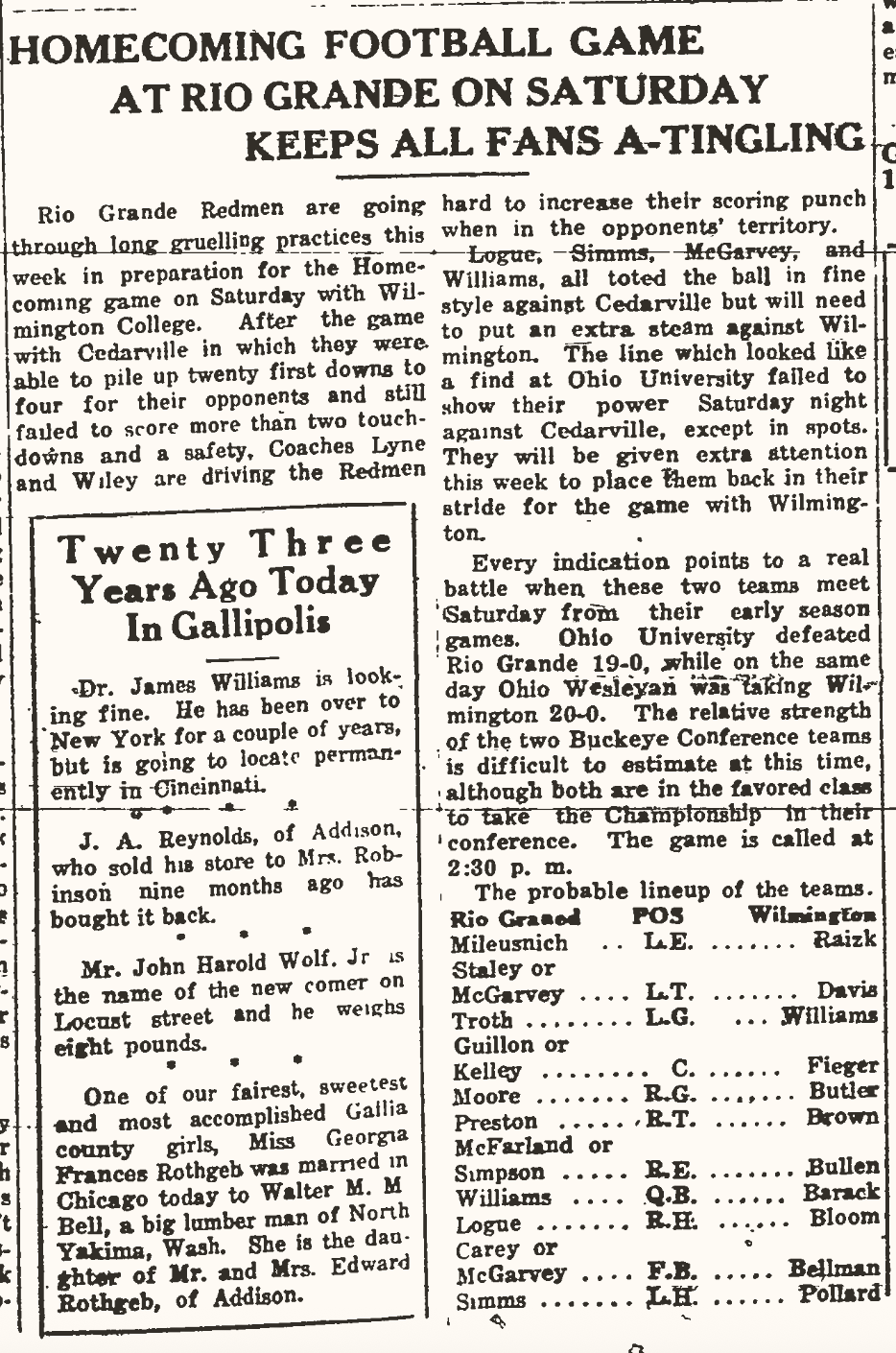
The Gallipolis Homecoming preview carried that image into the next week. Instead of treating
McGarvey only as a lineman, it grouped him with Rio Grande's ball carriers and presented him
as one of the players Wilmington would have to account for.
“Logue, Simms, McGarvey, and Williams, all toted the ball in fine style against Cedarville...”
Together, the Cedarville account and the Homecoming preview show McGarvey moving into a more
flexible offensive identity. By the time Rio Grande faced Wilmington, he was no longer just a
name in the line; he was a plausible fullback, a key runner, and a player whose position could
shift with the needs of the game.
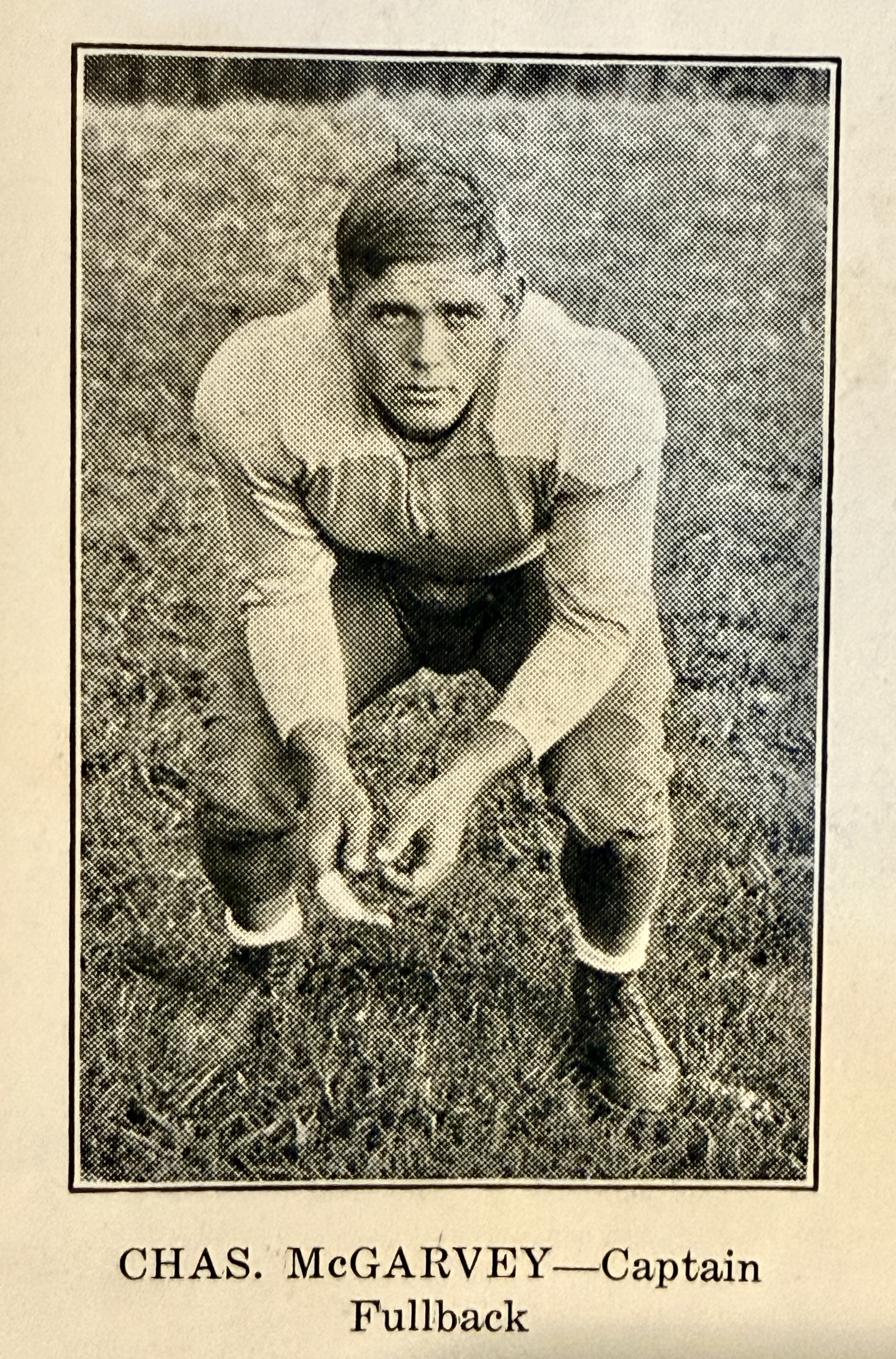
Chas. McGarvey, captain and fullback for Rio Grande during the 1932 season.
Captain fullback portrait
The best surviving article for McGarvey personally remains Rio Grande's narrow
7-6 loss to Wilmington. In that game he is identified as both captain and
star fullback, and the story places him at the center of Rio Grande's late scoring drive.
The account does not describe him in passing; it follows the ball through his hands as Rio
Grande tried to force a tie in the final moments.
Wilmington game, Oct. 10, 1932Follow-up column, Oct. 11, 1932
“McGarvey, star fullback of the Lyne-coached outfit, hit the line a yard at a time...”
That same drive narrowed the game to a single decisive play. After McGarvey pushed the ball
close enough to make the extra point matter, Rio Grande again trusted him with the attempt.
“the ball was snapped to McGarvey, who jabbed at the strongest point of Wilmington’s line”
The result was still a loss, but the description leaves McGarvey at the center of Rio
Grande's last chance. He ground out the drive, took the final plunge, and became the player
through whom the game's closing tension passed.
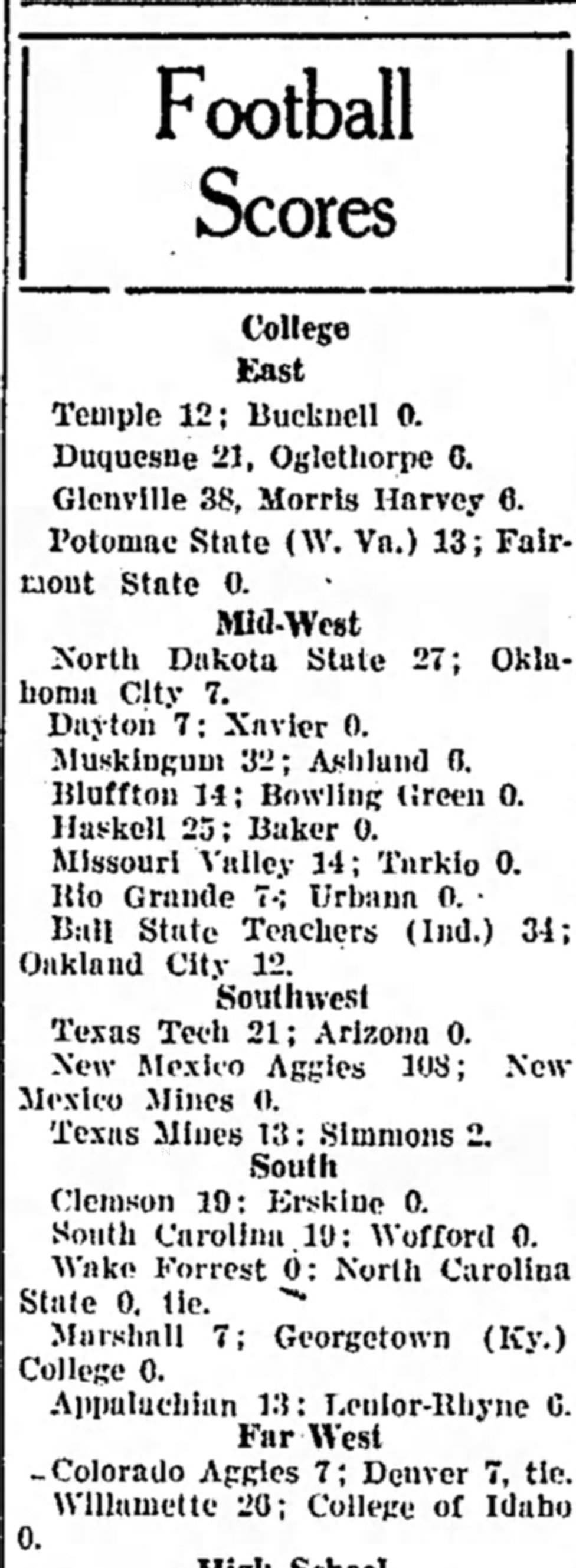
Another October score roundup confirms Rio Grande’s 7-0 win over Urbana, though the
clipping shared so far preserves only the result and not a fuller game story.
Football Scores, Oct. 15, 1932
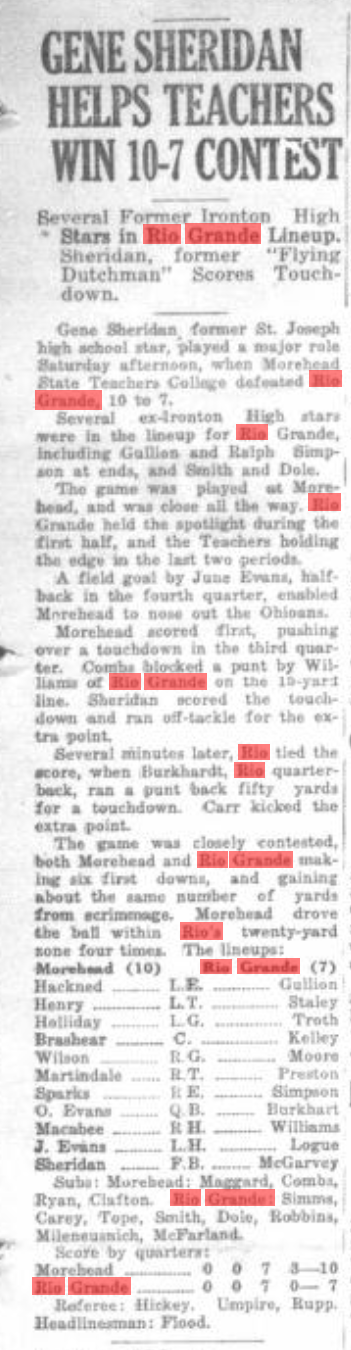
A week later, Rio Grande lost a close game at Morehead, 10-7. The short Lima wire story
reports that a fourth-quarter field goal made the difference, while the fuller local account
is more valuable for McGarvey because it includes complete lineups and places him in the
starting eleven at fullback. That story also preserves the names of other former Ironton-area
players in the Rio lineup.
Lima News, Oct. 23, 1932Likely Irontown News, Oct. 24, 1932
In the surviving 1932 coverage, McGarvey appears not just as a rostered player but as one
of the central figures of the team, captain, probable two-way starter, fullback, late-game
runner, and one of the men through whom Rio Grande’s offense and leadership were expected
to operate.
In Brief
1932 Season
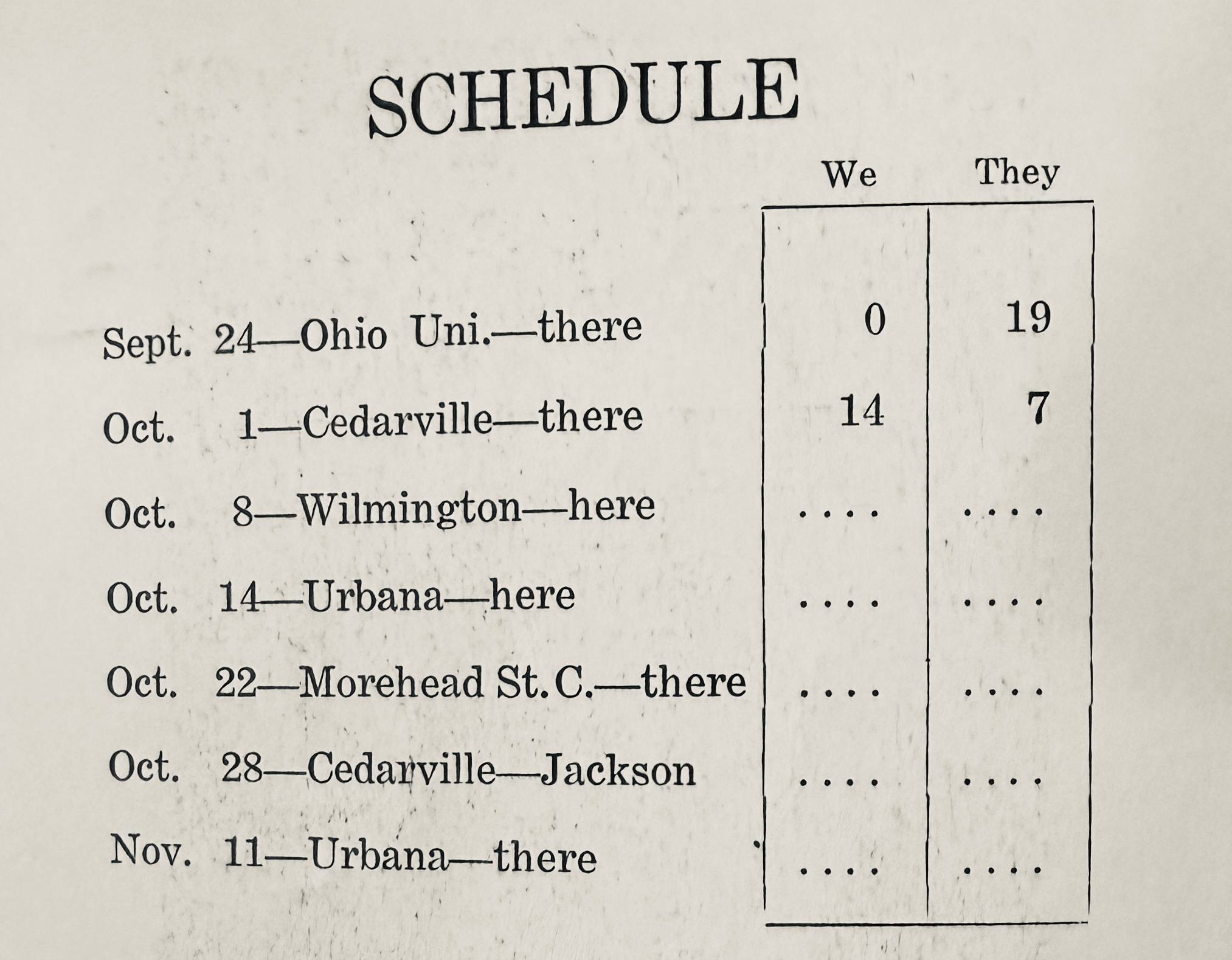
Published year-by-year records give Rio Grande a 3-4 record for the 1932
season, and the inside schedule from the 1932 Homecoming program now clarifies the shape
of that season. Rio Grande opened with a 19-0 loss at Ohio University, then played
Cedarville away on October 1 and won 14-7. The same printed schedule separately lists a
second Cedarville game at Jackson later in October, confirming that Cedarville appeared
twice on the 1932 schedule, once away and once as the Homecoming-era game at Jackson High
School field. The local material also preserves a 7-6 loss to Wilmington, a 7-0 win over
Urbana, and a 10-7 loss at Morehead.
Rio Grande year-by-year record1932 Homecoming program scheduleCedarville poster, Oct. 29, 1932Homecoming program cover, Oct. 29, 1932
The schedule therefore removes the earlier doubt about whether the Cedarville materials
referred to one game or two. What remains to be filled in are the final scores for the
second Cedarville game at Jackson and the November 11 Urbana game, the two open results
needed to reconcile the full 3-4 season record. Historically, the surviving evidence is
stronger now because it
shows McGarvey not only as captain, but as one of the players through whom Rio Grande
tried to organize its offense. The Gallipolis Homecoming preview placed him among the ball
carriers and probable starters, the Wilmington account made him the late-game fullback at
the center of the tying attempt, and the Morehead lineup preserved him as the starting
fullback. With the schedule now clearer, the 1932 evidence shows McGarvey carrying the
leadership role earned at the end of 1931 into a more demanding, visible senior season.
Semi-Professional Football
From Ohio Valley football to the 1937 Ashland Armcos
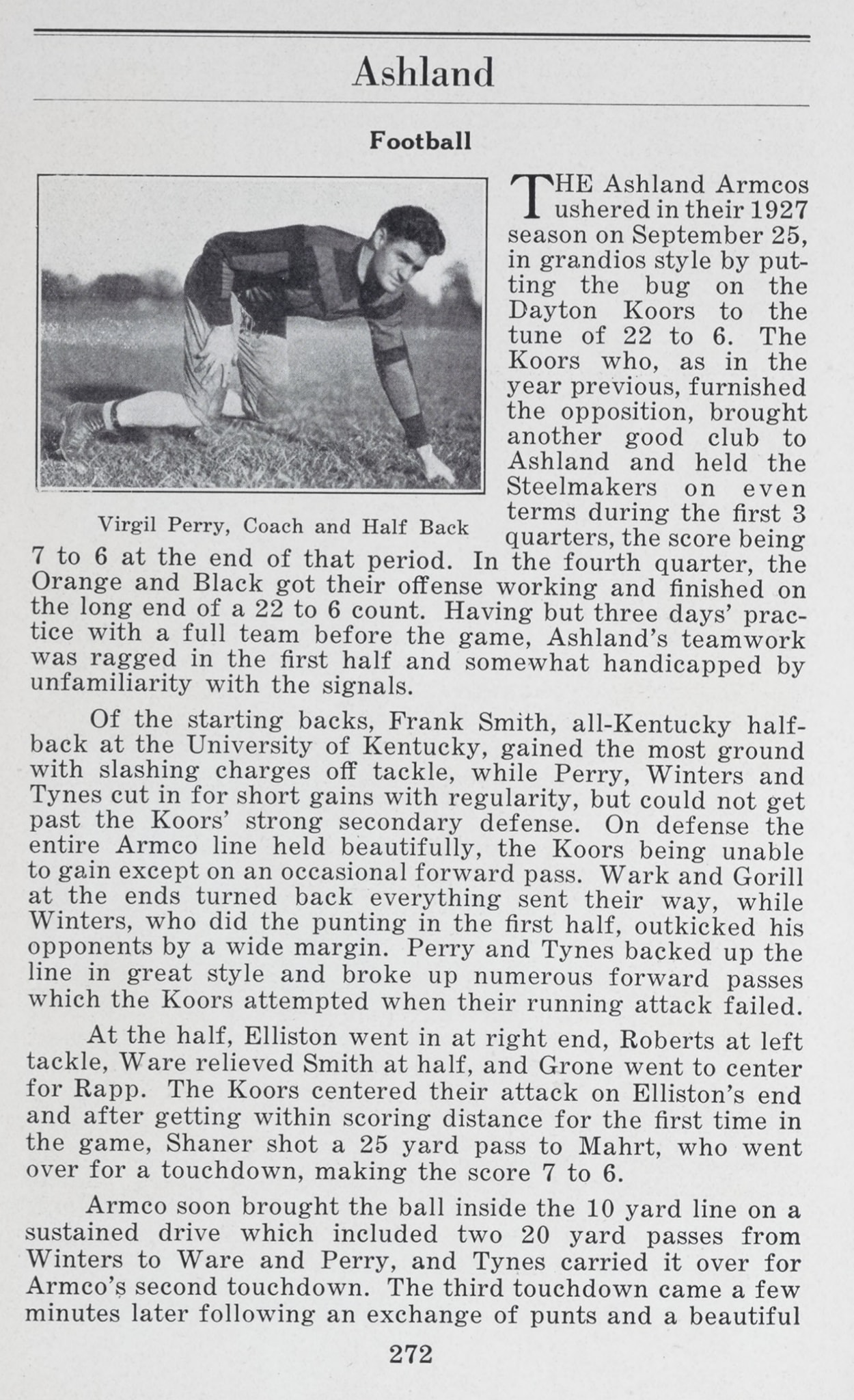
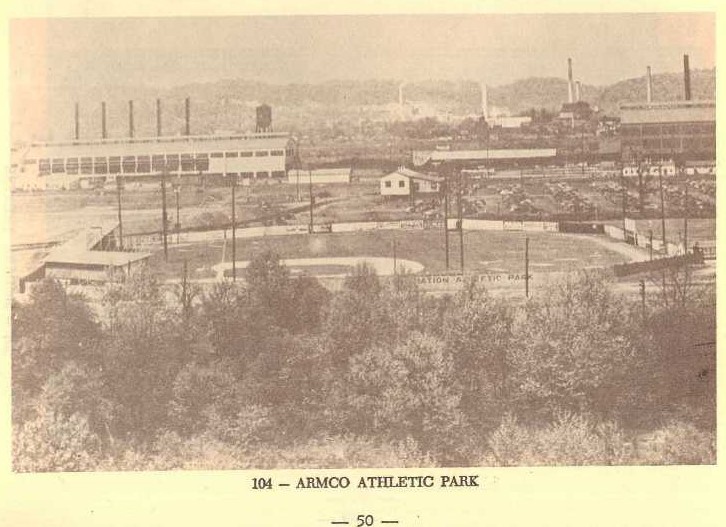
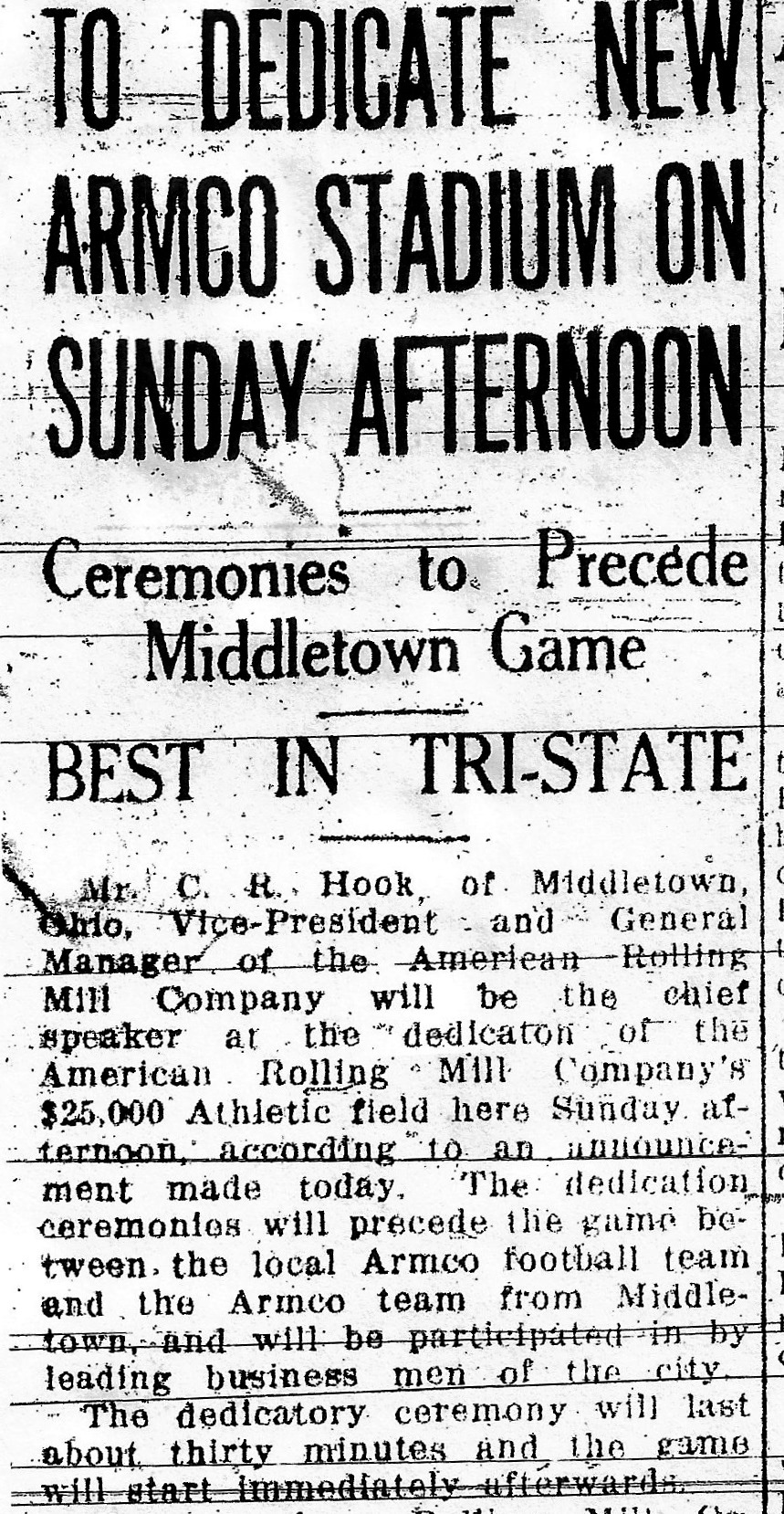
By the decade before Charles Leo McGarvey’s high school and college football years, the Ohio Valley already supported a strong and deeply rooted football culture that ranged from rough city-based sandlot teams to more organized semi-pro and industrial clubs. As the Upper Ohio Valley football history from the Ohio County Public Library suggests, local football had long been a serious community pastime, with neighborhood and city elevens forming an older competitive tradition that predated later industrial teams. Within that broader world, however, clubs such as Ashland Armco and the Middletown Armco Blues operated at a higher level. They drew experienced players, attracted substantial local crowds, and played against important regional opponents including the Ironton Tanks, Portsmouth Spartans, Dayton clubs, and West Virginia teams. In Ashland, that football culture was tied to a specific place as well as a regional network: the 1925 dedication of Armco’s new athletic field was presented as a major civic event, the field itself was praised as one of the finest in the tri-state, and later sources show it serving as the home ground for both school and semi-pro athletics. By 1927, Ashland Armco was already competing against clubs such as the Dayton Koors, Cleveland Panthers, Middletown Armco, and Ironton, showing that the football world McGarvey later entered in 1937 had already been established for years. As Carl M. Becker’s detailed history makes clear, the Ashland Armcos were not simply an isolated company team but part of a larger Ohio Valley semi-pro tradition in which Armco sponsorship, civic ambition, and the effort to measure themselves against the Ironton Tanks shaped the club’s identity and significance in Ashland.
1925 field dedication articleAssociation Athletic Field photograph1927 Ashland Armco articleUpper Ohio Valley sandlot football contextRegional football contextBecker, “Beat the Tanks”
Association Athletic Field in Ashland, Kentucky, early home of Ashland football and the Ashland Armco semi-pro team.
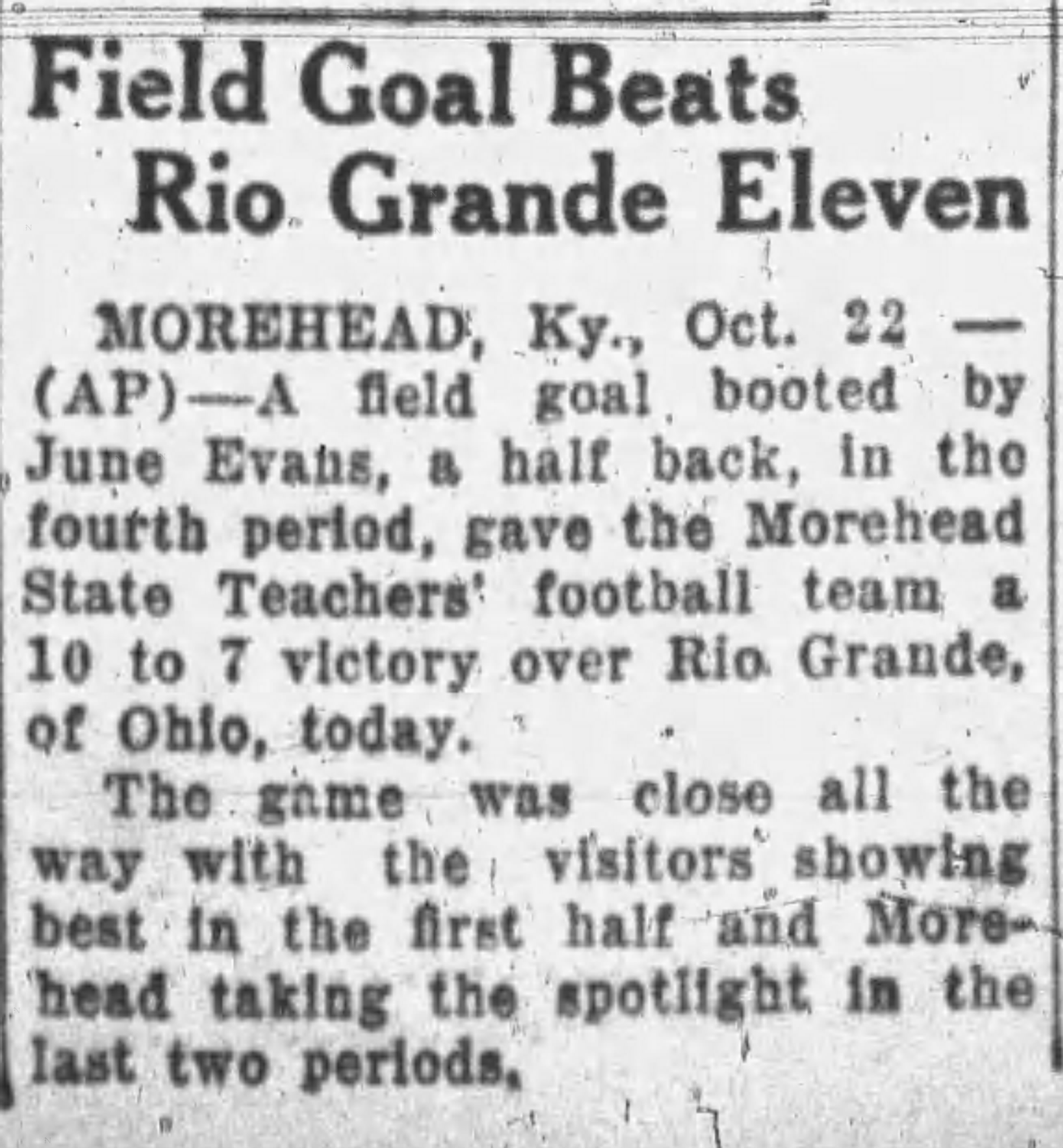
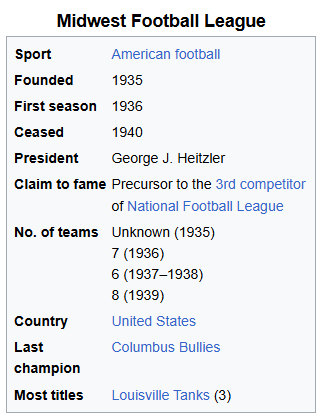
The clearest documentary proof that McGarvey continued his football career after Rio Grande appears in the 1937 Ashland Armcos roster, which lists Charles “Chuck” McGarvey as a right tackle from Rio Grande, weighing 177 pounds, and credits him with six games played and two starts. Ashland finished 5-3-1 and placed third in the Mid-West Football League, placing McGarvey on a competitive semi-pro club rather than on a loosely organized local "Sunday sandlot" team. That 1937 roster also gains added meaning when read against the earlier Ashland tradition: a decade before McGarvey joined the Armcos, Ashland was already fielding a serious regional club, and Fayne Grone, later McGarvey’s head coach, was himself part of that earlier football culture as a player. 1937 Ashland Armcos roster1937 MWFL context1927 Ashland Armco article
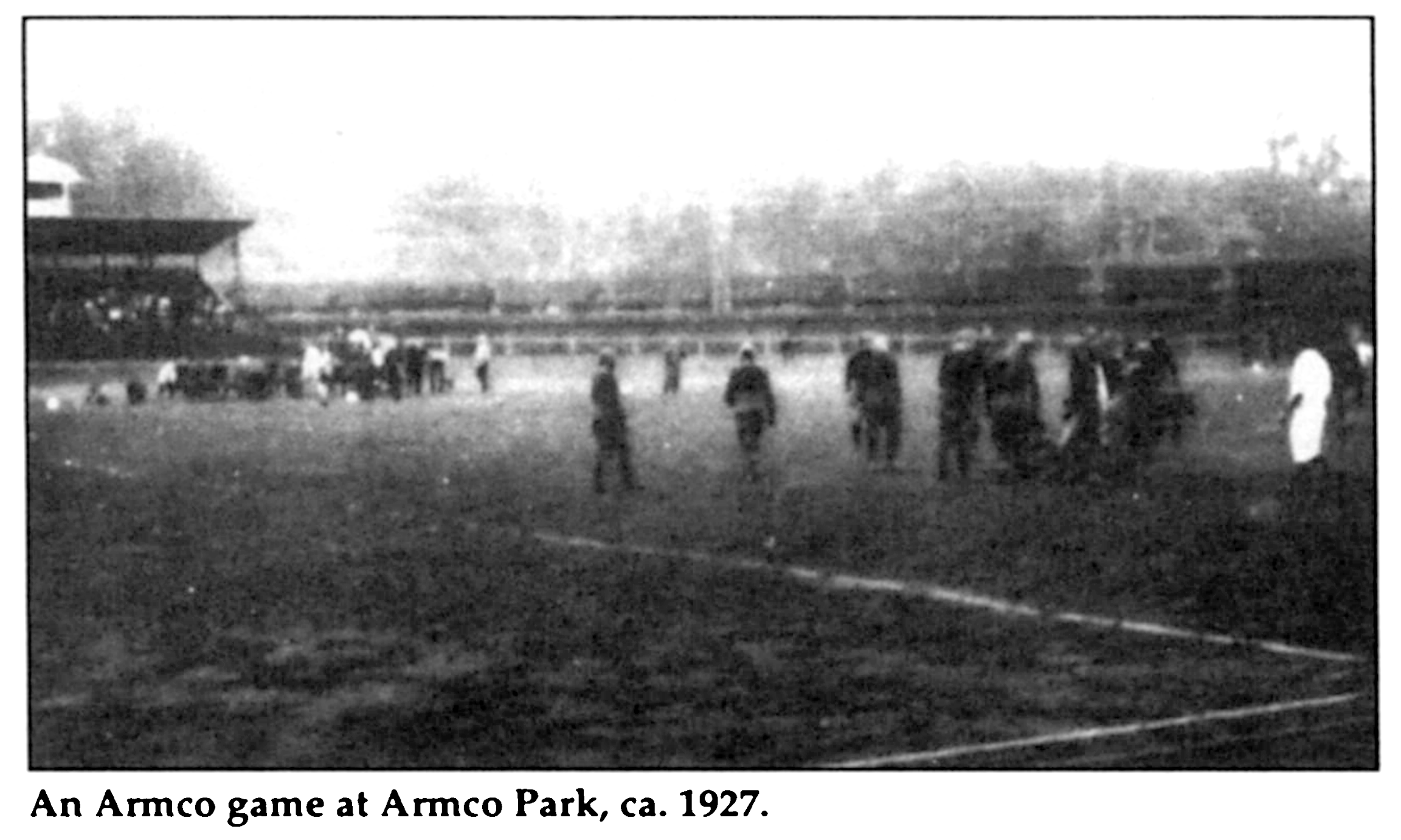
An Armco game at Armco Park, circa 1927, offering a period view of the field and football setting in Ashland about a decade before Charles Leo McGarvey later appeared on the 1937 Armcos roster. Becker, “Beat the Tanks”
In brief
Historical interpretation
Taken together, these sources suggest that Ashland football was already more than a casual company pastime by the mid-1920s. The dedication of the new athletic field framed the sport as a civic project, Association Athletic Field gave that culture a visible home, and the 1927 Ashland Armco article shows the city already operating within a demanding regional football circuit years before Charles Leo McGarvey reached the 1937 Armcos. Read in that wider context, McGarvey’s later roster appearance makes the most sense not as an isolated post-college episode, but as part of a longer Ashland tradition of industrial, community, and semi-pro football. 1925 field dedication articleAssociation Athletic Field photograph1927 Ashland Armco article1937 Ashland Armcos roster1937 MWFL context
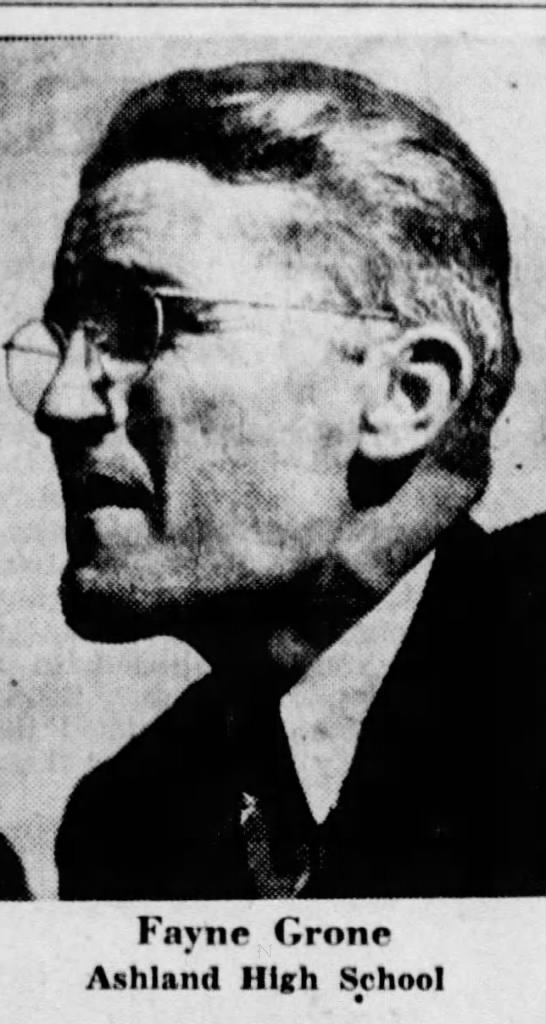
Coach Fayne Grone
Fayne Grone, head coach of the 1937 Ashland Armcos.
Fayne Grone was one of the most important football figures connected with Ashland in the first half of the twentieth century. Born about 1897, though some sources suggest 1899, he graduated from Ashland, likely played both football and basketball there, and later played football at Kentucky in 1918. He is also found at Georgetown College in 1920, where he played guard and center, and a brief Cincinnati newspaper notice suggests that he may also have played at Transylvania. Because Grone does not appear in the football record during part of the World War I era and later references note military service, it is likely that army service interrupted his early playing career before he returned to college football.
Fayne Grone profile
Before becoming a coach, Grone was part of the same rough, high-level semi-pro football world that later shaped Charles “Chuck” McGarvey’s post-college football career. He played for the Ironton Tanks and for Armco teams that operated on a level close to professional football, linking him directly to the Ohio Valley football culture that surrounded Ashland in the 1920s. He later moved into coaching, first working with the Ashland Tomcats under Paul Jenkins and then succeeding Jenkins as head coach for the 1935 season. That year Ashland went undefeated at 9-0, built on overwhelming offense and defense, including lopsided wins over Hazard, 68-0, and Paintsville, 92-0, while allowing only two points all season.
Fayne Grone profile
Grone’s connection to McGarvey becomes clearest in 1937, when he appears as head coach of the Ashland Armcos, the Mid-West Football League club on which McGarvey played after Rio Grande. Under Grone, Ashland finished 5-3-1 and placed third in the league, placing McGarvey on a competitive semi-pro team led by a coach whose experience stretched from early Ohio Valley semi-pro football into one of Ashland’s strongest high school eras. Grone’s later career extended beyond 1937 as well. He coached the St. Louis Gunners in 1938, returned to Ashland High School in 1939, also coached basketball there, and later led Newport in both football and basketball. He died in May 1970 in Illinois.
1937 Ashland Armcos roster1937 MWFL contextFayne Grone profile
c. 1897 to 1920
Born about 1897, though some sources suggest 1899, Grone graduated from Ashland and likely played school sports there. He later appears at Kentucky in 1918 and at Georgetown College in 1920 as a guard and center. Later references suggest that military service may have interrupted his early football years, and one newspaper note indicates that he may also have played at Transylvania.
Fayne Grone profile
1920s player
Grone played in the Ohio Valley semi-pro game for the Ironton Tanks and for Armco teams, tying him directly to the same regional football culture that later shaped McGarvey’s Ashland connection.
Fayne Grone profileBecker, “Beat the Tanks”
1935 Tomcats
After serving under Paul Jenkins, Grone became head coach at Ashland High School and led the 1935 Tomcats to a 9-0 undefeated season. His team overwhelmed Hazard 68-0 and Paintsville 92-0 and surrendered only two points all year.
Fayne Grone profile
1936 to 1937
Grone coached two games for Ashland in 1936 before Ernie Chaffin took over. He next appears in 1937 as head coach of the Ashland Armcos, whose 5-3-1 record and third-place finish placed McGarvey on a serious Mid-West Football League team.
1937 Ashland Armcos roster1937 MWFL contextFayne Grone profile
1938 to 1941
In 1938 Grone coached the St. Louis Gunners to a 4-3-1 season and a second-place league finish. He then returned to Ashland High School, coaching football from 1939 through 1941 and also leading Ashland basketball, including a regional title and state runner-up finish in 1939-40.
Fayne Grone profile
Later years
Grone later coached football and basketball at Newport for three seasons after World War II. He died in May 1970 in Illinois, leaving behind one of the strongest coaching and playing legacies associated with Ashland football.
Fayne Grone profile
Document Gallery
Newspaper Clippings, Photographs and Documents
These surviving newspaper clippings and images document Charles Leo McGarvey’s athletic career at Wellston High School and
Rio Grande College. Together they preserve game
coverage, team publicity, and a printed team photographs from the yearbooks and local newspapers.
Team photograph
1931 Wellston High School Basketball Team Featuring Charles McGarvey
This team photograph documents Charles Leo McGarvey during his senior year at Wellston High School as a member of the 1931 basketball team. The image is valuable because it shows that McGarvey’s athletic record at Wellston extended beyond football and included varsity basketball as well. In the photograph, he appears in the lower right, helping preserve a visual record of his final year in high school athletics before the better documented football seasons that followed at Rio Grande.
1931 Wellston High School basketball team photograph. Charles McGarvey is pictured in the lower right.
Year: 1931
Type: Team photograph
Level: High school
Sport: Basketball
Identification: Charles McGarvey appears in the lower right
Context: Senior year at Wellston High School
Historical significance: Documents McGarvey’s participation in basketball during his final year at Wellston, showing that his athletic record extended beyond football.
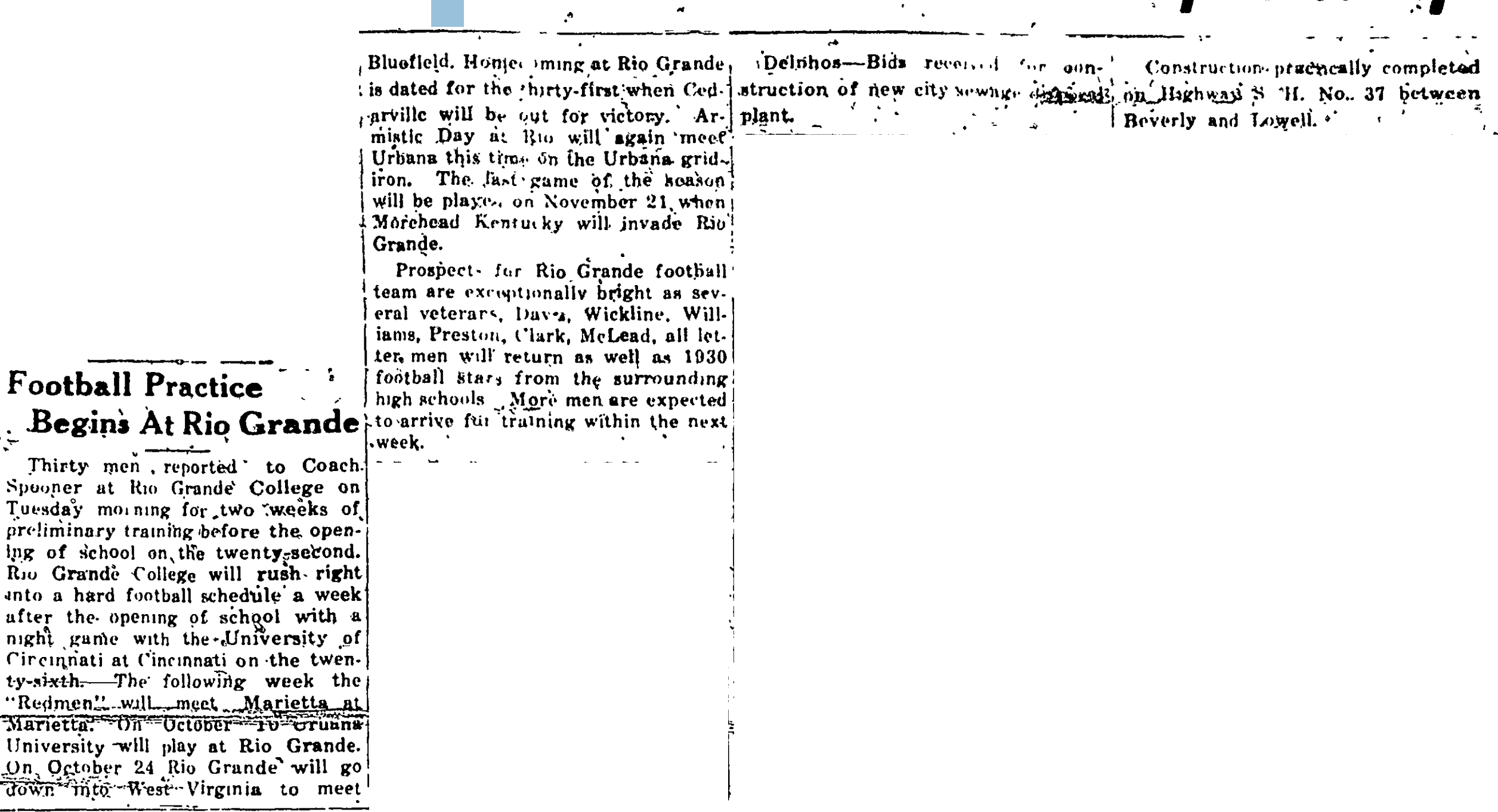
This The Gallipolis Daily Tribune article from September 10, 1931, offers an early
preseason glimpse of Rio Grande football. It reports that thirty men had already reported
to Coach Spooner, outlines the opening schedule, and describes prospects for the team as
exceptionally bright due to returning veterans and local talent.
The Gallipolis Daily Tribune, September 10, 1931, page 3. Early preseason report on Rio Grande football practice and schedule.
Date: September 10, 1931
Publication:The Gallipolis Daily Tribune
Page: 3
People mentioned: Coach Spooner, Davis, Wickline, Williams, Preston, Clark, McLead
Teams/Opponents mentioned: University of Cincinnati, Marietta, Urbana, Bluefield
Type: Preseason practice and schedule report
Level: College
Sport: Football
Football Practice Begins At Rio Grande
Thirty men reported to Coach Spooner at Rio Grande College on Tuesday morning for
two weeks of preliminary training before the opening of school on the twenty-second.
Rio Grande College will rush right into a hard football schedule a week after the opening
of school with a night game with the University of Cincinnati at Cincinnati on the
twenty-sixth.
The following week the Redmen will meet Marietta at Marietta. On October 17 Urbana
University will play at Rio Grande. On October 24 Rio Grande will go to West Virginia
to meet Bluefield.
Prospects for Rio Grande football team are exceptionally bright as several veterans,
Davis, Wickline, Williams, Preston, Clark, McLead, all letter men will return as well
as 1930 football stars from the surrounding high schools.
More men are expected to arrive for training within the next week.
This brief Gallipolis Daily Tribune clipping from September 19, 1931, offers a small
glimpse of the social side of Rio Grande football before the season was fully underway. It
reports that members of the squad were entertained at a picnic supper at Cora with Coach
Spooner, Dean and Mrs. W. A. Lewis, and guests from surrounding communities.
The Gallipolis Daily Tribune, September 19, 1931. Social notice about a picnic supper for the Rio Grande football squad.
Date: September 19, 1931
Publication:The Gallipolis Daily Tribune
People mentioned: Coach Spooner, Dean and Mrs. W. A. Lewis
Type: Social notice
Level: College
Sport: Football
Rio Grande Football Picnic
On Friday evening the men on the football squad of Rio Grande College were entertained
at a picnic supper at Cora. Besides the men on the squad and Coach Spooner, Dean and
Mrs. W. A. Lewis and a number of girls from surrounding communities were present.
“Great Plans Made for Rio Grande Home Coming Oct 31”
This Gallipolis Daily Tribune article from October 22, 1931, previews Rio Grande’s
upcoming Homecoming celebration on October 31. It highlights the day’s campus activities,
including a basket dinner, reunion events, and the football game against Cedarville, while
also emphasizing the strength and growing reputation of Coach Spooner’s team.
The Gallipolis Daily Tribune, October 22, 1931. Preview of Rio Grande’s Homecoming and the upcoming Cedarville game.
Date: October 22, 1931
Publication:The Gallipolis Daily Tribune
People mentioned: Coach Spooner, Miss McCuskey
Teams/Opponents mentioned: Rio Grande, Cedarville, Cincinnati University
Type: Homecoming preview
Level: College
Sport: Football
Great Plans Made for Rio Grande Home Coming Oct 31
Saturday, October 31st, is to be a great day in Rio Grande.
The faculty and students of the college, together with the entire community are pushing
forward plans for a great Homecoming and reunion on that day.
The program for the day consists of various events which include a soccer game played by
the teams made up of girls of the physical education class under the direction of Miss
McCuskey; a basket dinner on the campus at noon, and in the afternoon, Rio Grande’s
football team meets the Cedarville College team.
This promises to be a hotly contested game as Cedarville boasts a strong aggregation this
year and Rio’s team has met defeat only once. Since that was administered by a strong
Buckeye Conference team such as Cincinnati University and by a score of 19-6, this
indicates something of the calibre of Coach Spooner’s team.
The Rio team is made up mostly of college freshmen but in the squad are former stars
from high school teams of Wellston, Jackson, Ironton, Middleport, Point Pleasant, and
Gallipolis, and Rio’s coach has developed a team which is attracting attention all over
state because of their victories over Ohio Conference teams.
The Homecoming day’s activities are to culminate in a dinner in the evening at which
the old grads, former students and friends of the college will get together to celebrate
the victory of the day and live over their former campus days.
Invitations have been sent out to many. Since mailing lists can never include all the
friends of a college, it is hoped that all who read this account of the Homecoming will
plan to spend the day with their old friends of other days on the campus at Rio Grande
College.
This Ironton News clipping from October 28, 1931, previews Rio Grande's
annual Homecoming and reunion on October 31. Like the earlier Gallipolis preview, it
highlights the football game against Cedarville, the women's soccer game, the basket
dinner, and the evening reunion dinner, while also stressing that Coach Spooner's mostly
freshman team had lost only once.
The Ironton News, October 28, 1931. Preview of Rio Grande's Homecoming and Cedarville football game.
Date: October 28, 1931
Publication:The Ironton News
People mentioned: Miss McCuskey, Coach Spooner
Teams/Opponents mentioned: Rio Grande, Cedarville, Cincinnati University
Type: Homecoming preview
Level: College
Sport: Football
Rio Grande Home Coming October 31
Program for annual reunion and home coming include football game between Rio Grande and
Cedarville Colleges.
Saturday, October 31, is to be a great day in Rio Grande. The faculty and students of the
college, together with the entire community are pushing forward plans for a great Homecoming
and Reunion on that day.
The program for the day consists of various events which include a soccer game played by the
teams made up of girls of the Physical Education class under the direction of Miss McCuskey;
a basket dinner on the campus at noon, and in the afternoon, Rio Grande's football team
meets the Cedarville College team.
This promises to be a hotly contested game as Cedarville boasts a strong aggregation this
year and Rio's team has met defeat only once. Since that was administered by a strong
Buckeye Conference team such as Cincinnati University and by a score of 19-6, this indicates
something of the calibre of Coach Spooner's team.
The Rio team is made up mostly of College freshmen but in the squad are former stars from
High school teams of Wellston, Jackson, Ironton, Middleport, Point Pleasant and Gallipolis,
and Rio's coach has developed a team which is attracting attention all over the state because
of their victories over Ohio Conference teams.
The Homecoming Day's activities are to culminate in a dinner in the evening at which the old
grads, former students and friends of the College will get together to celebrate the victory
of the day and live over their former campus days.
Invitations have been sent out to many. Since mailing lists can never include all the friends
of a college, it is hoped that all who read this account of the Homecoming will plan to
spend the day with their old friends of other days on the campus at Rio Grande College.
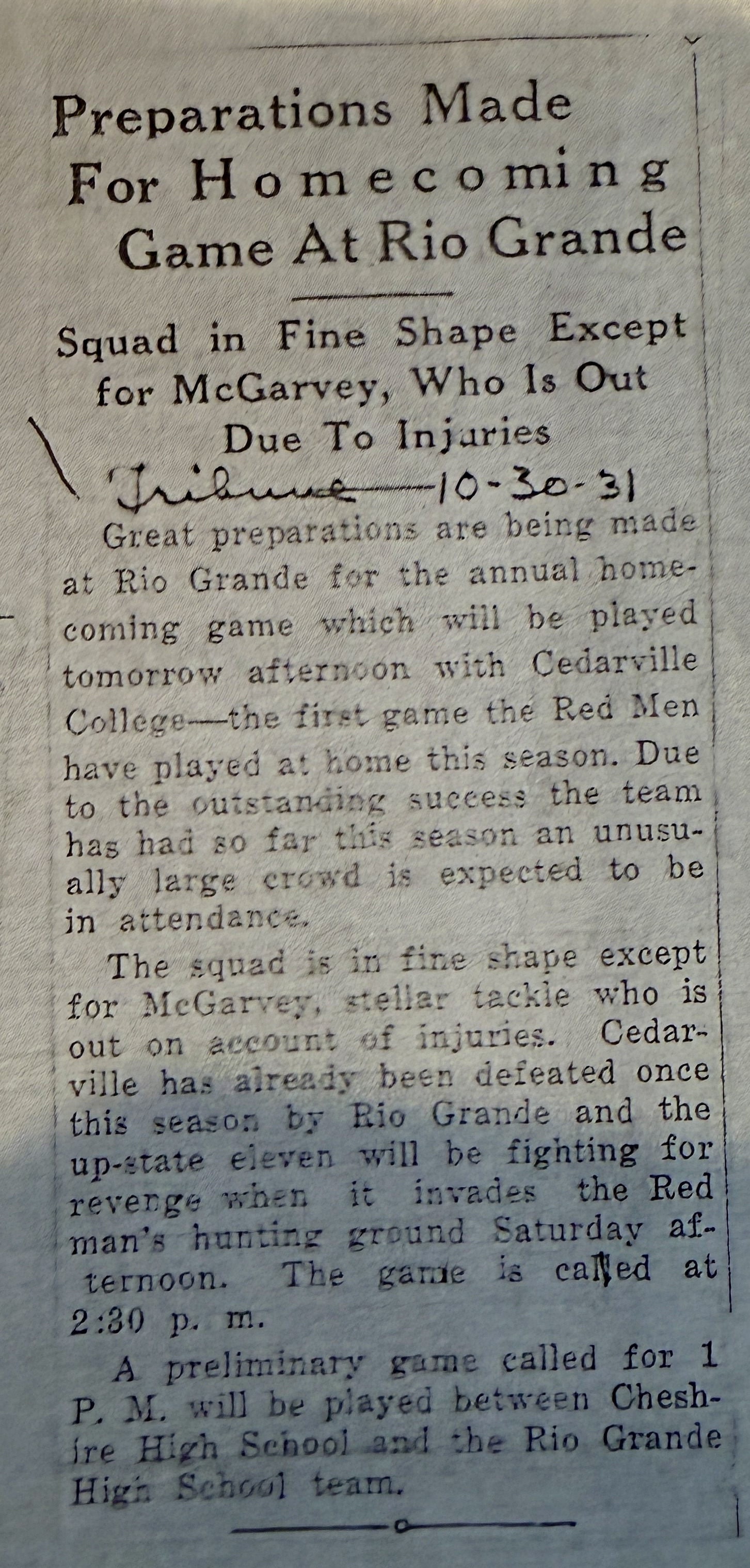
“Preparations Made For Homecoming Game At Rio Grande”
This The Gallipolis Daily Tribune clipping from October 30, 1931, previews Rio Grande’s Homecoming football game against Cedarville. It is especially important for Charles Leo McGarvey’s record because it identifies him as a stellar tackle and reports that he was out with injuries just before Rio Grande’s first home game of the season. The article also confirms the expected large Homecoming crowd, the 2:30 p.m. kickoff, and a preliminary game between Cheshire High School and the Rio Grande High School team.
The Gallipolis Daily Tribune, October 30, 1931. Homecoming preview noting that McGarvey was out due to injuries.
Date: October 30, 1931
Publication:The Gallipolis Daily Tribune
People mentioned: McGarvey
Teams/Opponents mentioned: Rio Grande, Cedarville College, Cheshire High School, Rio Grande High School
Type: Homecoming football preview
Level: College
Sport: Football
Historical significance: Documents McGarvey’s injury status immediately before Rio Grande’s 1931 Homecoming game and identifies him as a stellar tackle
Preparations Made For Homecoming Game At Rio Grande
Squad in Fine Shape Except for McGarvey, Who Is Out Due To Injuries
Great preparations are being made at Rio Grande for the annual home-coming game which will be played tomorrow afternoon with Cedarville College - the first game the Red Men have played at home this season. Due to the outstanding success the team has had so far this season an unusually large crowd is expected to be in attendance.
The squad is in fine shape except for McGarvey, stellar tackle who is out on account of injuries. Cedarville has already been defeated once this season by Rio Grande and the up-state eleven will be fighting for revenge when it invades the Red man's hunting ground Saturday afternoon. The game is called at 2:30 p. m.
A preliminary game called for 1 P. M. will be played between Cheshire High School and the Rio Grande High School team.
This Irontown News clipping from October 12, 1931, reports Rio Grande’s 18-7
win over Cedarville. Charles Leo McGarvey is singled out for blocking and recovering
a Cedarville punt, then later plunging the line for a touchdown in the third quarter.
The article also lists the starting lineup and identifies several Ironton boys on
the Rio Grande team.
People mentioned: Charles Leo McGarvey, Kelley, Rapp, Coach Spooner
Teams: Rio Grande vs. Cedarville
Level: College
Sport: Football
Playing their third game of the season Saturday at Cedarville, the Redmen of Rio Grande
outplayed their opponents to win 18-7. Cedarville scored first. The opening kickoff was
returned to Rio's forty-yard line and from there the Yellow Jackets marched down the field
for a touchdown. Ivons, Cedarville halfback, carried the ball over and kicked the extra point.
"A few moments later McGarvey blocked and recovered a Cedarville punt on Cedarville's 20-yard line."
20-yard line. Kelley scored on a lateral pass, but his attempted place kick was wide.
Both teams showed weakness on the defense but no further score was made in the first
or second periods.
"Rio Grande came back strong at the half and in a few minutes McGarvey plunged the line for a touchdown."
for a touchdown. Rio scored again in the fourth quarter after holding Cedarville for downs
deep in Cedarville's own territory. Rapp carried the ball. Coach Spooner made many
substitutions and 21 Redmen saw action. The line-up follows:
Rio Grande
Gullion* .......... L. E. .......... Morrison
McGarvey .......... L. T. .......... White
Brown ............. L. G. .......... Garlough
Davis ............. C. ............. Richards
Troth ............. R. G. .......... Mills
Preston ........... R. T. .......... Taylor
Wickline .......... R. E. .......... Scott
Rapp* ............. Q. B. .......... Murray
Carey ............. F. B. .......... Putom
Kelley* ........... L. H. .......... Irons
Rose* ............. R. H. .......... Brokaw
*Ironton boys.
Cedarville ........ 7 0 0 0, 7
Rio Grande ........ 6 0 6 6, 18
Rio Grande scoring: Touchdowns, Kelley, McGarvey, Rapp. Cedarville, touchdown, Irons;
point after touchdown, Irons.
Smith and Miller, both Ironton boys, substituted.
Next game Rio Grande will play Urbana College of Urbana, O., at Middleport, Saturday
night, October 17th, at 8 p. m.
This The Ironton News clipping from October 19, 1931, reports Rio Grande's
13-6 win over Urbana at Middleport. The short recap does not mention McGarvey, but it helps
fill out the 1931 season and shows how Ironton-area players such as Wilbur Rapp, Kelly, Rose,
Cary, and McKnight were credited in Rio Grande's early-season success.
The Ironton News, October 19, 1931. Rio Grande defeats Urbana, 13-6, at Middleport.
Date: October 19, 1931
Publication:The Ironton News
Teams: Rio Grande College vs. Urbana College
Location: Middleport, Ohio
People mentioned: Wilbur Rapp, Shorty Davies, Kelly, Rose, Cary, McKnight
Type: Game recap
Level: College
Sport: Football
Rapp Scores Two Touchdowns As Rio Grande Wins
Wilbur Rapp, former Ironton High School star under "Shorty" Davies, was the outstanding
star Saturday night at Middleport, O., when Rio Grande College defeated Urbana, 13 to 6.
Rapp scored both touchdowns, the first after a thrilling 60-yard run upon receiving a punt
in the second quarter, and the second on a series of line bucks in the fourth.
Kelly, also a former I. H. S. player, kicked the first goal from placement. Rapp missed the
second try.
Rose, Kelly, Cary and Rapp, all ex-Tiger gridders and McKnight, of Coal Grove, played major
parts in Rio Grande's victory.
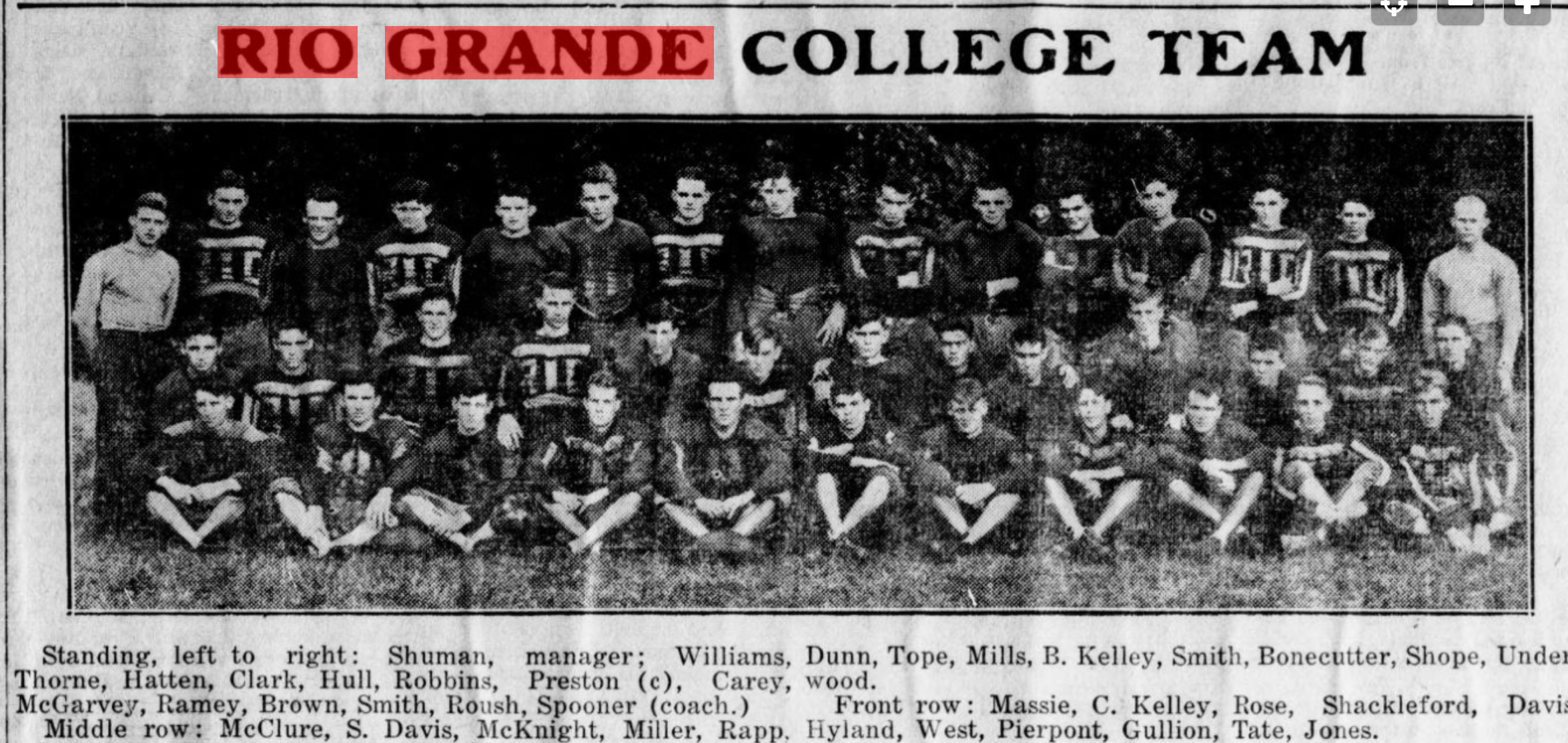
This team photograph, published in the Irontown News on November 18, 1931,
shows the Rio Grande College football team during Charles Leo McGarvey’s playing years.
McGarvey is identified in the printed caption among the players and staff listed below
the image.
Irontown News, November 18, 1931. Team photograph of the Rio Grande College football squad.
Date: November 18, 1931
Publication:Irontown News
Type: Team photograph with caption
People mentioned: Charles Leo McGarvey, Coach Spooner, Preston, Kelley, Rapp, Gullion, Rose
Level: College
Sport: Football
Caption transcription:
Standing, left to right: Shuman, manager; Williams, Dunn, Tope, Mills, B. Kelley,
Smith, Bonecutter, Shope, Under...
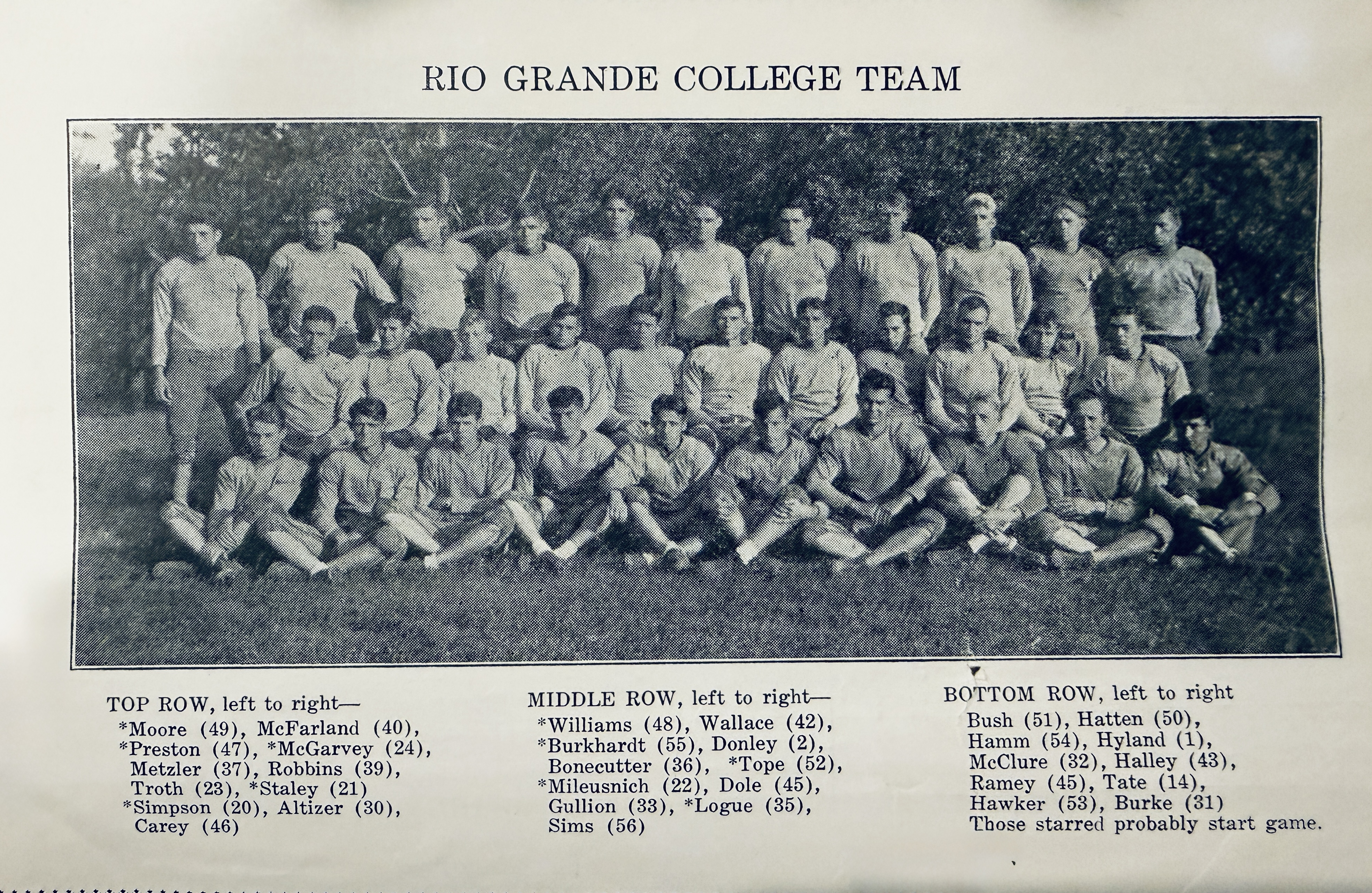
This team photograph shows the probable starters for Rio Grande’s 1931 Homecoming game
against Cedarville. The printed caption identifies Charles Leo McGarvey in the top row as
“*McGarvey (24),” and explains that starred players probably started the game. That makes
the image especially useful as evidence of McGarvey’s place among Rio Grande’s Homecoming
starters during the 1931 season.
Probable starters for Rio Grande’s 1931 Homecoming game. The printed roster identifies McGarvey in the top row as number 24.
Date: October 31, 1931
Document type: Homecoming game starters photograph with printed roster
Team: Rio Grande College football
Game: Rio Grande vs. Cedarville, 1931 Homecoming
McGarvey identification: Top row, “*McGarvey (24)”
Notable detail: Printed note says starred players probably start game
Level: College
Sport: Football
Historical significance: Places McGarvey among Rio Grande’s probable starters for the 1931 Homecoming game
Rio Grande College Team
Top row, left to right: *Moore (49), McFarland (40),
*Preston (47), *McGarvey (24), Metzler (37), Robbins (39), Troth (23),
*Staley (21), Simpson (20), Altizer (30), Carey (46).
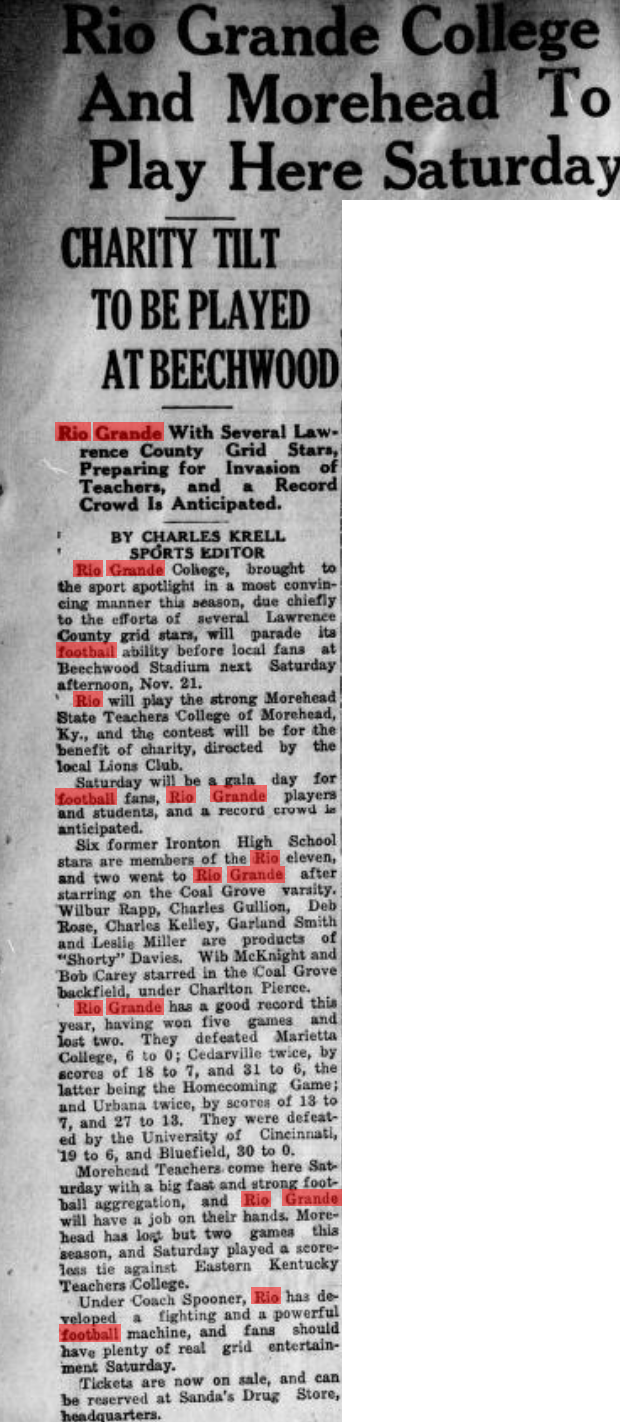
“Rio Grande College And Morehead To Play Here Saturday”
This Irontown News preview from November 16, 1931, announces Rio Grande’s
upcoming charity game against Morehead State Teachers College at Beechwood Stadium.
The article highlights Rio Grande’s strong season, Coach Spooner’s team, and several
Lawrence County players connected to the program, including Charles Leo McGarvey’s
Rio Grande squad.
Irontown News, November 16, 1931. Preview of Rio Grande’s charity game against Morehead.
Date: November 16, 1931
Publication:Irontown News
Byline: Charles Krell, Sports Editor
Teams: Rio Grande vs. Morehead State Teachers College
Level: College
Sport: Football
Rio Grande College And Morehead To Play Here Saturday
Charity Tilt To Be Played At Beechwood
By Charles Krell, Sports Editor
Rio Grande With Several Lawrence County Grid Stars, Preparing for Invasion of
Teachers, and a Record Crowd Is Anticipated.
Rio Grande College, brought to the sport spotlight in a most convincing manner this
season, due chiefly to the efforts of several Lawrence County grid stars, will parade
its football ability before local fans at Beechwood Stadium next Saturday afternoon,
Nov. 21.
Rio will play the strong Morehead State Teachers College of Morehead, Ky., and the
contest will be for the benefit of charity, directed by the local Lions Club.
Saturday will be a gala day for football fans, Rio Grande players and students, and a
record crowd is anticipated.
Six former Ironton High School stars are members of the Rio eleven, and two went to
Rio Grande after starring on the Coal Grove varsity. Wilbur Rapp, Charles Gullion,
Deb Rose, Charles Kelley, Garland Smith and Leslie Miller are products of “Shorty”
Davies. Wib McKnight and Bob Carey starred in the Coal Grove backfield, under
Charlton Pierce.
Rio Grande has a good record this year, having won five games and lost two. They
defeated Marietta College, 6 to 0; Cedarville twice, by scores of 18 to 7, and 31 to 6,
the latter being the Homecoming Game; and Urbana twice, by scores of 13 to 7, and
27 to 13. They were defeated by the University of Cincinnati, 19 to 6, and Bluefield,
30 to 0.
Morehead Teachers come here Saturday with a big fast and strong football aggregation,
and Rio Grande will have a job on their hands. Morehead has lost but two games this
season, and Saturday played a scoreless tie against Eastern Kentucky Teachers College.
Under Coach Spooner, Rio has developed a fighting and a powerful football machine,
and fans should have plenty of real grid entertainment Saturday.
Tickets are now on sale, and can be reserved at Sanda’s Drug Store, headquarters.
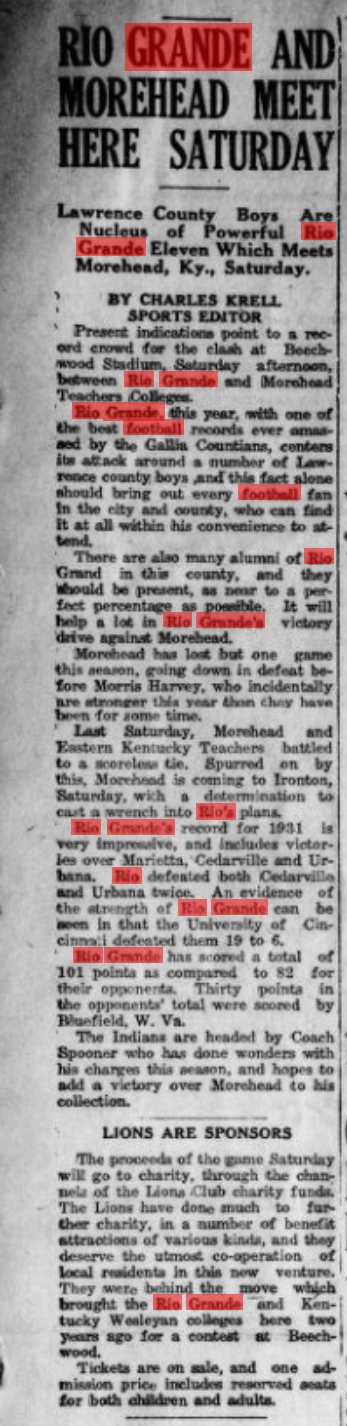
This Irontown News article from November 18, 1931, previews Rio Grande’s
upcoming game against Morehead and emphasizes the strong local interest surrounding
the matchup. The piece highlights the Lawrence County nucleus of the Rio Grande team,
summarizes the team’s impressive 1931 record, and notes that the game’s proceeds would
support the Lions Club charity fund.
Irontown News, November 18, 1931. Preview of Rio Grande’s game against Morehead at Beechwood Stadium.
Date: November 18, 1931
Publication:Irontown News
Byline: Charles Krell, Sports Editor
Teams: Rio Grande vs. Morehead Teachers College
People mentioned: Coach Spooner
Event note: Lions Club charity game at Beechwood Stadium
Level: College
Sport: Football
Rio Grande and Morehead Meet Here Saturday
Lawrence County Boys Are Nucleus of Powerful Rio Grande Eleven Which Meets Morehead, Ky., Saturday.
By Charles Krell Sports Editor
Present indications point to a record crowd for the clash at Beechwood Stadium,
Saturday afternoon, between Rio Grande and Morehead Teachers College.
Rio Grande this year, with one of the best football records ever amassed by the Gallia
Countians, contains its attack around a number of Lawrence county boys and the fact
alone should bring out every football fan in the city and county, who can find it at all
within his convenience to attend.
There are also many alumni of Rio Grande in this county, and they should be present,
as near to a perfect percentage as possible. It will help a lot in Rio Grande’s victory
drive against Morehead.
Morehead has lost but one game this season, going down in defeat before Morris Harvey,
who incidentally are stronger this year than they have been for some time.
Last Saturday, Morehead and Eastern Kentucky Teachers battled to a scoreless tie.
Spurred on by this, Morehead is coming to Ironton, Saturday, with a determination
to cast a wrench into Rio plans.
Rio Grande’s record for 1931 is very impressive, and includes victories over Marietta,
Cedarville and Urbana. Rio defeated both Cedarville and Urbana twice. An evidence of
the strength of Rio Grande can be seen in that the University of Cincinnati defeated
them 19 to 6.
Rio Grande has scored a total of 101 points as compared to 82 for their opponents.
Thirty points in the opponents’ total were scored by Bluefield, W. Va.
The Indians are headed by Coach Spooner who has done wonders with his charges this
season, and hopes to add a victory over Morehead to his collection.
Lions Are Sponsors
The proceeds of the game Saturday will go to charity, through the channels of the
Lions Club charity fund. The Lions have done much to further charity, in a number
of benefit attractions of various kinds, and they deserve the utmost co-operation of
local residents in this new venture.
They were behind the move which brought Rio Grande and Kentucky Wesleyan colleges
here two years ago for a contest at Beechwood.
Tickets are on sale, and one admission price includes reserved seats for both children
and adults.
This The Ironton News article from November 20, 1931, previews Rio Grande’s
charity game against Morehead at Beechwood Stadium. It emphasizes the local interest
in seeing former high school stars now playing college football, gives the probable
starting lineups, and summarizes Rio Grande’s season record entering the game.
The Ironton News, November 20, 1931. Preview of Rio Grande’s charity game against Morehead at Beechwood Stadium.
Date: November 20, 1931
Publication:The Ironton News
Byline: Charles Krell, News Sports Editor
Teams: Rio Grande vs. Morehead College
People mentioned: Coach Spooner, Wilbur Rapp, Leslie Miller, Charles Kelley, Charles Gullion, Deb Rose, Garland Smith, Wilbur McKnight, Bob Carey
Type: Game preview with lineups
Level: College
Sport: Football
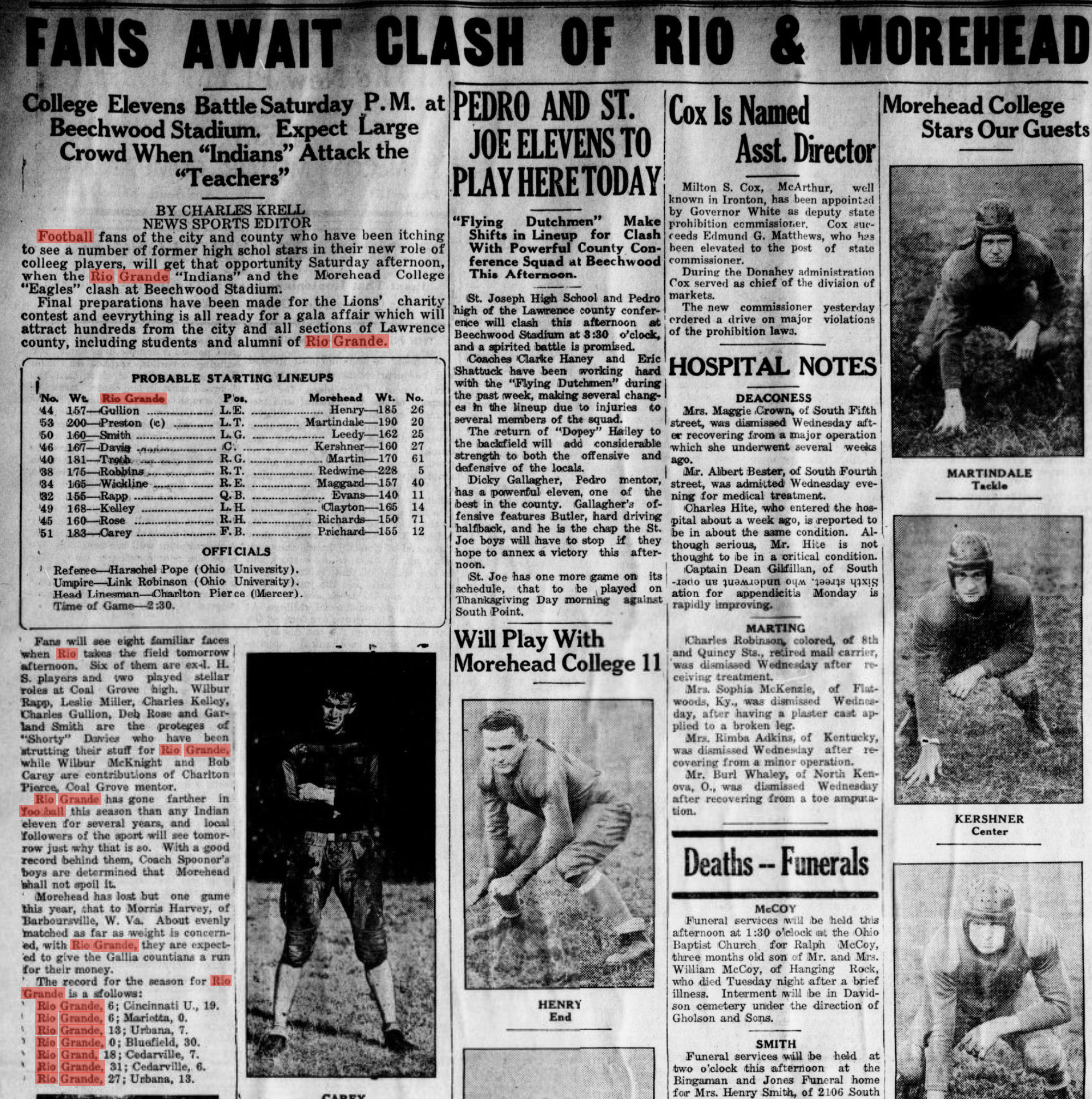
Fans Await Clash of Rio & Morehead
College Elevens Battle Saturday P.M. at Beechwood Stadium. Expect Large Crowd When “Indians” Attack the “Teachers”
By Charles Krell News Sports Editor
Football fans of the city and county who have been itching to see a number of former
high school stars in their new role of college players, will get that opportunity Saturday
afternoon, when the Rio Grande “Indians” and the Morehead College “Eagles” clash at
Beechwood Stadium.
Final preparations have been made for the Lions’ charity contest and everything is all
ready for a gala affair which will attract hundreds from the city and all sections of
Lawrence county, including students and alumni of Rio Grande.
Probable starting lineups
Rio Grande
Gullion .......... L.E.
Preston (c) ...... L.T.
Smith ............ L.G.
Davis ............ C.
Troth ............ R.G.
Robbins .......... R.T.
Wickline ......... R.E.
Rapp ............. Q.B.
Kelley ........... L.H.
Rose ............. R.H.
Carey ............ F.B.
Officials
Referee, Harschel Pope (Ohio University).
Umpire, Link Robinson (Ohio University).
Head Linesman, Charlton Pierce (Mercer).
Time of Game, 2:30.
Fans will see eight familiar faces when Rio takes the field tomorrow afternoon. Six of
them are ex-I. H. S. players and two played stellar roles at Coal Grove high. Wilbur
Rapp, Leslie Miller, Charles Kelley, Charles Gullion, Deb Rose and Garland Smith are
proteges of “Shorty” Davies who have strutted their stuff for Rio Grande while Wilbur
McKnight and Bob Carey are contributions of Charlton Pierce, Coal Grove mentor.
Rio Grande has gone farther in football this season than any Indian eleven for several
years, and local followers of the sport will see tomorrow just why that is so. With a
good record behind them, Coach Spooner’s boys are determined that Morehead shall not
spoil it.
Morehead has lost but one game this year, that to Morris Harvey, of Barboursville, W.
Va. About evenly matched as far as weight is concerned, with Rio Grande, they are
expected to give the Gallia countians a run for their money.
The record for the season for Rio Grande is as follows:
Rio Grande, 6; Cincinnati U., 19.
Rio Grande, 6; Marietta, 0.
Rio Grande, 13; Urbana, 7.
Rio Grande, 0; Bluefield, 30.
Rio Grande, 18; Cedarville, 7.
Rio Grande, 31; Cedarville, 6.
Rio Grande, 27; Urbana, 13.
"Rio Grande Wins From Morehead In Charity Tilt 20-12"
This The Ironton News clipping from November 23, 1931, gives a compact local
recap of Rio Grande's 20-12 victory over Morehead State Teachers College in the charity
game. It is especially useful because it confirms the final 6-2 season record and names
McGarvey among Rio Grande's touchdown scorers.
The Ironton News, November 23, 1931. Local recap of Rio Grande's 20-12 charity-game win over Morehead.
Date: November 23, 1931
Publication:The Ironton News
Teams: Rio Grande College vs. Morehead State Teachers College
People mentioned: McGarvey, Rapp, Knight, Maggard, Pritchard, Coach Spooner
Type: Game recap and season summary
Level: College
Sport: Football
Rio Grande Wins From Morehead In Charity Tilt 20-12
Rio Grande College brought its 1931 season to a close Saturday, defeating the Morehead,
Ky., State Teachers College, 20 to 12. Rio has had a splendid season, winning six games
and losing only two.
Rio Grande scored 13 points in the first half while Morehead went without a tally. And in
the second half, Morehead came back to make two touchdowns, while Rio was marking up a
single counter.
McGarvey, Rapp and Knight scored touchdowns for Rio, while Maggard and Pritchard crossed
the Gallia countians' goal line.
The game was a charity contest promoted by the Lions Club, and several Ironton boys
figured prominently in Rio Grande's victory, as they have throughout the present season,
under Coach Spooner.
“Rio Grande Red Men Finish Season in Blaze of Victory”
This multi-page Gallipolis Daily Tribune article from November 24, 1931, gives one of the fullest surviving accounts of Rio Grande’s 20-12 victory over Morehead and the team’s successful 1931 season. It is especially valuable because it specifically mentions McGarvey’s role in relief of the injured Carey and helps summarize how Coach Spooner’s team finished with six wins and two losses.
The Gallipolis Daily Tribune, November 24, 1931. First page of a multi-page account of Rio Grande’s 20-12 win over Morehead and the close of the 1931 season.
Date: November 24, 1931
Publication:The Gallipolis Daily Tribune
Teams: Rio Grande vs. Morehead State Teachers College
People mentioned: McGarvey, Carey, Rapp, Kelly, Rose, Capt. Preston, Robbins, Ed Davis, Garland Smith, Knight, McKnight, Coach Spooner
Type: Game recap and season summary
Level: College
Sport: Football
“Rio Grande Red Men Finish Season in Blaze of Victory”
Overpower Strong Morehead, Ky., College Team by 20-12 To Make Total of Six Games Won and Only Two Lost
Rio Grande College finished the most successful football season of recent years by defeating the Morehead, Ky., State Teachers College 20-12 Saturday at Ironton.
To the Rio Grande line go honors for the victory. The backfield, handicapped by injuries, did not display their usual drive but the line played the best game of the season. Carey, regular full back, was early forced from the game by an injured knee, but McGarvey, and Rose both had injured ankles and played mediocre games.
Capt. Preston played an outstanding game at tackle and Robbins on the right tackle was not to be outdone. Ed Davis, center, played a fine game but the brilliant tackles of Garland Smith, guard, were the most notable feature of the game. The ends were also distinguished by their accurate tackling.
Outplay Teachers First Half
Rio Grande received the opening kick and started a drive up the field. They lost the ball on a fumble near the goal line but a short kick and a penalty put them in a scoring position. McGarvey took it over and Kelly’s kick was successful. Morehead then showed the only flash of promise of the quarter and earned two first downs. An intercepted pass gave Rio the ball and they took it straight down the field for their second score of the half.
Rapp carried the ball across the line and a pass for the extra point was not completed. Rio Grande completely outplayed the heavier Morehead line in their half making twelve first downs to two for the visitors.
This Irontown News clipping from December 2, 1931, summarizes Rio Grande’s
successful football season, noting a final record of six wins and two losses with 122
points scored. The article also emphasizes the team’s improvement from the previous
year and identifies key departing players from the 1931 squad.
Irontown News, December 2, 1931. Season summary reporting Rio Grande’s 6-2 football record.
Date: December 2, 1931
Publication:Irontown News
Dateline: Rio Grande, Ohio
Season record: 6 wins, 2 losses
People mentioned: Coach Spooner, Capt. Preston, Wickline, Knight, Davis
Level: College
Sport: Football
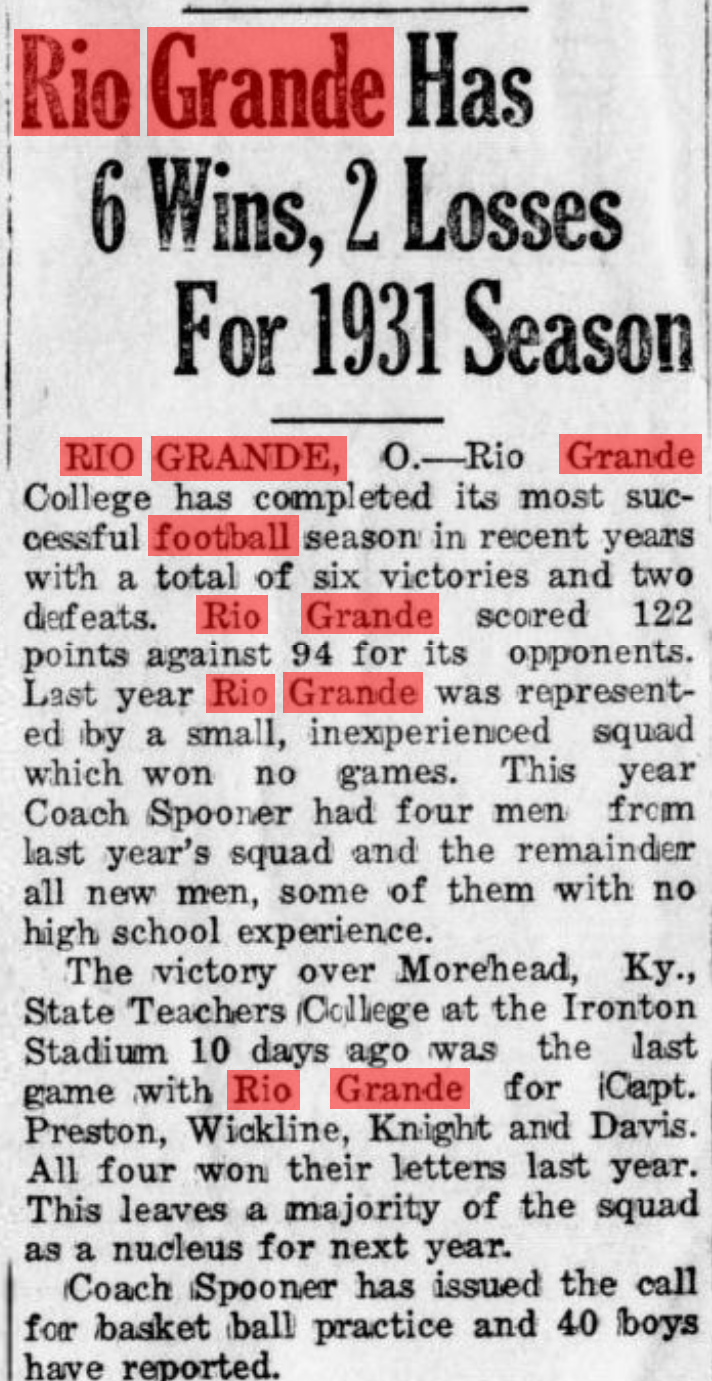
Rio Grande Has 6 Wins, 2 Losses For 1931 Season
RIO GRANDE, O. Rio Grande College has completed its most successful football season
in recent years with a total of six victories and two defeats. Rio Grande scored 122
points against 94 for its opponents.
Last year Rio Grande was represented by a small, inexperienced squad which won no
games. This year Coach Spooner had four men from last year’s squad and the remainder
all new men, some of them with no high school experience.
The victory over Morehead, Ky., State Teachers College at the Ironton Stadium 10 days
ago was the last game with Rio Grande for Capt. Preston, Wickline, Knight and Davis.
All four won their letters last year. This leaves a majority of the squad as a nucleus
for next year.
Coach Spooner has issued the call for basketball practice and 40 boys have reported.
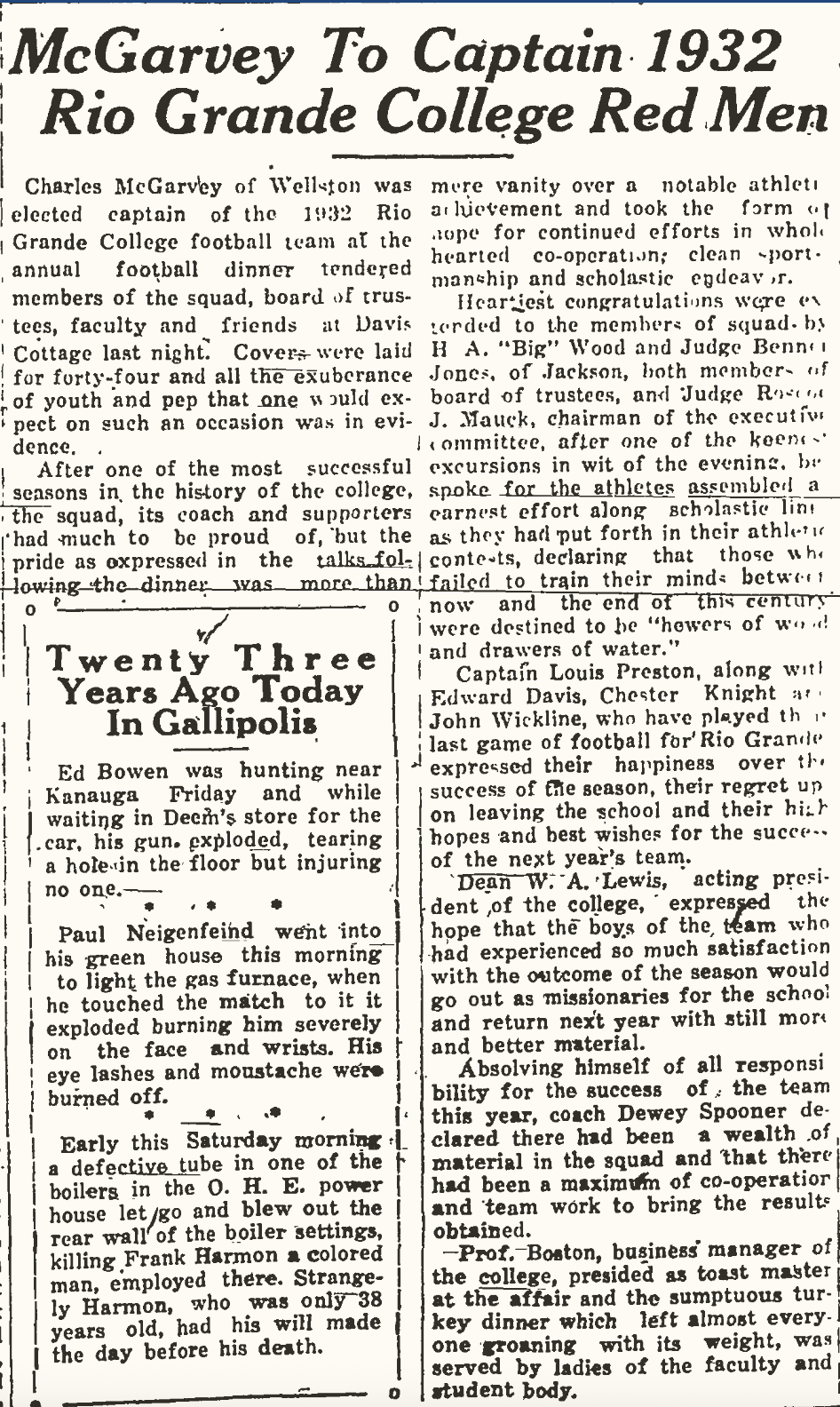
This Gallipolis Daily article from December 5, 1931, reports that Charles
McGarvey of Wellston was elected captain of the 1932 Rio Grande College football team
at the annual football dinner held at Davis Cottage. The article also captures speeches
by trustees, faculty, graduating players, and Coach Dewey Spooner following one of the
most successful seasons in the college’s recent football history.
People mentioned: Charles McGarvey, Louis Preston, Edward Davis, Chester Knight, John Wickline, Dean W. A. Lewis, Coach Dewey Spooner, H. A. “Big” Wood, Judge Bennet Jones, Judge Russell J. Mauck, Prof. Borton
"Charles McGarvey of Wellston was elected captain of the 1932 Rio Grande College football team..."
football team at the annual football dinner tendered members of the squad, board of
trustees, faculty and friends at Davis Cottage last night. Covers were laid for forty-four
and all the exuberance of youth and pep that one would expect on such an occasion was
in evidence.
After one of the most successful seasons in the history of the college, the squad, its
coach and supporters had much to be proud of, but the pride as expressed in the talks
following the dinner was more than vanity over a notable athletic achievement and took
the form of hope for continued efforts in wholehearted co-operation, clean sportsmanship
and scholastic endeavor.
Heartiest congratulations were extended to the members of the squad by H. A. “Big”
Wood and Judge Bennet Jones, of Jackson, both members of the board of trustees, and
Judge Russell J. Mauck, chairman of the executive committee, after one of the keenest
excursions in wit of the evening. He spoke for the athletes assembled, urging an earnest
effort along scholastic lines as they had put forth in their athletic contests.
Captain Louis Preston, along with Edward Davis, Chester Knight and John Wickline, who
have played their last game of football for Rio Grande, expressed their happiness over
the success of the season, their regret upon leaving the school and their high hopes and
best wishes for the success of the next year’s team.
Dean W. A. Lewis, acting president of the college, expressed the hope that the boys of
the team who had experienced so much satisfaction with the outcome of the season would
go out as missionaries for the school and return next year with still more and better
material.
Absolving himself of all responsibility for the success of the team this year, Coach Dewey
Spooner declared there had been a wealth of material in the squad and that there had been
a maximum of co-operation and team work to bring the results obtained.
Prof. Borton, business manager of the college, presided as toast master at the affair and
the sumptuous turkey dinner which left almost everyone groaning with its weight, was
served by ladies of the faculty and student body.
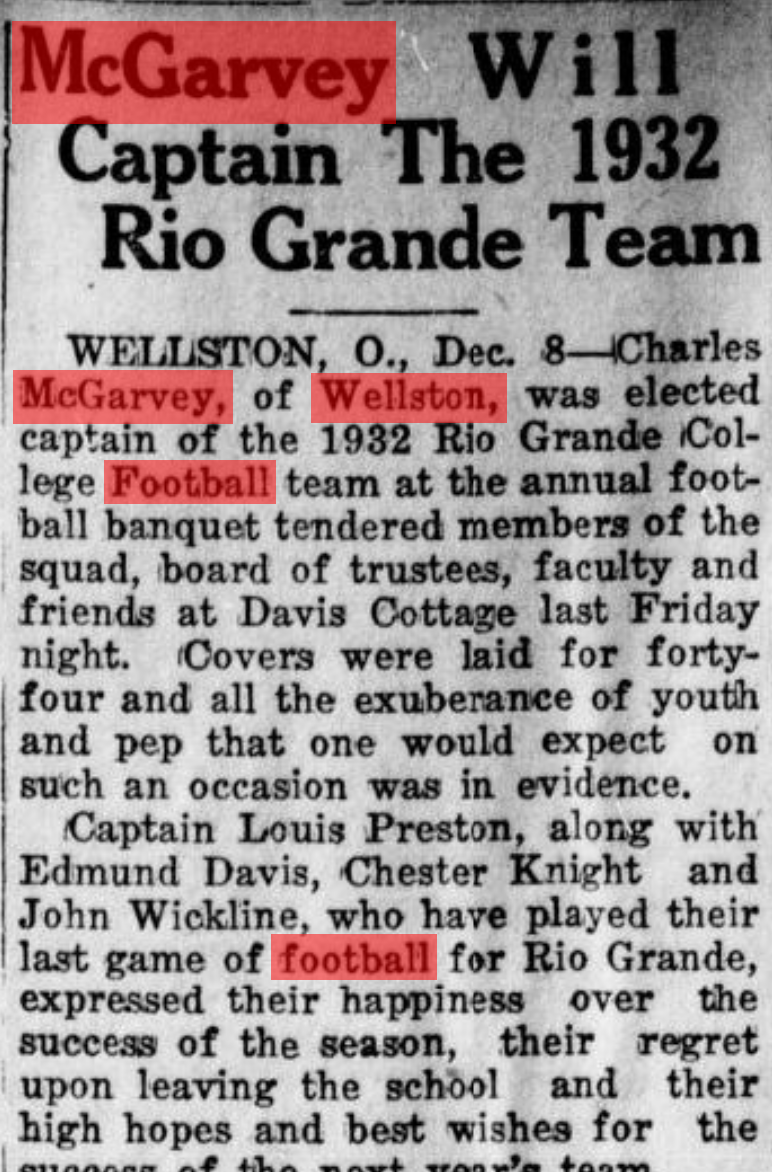
This Irontown News article from December 9, 1931, reports that Charles Leo
McGarvey was elected captain of the 1932 Rio Grande College football team. The brief
notice places him among the program’s recognized leaders at the close of the 1931 season
and names several departing players honored at the annual football banquet.
Irontown News, December 9, 1931. Charles McGarvey is elected captain of Rio Grande’s 1932 football team.
Date: December 9, 1931
Publication:Irontown News
Dateline: Wellston, Ohio, December 8
People mentioned: Charles McGarvey, Louis Preston, Edmund Davis, Chester Knight, John Wickline
Level: College
Sport: Football
McGarvey Will Captain The 1932 Rio Grande Team
WELLSTON, O., Dec. 8, Charles McGarvey, of Wellston, was elected captain of the 1932
Rio Grande College football team at the annual football banquet tendered members of the
squad, board of trustees, faculty and friends at Davis Cottage last Friday night. Covers
were laid for forty-four and all the exuberance of youth and pep that one would expect on
such an occasion was in evidence.
Captain Louis Preston, along with Edmund Davis, Chester Knight and John Wickline, who
have played their last game of football for Rio Grande, expressed their happiness over the
success of the season, their regret upon leaving the school and their high hopes and best
wishes for the success of the next year’s team.
This The Portsmouth Times clipping from August 10, 1932, reports that Paul R.
Lyne was returning to Rio Grande College as coach and director of physical education.
The article is especially useful as a preseason source because it notes Lyne’s earlier
service at Rio Grande from 1923 to 1929 and his more recent coaching work at Defiance.
The Portsmouth Times, August 10, 1932. Paul R. Lyne returns to Rio Grande as coach and director of physical education.
Date: August 10, 1932
Publication:The Portsmouth Times
Subject: Preseason coaching change
People mentioned: Paul R. Lyne
Institution: Rio Grande College
Level: College
Sport: Football
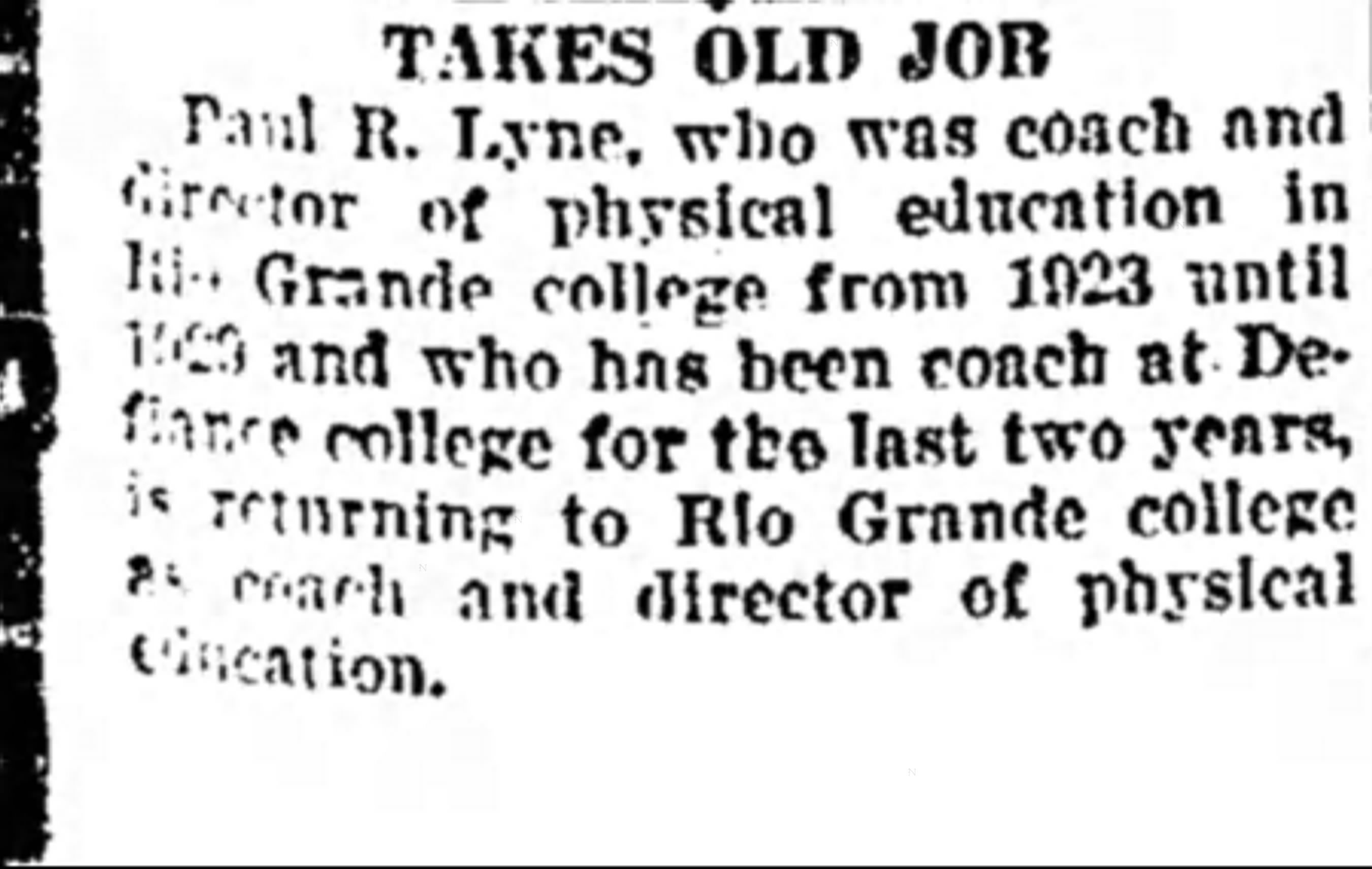
Paul R. Lyne, who was coach and director of physical education in Rio Grande college
from 1923 until 1929 and who has been coach at Defiance college for the last two years,
is returning to Rio Grande college as coach and director of physical education.
“Seven New Coaches on Deck for Various Ohio College Elevens”
This The Piqua Daily Call preseason article from September 6, 1932, surveys
coaching changes across Ohio college football and notes that Paul R. Lyne would direct
Rio Grande College’s football team that season, assisted by William Wiley. It is a useful
early-season source for placing Rio Grande’s 1932 coaching staff in the broader Ohio
college football landscape.
The Piqua Daily Call, September 6, 1932. Preseason article noting Paul R. Lyne as Rio Grande’s new football coach.
Date: September 6, 1932
Publication:The Piqua Daily Call
Byline: Ralph Teatsorth
Teams/Programs: Rio Grande and Ohio college football programs
People mentioned: Paul R. Lyne, William Wiley, Dr. Dalton Peelle, Frank S. Wilton Jr., Stuart Holcomb
Type: Preseason coaching roundup
Level: College
Sport: Football
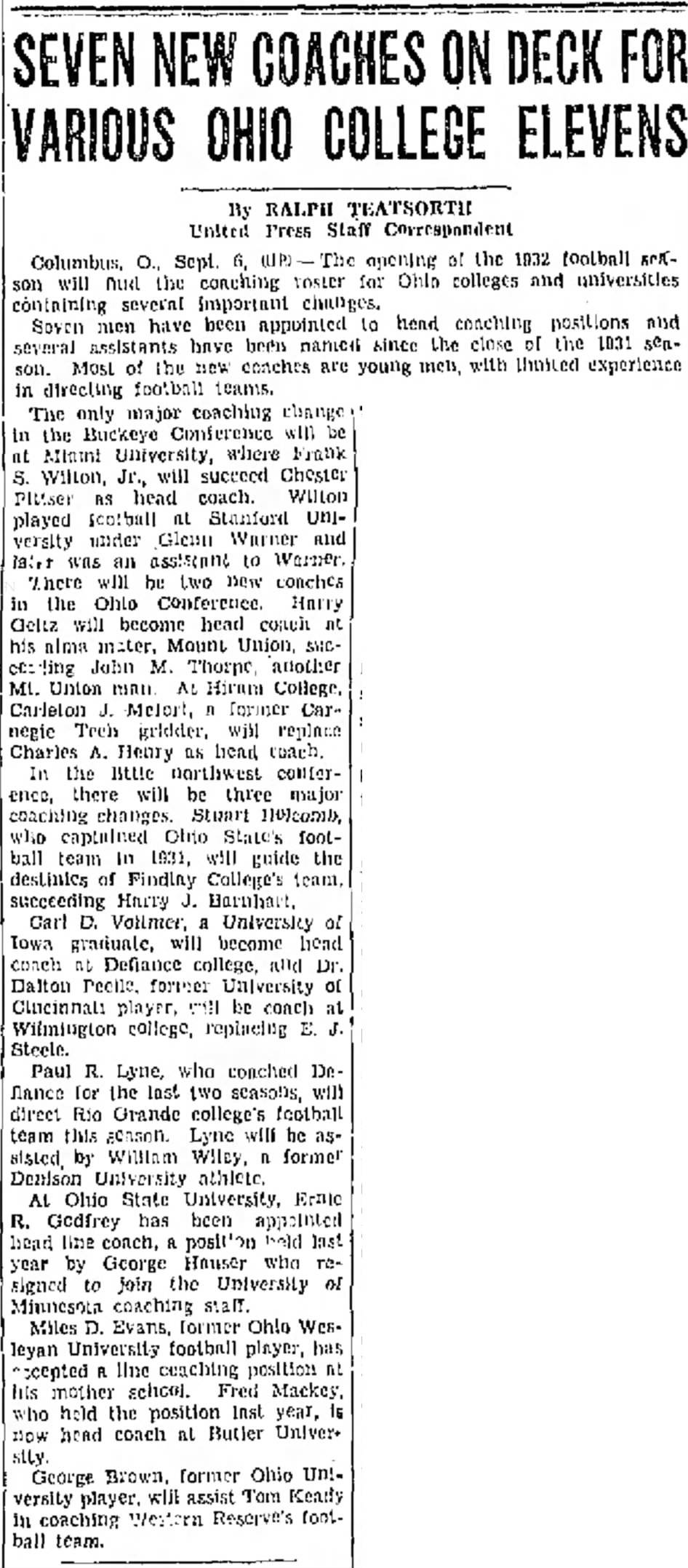
Seven New Coaches on Deck for Various Ohio College Elevens
By Ralph Teatsorth
United Press Staff Correspondent
Columbus, O., Sept. 6, (UP), The opening of the 1932 football season will find the
coaching roster for Ohio colleges and universities containing several important changes.
Seven men have been appointed to head coaching positions and several assistants have
been named since the close of the 1931 season. Most of the new coaches are young men,
with limited experience in directing football teams.
The only major coaching change in the Buckeye Conference will be at Akron University,
where Frank S. Wilton, Jr., will succeed Chester Fowler as head coach. Wilton played
football at Stanford University under Glenn Warner and last was an assistant to Warner.
There will be two new coaches in the Ohio Conference. Harry Geltz will become head
coach at his alma mater, Mount Union, succeeding John M. Thorne, another Mt. Union
man. At Hiram College, Calderon J. Meloh, a former Carnegie Tech gridder, will replace
Charles A. Henry as head coach.
In the state northwest conference, there will be three major coaching changes. Stuart
Holcomb, who captained Ohio State’s football team in 1931, will guide the destinies of
Findlay College’s team, succeeding Harry J. Harnball. Carl D. Vollmer, a University of
Iowa graduate, will become head coach at Defiance College, and Dr. Dalton Peelle,
former University of Cincinnati player, will be coach at Wilmington College, replacing
E. J. Steele.
Paul R. Lyne, who coached Defiance for the last two seasons, will direct Rio Grande
college’s football team this season. Lyne will be assisted by William Wiley, a former
Denison University athlete.
At Ohio State University, Ernie R. Godfrey has been appointed head line coach, a
position held last year by George Hauser, who resigned to join the University of
Minnesota coaching staff.
Miles D. Evans, former Ohio Wesleyan University football player, has accepted a line
coaching position at his mother school. Fred Mackey, who held the position last year,
is now head coach at Butler University.
George Brown, former Ohio University player, will assist Tom Keady in coaching
Western Reserve’s football team.
This The Lima News clipping from September 25, 1932, is another wire-service
style report on Ohio University’s 19-0 opening win over Rio Grande. Though brief, it
reinforces the coverage of Elden Armbrust’s standout performance in the opener.
The Lima News, September 25, 1932. Ohio University defeats Rio Grande, 19-0, in the season opener.
Date: September 25, 1932
Publication:The Lima News
Dateline: Athens, Ohio, September 24 (AP)
Teams: Rio Grande vs. Ohio University
People mentioned: Elden Armbrust
Level: College
Sport: Football
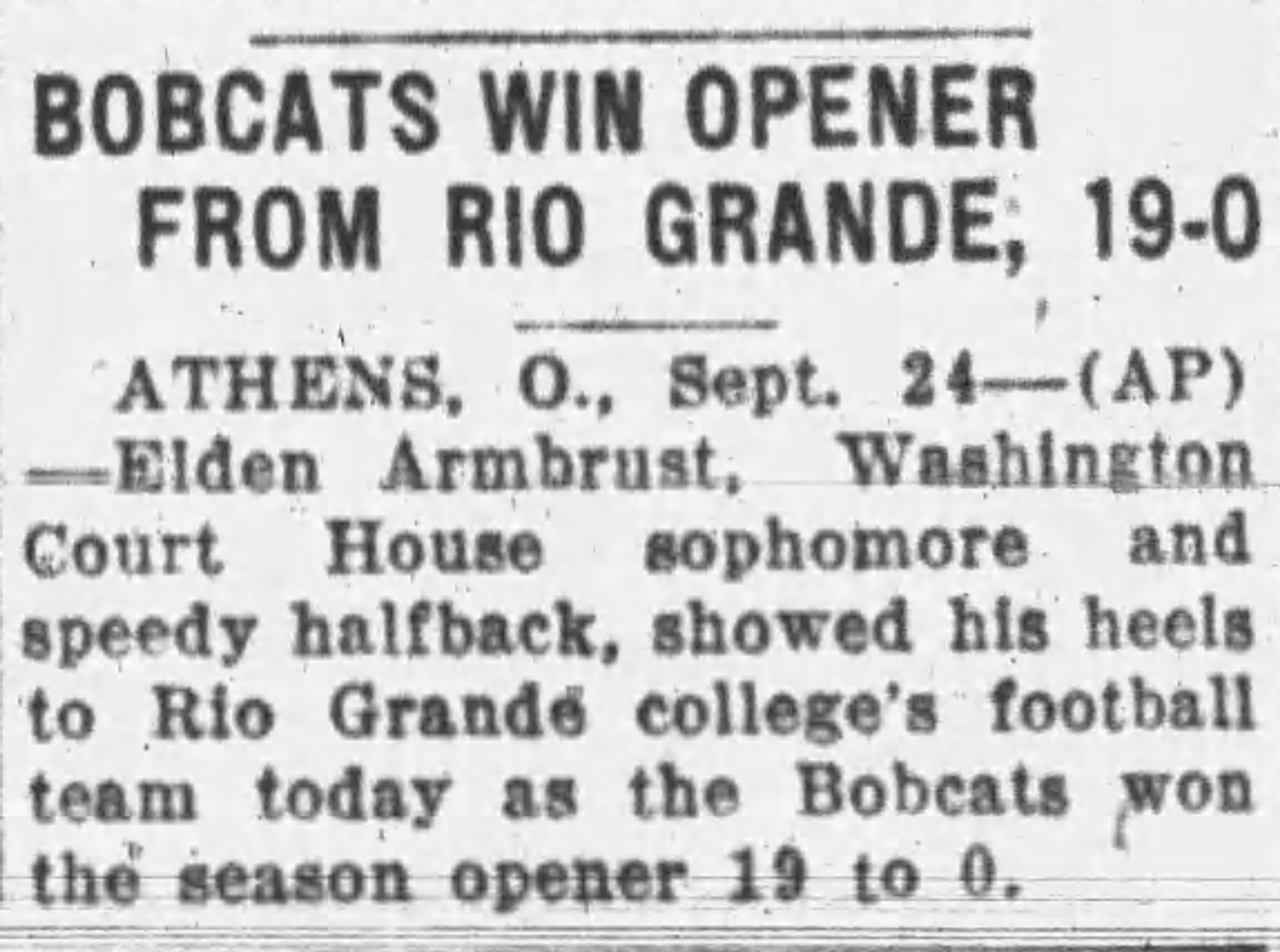
Bobcats Win Opener From Rio Grande, 19-0
ATHENS, O., Sept. 24, (AP), Elden Armbrust, Washington Court House sophomore and
speedy halfback, showed his heels to Rio Grande college’s football team today as the
Bobcats won the season opener 19 to 0.
This The Sandusky Register clipping from September 25, 1932, reports Rio Grande’s
19-0 loss to Ohio University in the season opener. The article centers on Ohio halfback
Elden Armbrust, whose speed and scoring runs helped decide the game, while also noting
Rio Grande’s difficulty moving the ball through the air.
The Sandusky Register, September 25, 1932. Ohio University defeats Rio Grande, 19-0, in the season opener.
Date: September 25, 1932
Publication:The Sandusky Register
Dateline: Athens, Ohio, September 24 (AP)
Teams: Rio Grande vs. Ohio University
People mentioned: Elden Armbrust, Brown, Robinett, Don Peden
Level: College
Sport: Football
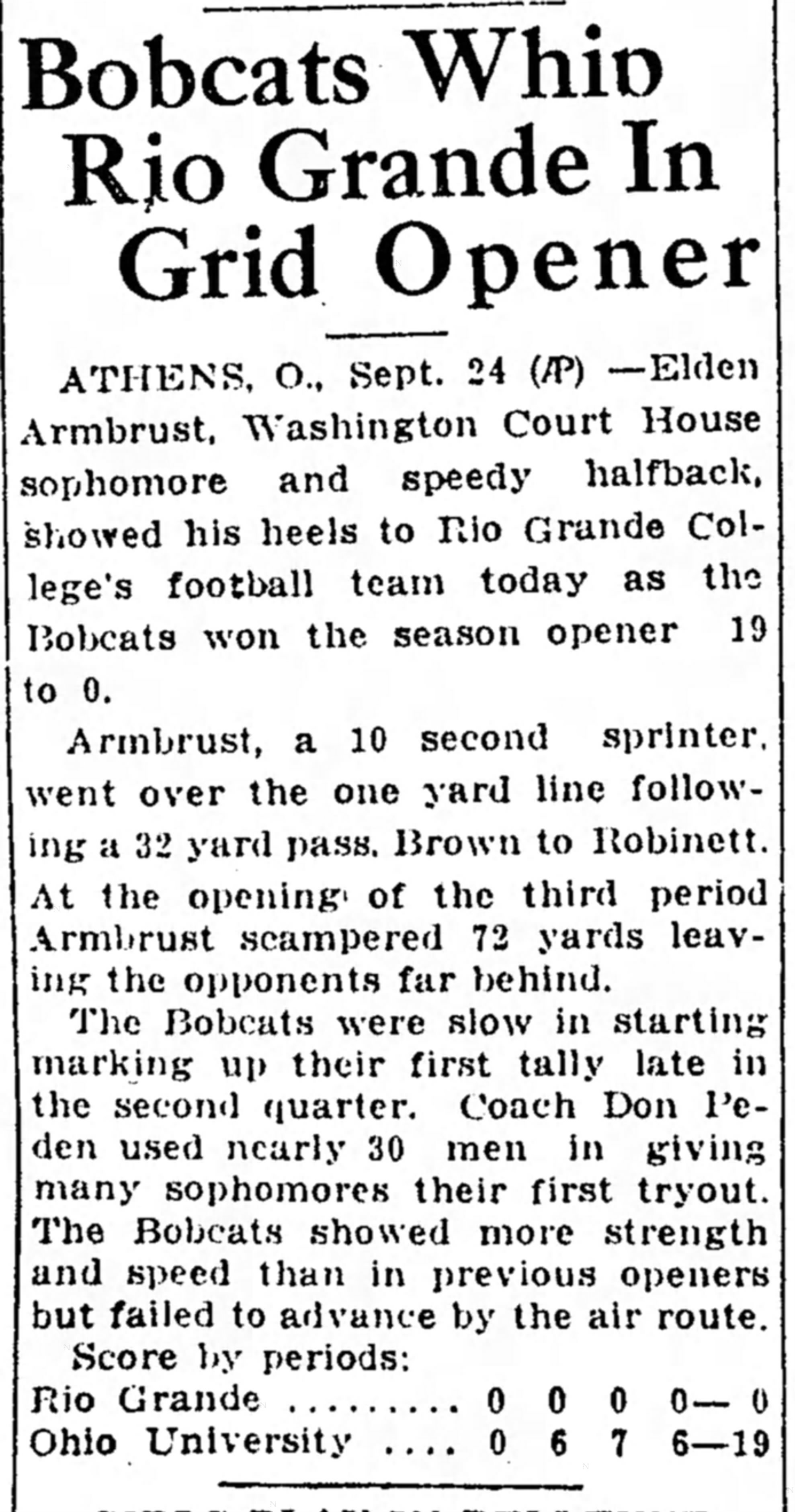
Bobcats Whip Rio Grande In Grid Opener
ATHENS, O., Sept. 24 (AP), Elden Armbrust, Washington Court House sophomore and
speedy halfback, showed his heels to Rio Grande College’s football team today as the
Bobcats won the season opener 19 to 0.
Armbrust, a 10 second sprinter, went over the one yard line following a 32 yard pass,
Brown to Robinett. At the opening of the third period Armbrust scampered 72 yards
leaving the opponents far behind.
The Bobcats were slow in starting, marking up their first tally late in the second quarter.
Coach Don Peden used nearly 30 men in giving many sophomores their first tryout.
The Bobcats showed more strength and speed than in previous openers but failed to
advance by the air route.
Score by periods:
Rio Grande .......... 0 0 0 0, 0
Ohio University ..... 0 6 7 6, 19
This The Coshocton Tribune clipping from September 25, 1932, covers Ohio
University’s 19-0 win over Rio Grande in the season opener. While the Bobcats won
comfortably, the article emphasizes that Rio Grande played a scrappy defensive game
and forced Ohio to work for its points.
The Coshocton Tribune, September 25, 1932. Ohio University defeats Rio Grande, 19-0, in the season opener.
Date: September 25, 1932
Publication:The Coshocton Tribune
Dateline: Athens, Ohio, September 24
Teams: Rio Grande vs. Ohio University
People mentioned: Armbrust
Level: College
Sport: Football
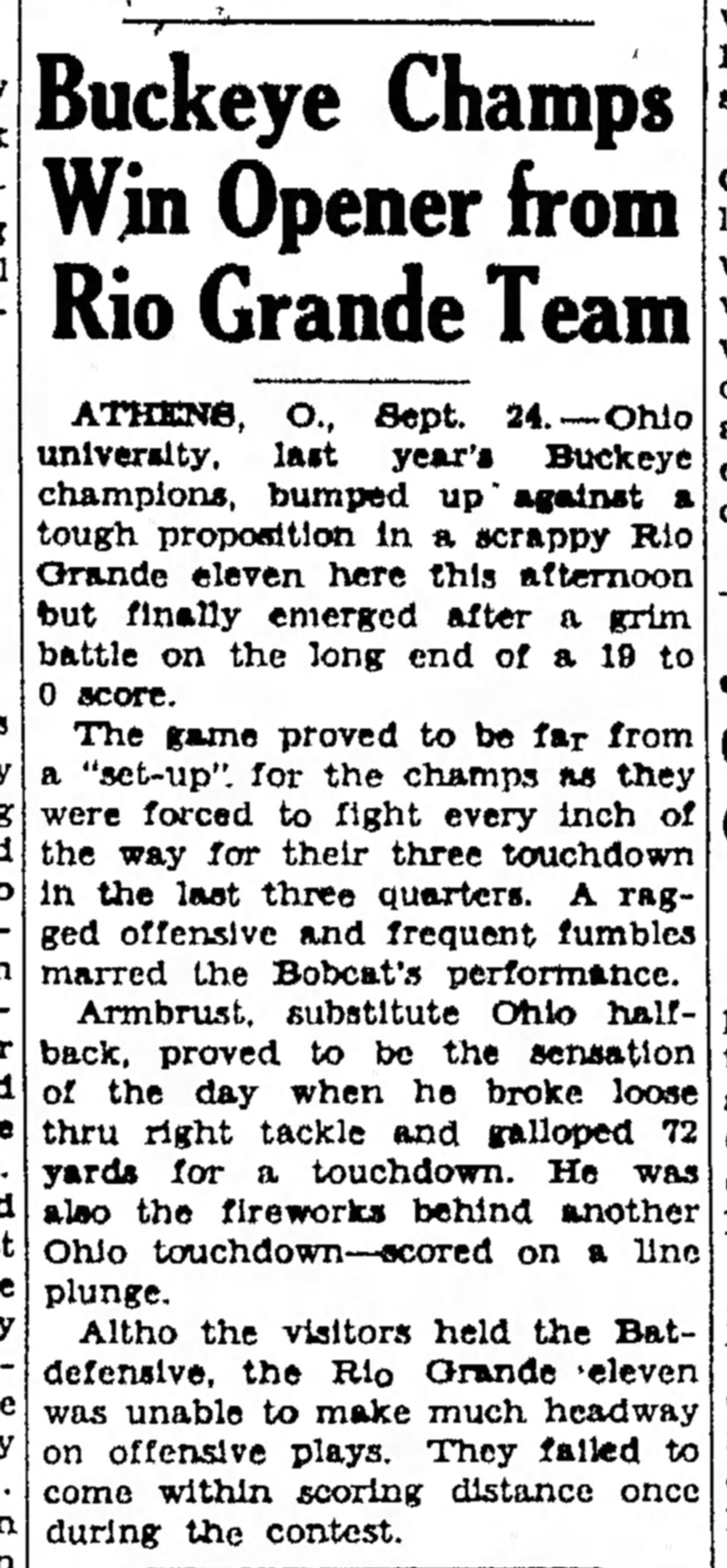
Buckeye Champs Win Opener from Rio Grande Team
ATHENS, O., Sept. 24. Ohio university, last year’s Buckeye champions, bumped up
against a tough proposition in a scrappy Rio Grande eleven here this afternoon but
finally emerged after a grim battle on the long end of a 19 to 0 score.
The game proved to be far from a “set-up” for the champs as they were forced to
fight every inch of the way for their three touchdowns in the last three quarters.
A ragged offensive and frequent fumbles marred the Bobcats’ performance.
Armbrust, substitute Ohio halfback, proved to be the sensation of the day when he
broke loose thru right tackle and galloped 72 yards for a touchdown. He was also
the fireworks behind another Ohio touchdown, scored on a line plunge.
Although the visitors held the Bobcats defensive, the Rio Grande eleven was unable
to make much headway on offensive plays. They failed to come within scoring
distance once during the contest.
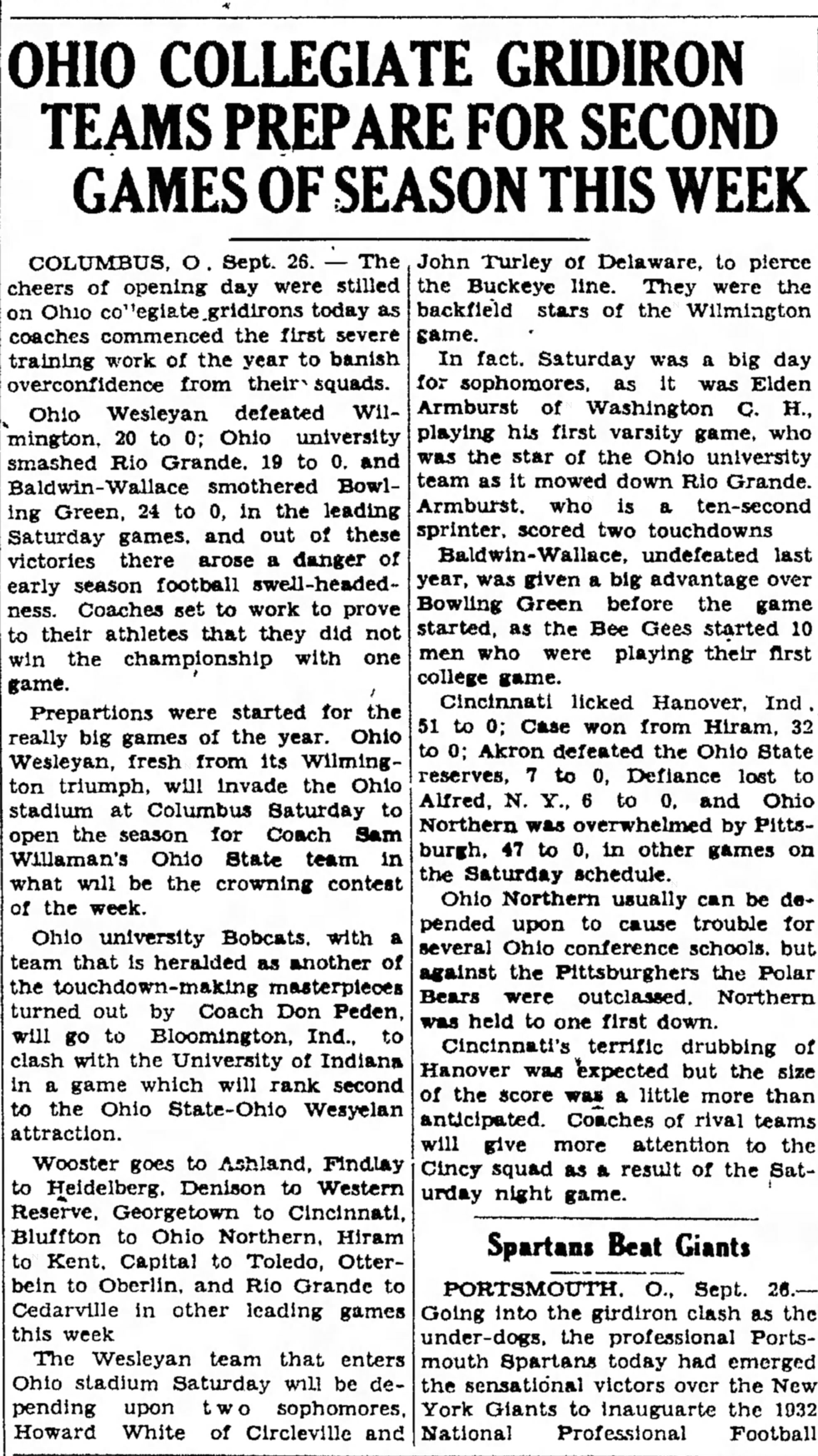
“Ohio Collegiate Gridiron Teams Prepare for Second Games of Season This Week”
This The Coshocton Tribune article from September 26, 1932, places Rio Grande’s
opening loss to Ohio University in the wider context of early season college football across
Ohio. It notes that Ohio’s win over Rio Grande was one of the weekend’s leading results
and highlights sophomore Elden Armbrust’s performance in the game.
The Coshocton Tribune, September 26, 1932. Statewide roundup noting Ohio University’s 19-0 win over Rio Grande.
Date: September 26, 1932
Publication:The Coshocton Tribune
Dateline: Columbus, Ohio, September 26
Teams: Rio Grande vs. Ohio University; Rio Grande vs. Cedarville (upcoming)
People mentioned: Elden Armbrust, Don Peden, Sam Willaman, Howard White, John Turley
Level: College
Sport: Football
Ohio Collegiate Gridiron Teams Prepare for Second Games of Season This Week
COLUMBUS, O., Sept. 26. The cheers of opening day were stilled on Ohio collegiate
gridirons today as coaches commenced the first severe training work of the year to
banish overconfidence from their squads.
Ohio Wesleyan defeated Wilmington, 20 to 0; Ohio university smashed Rio Grande,
19 to 0, and Baldwin-Wallace smothered Bowling Green, 24 to 0, in the leading
Saturday games, and out of these victories there arose a danger of early season
football swell-headedness. Coaches set to work to prove to their athletes that they
did not win the championship with one game.
Preparations were started for the really big games of the year. Ohio Wesleyan, fresh
from its Wilmington triumph, will invade the Ohio stadium at Columbus Saturday to
open the season for Coach Sam Willaman’s Ohio State team in what will be the
crowning contest of the week.
Ohio university Bobcats, with a team that is heralded as another of the touchdown-making
masterpieces turned out by Coach Don Peden, will go to Bloomington, Ind., to clash
with the University of Indiana in a game which will rank second to the Ohio State-Ohio
Wesleyan attraction.
Wooster goes to Ashland, Findlay to Heidelberg, Denison to Western Reserve,
Georgetown to Cincinnati, Bluffton to Ohio Northern, Hiram to Kent, Capital to Toledo,
Otterbein to Oberlin, and Rio Grande to Cedarville in other leading games this week.
The Wesleyan team that enters Ohio stadium Saturday will be depending upon two
sophomores, Howard White of Circleville and John Turley of Delaware, to pierce the
Buckeye line. They were the backfield stars of the Wilmington game.
In fact, Saturday was a big day for sophomores, as it was Elden Armbrust of
Washington C. H., playing his first varsity game, who was the star of the Ohio
university team as it moved down Rio Grande. Armbrust, who is a ten-second
sprinter, scored two touchdowns.
Baldwin-Wallace, undefeated last year, was given a big advantage over Bowling Green
before the game started, as the Bee Gees started 10 men who were playing their first
college game.
Cincinnati licked Hanover, Ind., 51 to 0; Case won from Hiram, 32 to 0; Akron defeated
the Ohio State reserves, 7 to 0, Defiance lost to Alfred, N. Y., 6 to 0, and Ohio Northern
was overwhelmed by Pittsburgh, 47 to 0, in other games on the Saturday schedule.
Ohio Northern usually can be depended upon to cause trouble for several Ohio conference
schools, but against the Pittsburghers the Polar Bears were outclassed. Northern was
held to one first down.
Cincinnati’s terrific drubbing of Hanover was expected but the size of the score was a
little more than anticipated. Coaches of rival teams will give more attention to the Cincy
squad as a result of the Saturday night game.
“Don Peden Drives Bobcats Hard For Stiff Grid Tilts”
This The Piqua Daily Call article from September 28, 1932, looks back at Ohio
University’s 19-0 opening win over Rio Grande from the Bobcats’ perspective. Rather than
celebrating the result, the piece argues that Ohio’s performance against Rio Grande exposed
weaknesses in rhythm, blocking, and overall smoothness ahead of tougher upcoming games.
The Piqua Daily Call, September 28, 1932. Follow-up analysis after Ohio University’s 19-0 win over Rio Grande.
Date: September 28, 1932
Publication:The Piqua Daily Call
Dateline: Athens, September 28
Teams: Ohio University vs. Rio Grande
People mentioned: Don Peden
Type: Follow-up analysis
Level: College
Sport: Football
Don Peden Drives Bobcats Hard For Stiff Grid Tilts
Athens, Sept. 28, Faint were the growls of the Ohio University Bobcats Saturday as they
defeated Rio Grande College 19-0 in the first game of the season. In the face of very
ordinary opposition the revamped 1932 edition of the Buckeye Champions provided Ohio
coaches and fans with none too much encouragement for the future.
Despite the lack of punch and smoothness in last Saturday’s mild affair, Coach Peden
has started to iron out the problem developed by the opening game. The Ohio strategy
expert has only a few days in which to prepare his machine for his major battle with
Indiana at Bloomington this week.
The strength that Ohio will show against the Big Ten team is almost as problematical
now as it was at the opening of practice. If the game with Rio Grande were taken as a
criterion, the Bobcats would have little chance of capturing a fourth consecutive Buckeye
title or playing the Hoosiers and, later the Navy Midshipmen on even terms.
Coach Peden will not allow his team to be measured by its showing last week, however.
Rhythm and unison of attack between the backfield and line will be stressed in drill this
week. Ball carriers were too frequently stripped of interference in the opening game and
the forward wall was not as im-
This Gazette News-Current article from October 3, 1932, reports Rio Grande’s
14-7 victory over Cedarville in a night game played at Cox Athletic Field in Xenia.
The 1932 Homecoming program schedule confirms this as the first Cedarville meeting,
listed as the October 1 away game, separate from the later Cedarville game at Jackson.
The article notes Rio Grande’s statistical edge, highlights a safety that helped swing
momentum, and credits Fullback McGarvey with a twenty-five-yard dash that set up one
of the team’s touchdowns.
Gazette News-Current, October 3, 1932, page 1. Rio Grande defeats Cedarville, 14-7, in Xenia.
Publication date: October 3, 1932
Game date: October 1, 1932
Publication:Gazette News-Current
Location: Cox Athletic Field, Xenia, Ohio
Page: 1
Teams: Rio Grande vs. Cedarville
Schedule context: First Cedarville meeting of 1932; the Homecoming program schedule separately lists a later Cedarville game at Jackson
People mentioned: McGarvey, Logue, Murray, Garlough, Hargrave, McFarland
Level: College
Sport: Football
Cedarville Loses to Rio Grande 14-7
Ault’s Charges Give Stiff Battle In Night Game Here
A lightweight Cedarville College eleven which offered stubborn resistance from beginning
to end eventually bowed to Rio Grande College by a 14 to 7 margin in a night football
game transferred to Xenia and staged on a neutral gridiron Saturday night at Cox
Athletic Field.
Although beaten, the Yellow Jackets were far from disgraced, and in the fourth period
Quarterback Murray gave the small throng of spectators on hand something to cheer
about when he intercepted a pass and sprinted eighty-five yards for Cedarville’s solitary
touchdown, the most spectacular run of the game. Fullback Preston Garlough passed to
Hargrave, halfback, for the extra point.
A heavier Rio Grande team, which held Ohio University, defending Buckeye Conference
champions, to a 19 to 0 score a week ago, piled up twenty first downs as compared with
four for Cedarville.
A series of five first downs brought Rio Grande to Cedarville’s two-yard line in the first
period, whereupon the Yellow Jackets became a mobile fighting unit, stiffened
magnificently and took the ball on downs.
On the next play, however, Garlough fumbled behind his own goal line, and was tackled
by McFarland, right end, giving the visitors two points on a safety.
Starting the second quarter, Murray reeled off two first downs for Cedarville on short
dashes around end and off tackle, and when a kick became necessary, Rio Grande
launched an uninterrupted drive down the field.
The parade returned a dash of twenty-five yards by Fullback McGarvey and with the ball
in scoring range, Halfback Logue crossed the goal line on a short thrust off tackle. The
place kick for extra point was low to the uprights.
Rio Grande sustained another forward march in the third quarter, climaxed when Logue
skirted end for twenty yards over the last white line. The extra point was not converted.
Score by periods:
Rio Grande .......... 2 6 6 0, 14
Cedarville .......... 0 0 0 7, 7
Rio Grande scoring: touchdowns, Logue, 2; safety (Garlough). Cedarville scoring:
touchdown, Murray; point after touchdown, Hargrave (pass from Garlough).
This News Journal clipping from October 4, 1932, previews Wilmington College’s
upcoming trip to Rio Grande for a Saturday game that would serve as Rio Grande’s
Homecoming. The article describes Rio Grande as one of its most formidable teams in
history, balanced in size and weight and equipped with a versatile attack.
News Journal, October 4, 1932. Preview of Wilmington College’s game at Rio Grande on Homecoming weekend.
Date: October 4, 1932
Publication:News Journal
Teams: Wilmington College vs. Rio Grande
People mentioned: Amos Smith, Dalton Peelle
Event note: Wilmington game
Level: College
Sport: Football
Elevens Will Do Battle On Foreign Grids
High School To Play Friday At Dayton Fairmont-Field; College to Rio Grande
Both Wilmington football teams will meet opponents on foreign gridirons this week,
with the High School eleven traveling to Dayton, Friday afternoon, for a contest with
Fairmont Hi and the Wilmington College gridders journeying to the river valley for a
game at Rio Grande College, Saturday afternoon.
Wilmington Hi’s game at Dayton Fairmont will mark the opening of athletic relations
between the two institutions. The college’s exhibition at Rio Grande, Saturday, will be
Homecoming Day at that school.
Coach Amos Smith is drilling his inexperienced team in all phases of the game this week,
hoping to have an improved eleven ready to meet the strong outfit at Fairmont. Smith is
considering a few shifts in his lineup and is endeavoring to find a smoother working
combination.
Dr. Dalton Peelle is drilling the W. C. footballers at an easier pace this week, following
three weeks of hard scrimmages and two hard games.
Dr. Peelle expects a stiff encounter at Rio Grande, but his squad is tired and a number
of the members came out of the game with U. of Dayton Reserves badly battered.
Rio Grande has one of its most formidable teams in history, an eleven well balanced in
height and weight and boasting a versatile attack.
This News Journal clipping from October 6, 1932, previews Wilmington College’s
Homecoming trip to Rio Grande. The article describes Rio Grande as a formidable,
well-balanced, and capably coached team, references its recent games against Ohio
University and Cedarville, and outlines Wilmington’s expected lineup changes.
News Journal, October 6, 1932. Preview of Wilmington College’s trip to Rio Grande for Homecoming.
Tornado To Have Slight Edge In Weight in Third Effort To Achieve Victory
Wilmington College gridders will en-bus Saturday at 8:45 A. M. for their second football
trip of the current campaign, traveling 100 miles southeast to Rio Grande College,
located in the Ohio river valley, near Gallipolis.
The Green and White squad will make the round trip in one day, returning Saturday
evening after their game. Few fans and students will find it possible to accompany
the team.
The Green and White’s appearance at Rio Grande, Saturday, will mark homecoming day
for that institution and the school is making many special plans for the day.
Dr. Dalton Peelle, W. C. football coach, will demand victory from his gridders this week.
The Tornado has met defeats at Ohio Wesleyan, 20 to 0 and against U. Dayton reserves,
13 to 6.
Rio Grande has a formidable, well balanced and capably coached team which is uniform
in height and weight. The Lynn-coached combination averages about 170 pounds, which
will give W. C. a slight weight advantage.
Rio Grande extended Ohio University, B. A. A. champions, to the limit two weeks ago,
the Bobcats eking out a fourth quarter victory, 19 to 0. Last Saturday night at Xenia,
Rio Grande trimmed Cedarville’s scrappy eleven, 14 to 7.
A number of shifts will be made in Wilmington’s lineup this week, according to Dr. Peelle.
Fieger will again start at center, but Davis and Lander will be at the guard positions.
The tackle posts will be held down by Brown and Henry, the latter being a promising
freshman lineman from McDermott High. Bullen and Raizk will be at the flanks.
In the backfield, Dr. Peelle plans to start Bryce Bloom at quarterback, Pollard and
Bellman at halfbacks and Wright at fullback.
This combination would afford three good blockers in Bloom, Wright and Pollard.
All are capable ball toters, Bellman will do the punting and all are good forward passers,
Wright being a southpaw tosser.
Dr. Peelle anticipates a hard game at Rio Grande but hopes to have his team ready for
its first win of the year.
Rome Rankin, coach of New Boston high school and a former All-West Virginia star
halfback, will referee the contest. The game is scheduled for 2:30 P. M.
Fans following the team from here will go to Washington C. H. and take state route 11,
southeast to Rio Grande. The route goes through Frankfort, Chillicothe and Jackson.
This Wilmington News Journal article from October 7, 1932, previews Wilmington
College’s Saturday trip to Rio Grande while also covering Wilmington High School’s game
at Fairmont. The piece is useful for showing that Wilmington entered the Rio Grande
matchup as a favorite and expected a strong performance from Dr. Peelle’s team.
Wilmington News Journal, October 7, 1932. Preview of Wilmington College’s trip to Rio Grande.
Date: October 7, 1932
Publication:Wilmington News Journal
Byline: H. Kroger Babb
Teams: Wilmington College vs. Rio Grande
People mentioned: H. Kroger Babb, Dr. Peelle
Level: College
Sport: Football
Hurricane at Fairmont for Gridiron Tilt
Wilmington College Eleven Goes To Rio Grande For Clash Saturday
By H. Kroger Babb
Wilmington Hi’s Orange Hurricane is in Dayton, today, opening athletic rivalry with
another first class Miami Valley school, Fairmont. The Orange and Purple were billed
to clash on the Dorothy Lane gridiron at 3 P. M. this afternoon with a crowd of about
2,000 in prospect.
The locals are on the short end of the odds, facing a veteran team which this season
has trimmed Miamisburg and Cedarville in impressive fashion. Fairmont’s edge is
given as two touchdowns by Dayton dopesters.
Wilmington College’s pigskin tribe will pack its moleskins after a light drill this
afternoon, making ready to en-bus at 8:45 A. M., Saturday, for a trip into the heart
of the Ohio river valley, to meet Rio Grande College.
With no serious injuries among the players, the Green and White rules a favorite over
the two-year school. If Dr. Peelle’s outfit is ready to go at top speed, their margin
should be at least two touchdowns.
Other high school games holding interest in this section today saw Washington C. H.
stacking up even with the Vikings at Chillicothe, Greenfield figured to beat Dayton
Oakwood, Lebanon given an edge over Cedarville, O. S. & S. O. Home a slight favorite
over Bradford, West Carrollton rated easy winner over Germantown, Portsmouth and
Cincinnati Withrow acknowledged a toss-up, Bellefontaine figured to take Sidney and
Greenville an edge over Xenia Central at Xenia tonight.
In the collegiate rank, Dayton U. and the U. S. Marines are expected to make the fur
fly in the Gem City tonight with the outcome much in doubt and Xavier U. figured to
win over Oglethorpe of Atlanta in a night game at Cincinnati, this evening.
Ohio Wesleyan is expected to play Syracuse U. a hard game tomorrow while Ohio State
goes in a favorite over Indiana in the Buckeyes horseshoe.
“Homecoming Football Game at Rio Grande on Saturday Keeps All Fans A-Tingling”
This Gallipolis Daily Tribune article from October 7, 1932, previews Rio Grande’s
Homecoming game against Wilmington College. It is especially useful because it specifically
mentions McGarvey among the Redmen ball carriers, discusses areas the team was trying to
improve after the Cedarville game, and lists McGarvey as a probable starter at either left
tackle or fullback.
Gallipolis Daily Tribune, October 7, 1932. Preview of Rio Grande’s Homecoming game against Wilmington College.
Date: October 7, 1932
Publication:Gallipolis Daily Tribune
Teams: Rio Grande vs. Wilmington College
People mentioned: McGarvey, Logue, Simms, Williams, Coaches Lyne and Wiley
Type: Homecoming game preview
Level: College
Sport: Football
Homecoming Football Game at Rio Grande on Saturday Keeps All Fans A-Tingling
Rio Grande Redmen are going hard to increase their scoring punch through long gruelling
practices this week in preparation for the Homecoming game on Saturday with Wilmington
College. After the game with Cedarville in which they were able to pile up twenty first
downs to four for their opponents and still failed to score more than two touchdowns and
a safety, Coaches Lyne and Wiley are driving the Redmen hard to increase their scoring
punch when in the opponents’ territory.
Logue, Simms, McGarvey, and Williams, all toted the ball in fine style against Cedarville
but will need to put an extra steam against Wilmington. The line which looked like a find
at Ohio University failed to show their power Saturday night against Cedarville, except in
spots. They will be given extra attention this week to place them back in their stride for
the game with Wilmington.
Every indication points to a real battle when these two teams meet Saturday from their
early season games. Ohio University defeated Rio Grande 19-0, while on the same day
Ohio Wesleyan was taking Wilmington 20-0. The relative strength of the two Buckeye
Conference teams is difficult to estimate at this time, although both are in the favored
class to take the championship in their conference. The game is called at 2:30 p. m.
The probable lineup of the teams
Rio Grande
Mileusnich ........ L.E.
Staley or McGarvey ........ L.T.
Troth ............ L.G.
Gullion or Kelley ........ C.
Moore ............ R.G.
Preston .......... R.T.
McFarland or Simpson ........ R.E.
Williams ......... Q.B.
Logue ............ R.H.
Carey or McGarvey ........ F.B.
Simms ............ L.H.
Wilmington
Raizk ............ L.E.
Davis ............ L.T.
Williams ......... L.G.
Fieger ........... C.
Butler ........... R.G.
Brown ............ R.T.
Bullen ........... R.E.
Barack ........... Q.B.
Bloom ............ R.H.
Bellman .......... F.B.
Pollard .......... L.H.
This News Journal article from October 10, 1932, reports Wilmington’s 7-6
upset over Rio Grande. It is especially valuable for Charles Leo McGarvey’s
story because it identifies him as Rio Grande’s captain, describes his late scoring drive,
and recounts the failed final extra-point attempt that preserved Wilmington’s win.
News Journal, October 10, 1932. Wilmington defeats Rio Grande, 7-6.
Gallia Countians Fail In Try For Extra Point To Tie Count
By Kroger Babb
Wilmington College achieved its first grid victory since the middle of the 1931
campaign, Saturday, defeating Rio Grande, 7 to 6, in a homecoming contest witnessed
by more than 1,200 at Gallia county institution.
Bellman, W. C. star freshman halfback, accounted for the Tornado’s winning count,
snagging a sensational pass for a touchdown and adding the extra point by place kick,
which at the finish proved the winning edge.
The two elevens were well matched, W. C. being the heavier and Rio Grande the faster,
more versatile and aggressive. The first half scoreless, neither team being able to
puncture the other’s defense.
Score In Third Period
Wilmington’s scoring came late in the third quarter. W. C. recovered a fumble on
Rio Grande’s 44-yard line and Bellman in two efforts carried the ball to the 30.
A pass, Barack to Pollard, netted 15 yards but the Red and White team stiffened and
a 5-yard penalty sent the Tornado back to the 20-yard stripe. On fourth down came
the spectacular pass for a score. “Pennsy” Pollard, two-headed W. C. halfback,
whirled a long spiral in pass into the end zone while Bellman gathered in with one
hand while three Rio Grande players lunged at his anatomy. With Barack holding the
ball, Bellman applied his educated toe to the leather, sending it squarely through
the uprights for the all-important seventh point.
Rio Grande gained the ball on Wilmington’s 40, late in the game and unleashed its
scoring drive. McGarvey, star fullback of the Lynn-coached outfit, hit the line a yard
at a time until he got to play, Carey, a rangy tackle, dropped back and tossed a long
pass to Milensich, an end, who shook loose from Bloom and rambled in for a touchdown.
The big homecoming day crowd went wild and with a tie hinging on the last play,
both teams gave their greatest effort.
Brown Stops Play
Clever and tricky as they were, the Rio Grande eleven failed to outsmart Dr. Peelle’s
machine on the extra point effort. They lined up as if to place kick, but the ball was
snapped to McGarvey, who jabbed at the strongest point of Wilmington’s line. When
big “Briar” Brown had finished his job, there was no doubt about the failure of the
play. Brown had McGarvey’s shoe tied in hard knots with a vicious charging tackle and
Jacoby stole the ball to make the matter doubly certain.
W. C. conquered a good opponent, a team with natural ability and speed and coached
to perfection. The Rio Grande outfit played inspired ball before its big homecoming
day crowd and boasted in McGarvey and Preston a pair of defensive tackles that would
not tolerate any fooling.
The Quakers’ passing offense was their major weapon, slow-charging and interior
blocking rendering most running plays ineffective. The Green and White line played
its best ball when on defense and Dr. Peelle’s forward pass defense turned the tide,
the Rio Grande team completing but two of 12 aerial efforts.
Dr. Peelle started his second team, playing a shock troop of football the first period.
But the Tornado when sent in, was unable to unleash a damaging wind excepting for
the Pollard to Bellman pass in the third stanza.
The work of Lander and Henry predominated the defensive play of the Quaker linemen
with Brown and Davis noticeably effective offensively. Honors generally fell divided
among the Green and White backs, Bellman, Barack, Bloom, Pollard and Wright all
contributing creditably.
Lineups and summary
Wilmington (7)
Butler .......... le .......... Milensich
Barbour ......... lt .......... Carey
H. Williams ..... lg .......... Troth
Johnson ......... c ........... Kelley
Hartman ......... rg .......... Moore
Steen ........... rt .......... Preston
Bullen .......... re .......... McFarland
Bloom (C) ....... qb .......... Williams
Houck ........... lh .......... Murns
King ............ rh .......... Logue
Manuel .......... fb .......... McGarvey (C)
This News Journal column from October 11, 1932, reflects on Wilmington’s
7-6 win over Rio Grande and preserves a colorful contemporary account of Rio Grande’s
last-second touchdown before time expired. The piece is especially useful for its vivid
description of the dramatic finish and its anecdote about Wilmington tackle Leslie
“Briar” Brown during the game.
News Journal, October 11, 1932. Kroger Babb reflects on Wilmington’s narrow 7-6 win over Rio Grande.
Date: October 11, 1932
Publication:News Journal
Byline: Kroger Babb
Type: Sports column
People mentioned: Kroger Babb, Leslie “Briar” Brown, Milensich, Barack
Related game: Wilmington 7, Rio Grande 6
Level: College
Sport: Football
Sport Honey From the Bumble Bee
By Kroger Babb
WE DEBATED many moments last Saturday morning on where to go. We know, thank you,
where many think we should be, but to get on with subject the question was, Rio Grande
or Columbus?
We chose the former and shall never regret it. At Columbus, a miserable exhibition
against Indiana. Possibly W. C. played no better football but the game did provide this
observer with two pleasures he shall never forget.
A FEW years ago Ashland scored a winning touchdown on the local field in the last 30
seconds of play. That was the best “last minute” rally the writer had witnessed, until
Saturday.
Rio Grande’s “before the gun” score didn’t win the contest but it did come just in time
to be a part of the ball game. One of the official timers tells us that when the ball was
snapped on the Lynemen’s scoring play the watch showed just 11 seconds remaining.
When time went out after Milensich had crossed the goal line for Rio Grande’s touchdown
there were just four seconds left.
Time is out on extra point plays and doesn’t go in until the following kickoff. Rio Grande
kicked off, Barack caught the ball and the gun cracked.
Besides being a new “beating-the-gun” record, this particular score provides some other
interesting details. It requires approximately seven seconds to complete an ordinary
forward pass play and the average kickoff assumes about four seconds.
THE FUNNIEST remark we have ever heard a player make on a football field was made in
the Rio Grande game.
Leslie “Briar” Brown, W. C.’s big tackle and former Hillsboro Hi star fullback, was the
comedian.
Brown was having trouble with his opponents and was “steamed up” aplenty. His rather
jungle-like actions drew a 15 yard penalty at one time and he demanded an explanation
from the referee and was promptly informed, “For unnecessary roughness.”
A few plays later Big Briar broke through Rio Grande’s line and made a bruising tackle
of a ball carrier. He pinned the runner to the ground for a sizeable loss and the Rio
Grande player, in disgust, threw the ball, boyish-like, some 10 yards.
As the referee, a white-haired gentleman, chased after the bounding pigskin, Brown
rushed and loudly exclaimed, “Now, Mr. Referee, why don’t you penalize that guy five
yards for unnecessary, for unnecessary, oh, for unnecessary foolishness!”
This brief score roundup clipping, likely from the Irontown News, records Rio
Grande’s 7-0 win over Urbana. Although it does not include narrative coverage, it serves
as a compact contemporary result notice for the 1932 season.
Football score listing showing Rio Grande 7, Urbana 0.
This The Lima News clipping from October 23, 1932, reports Morehead State
Teachers’ 10-7 victory over Rio Grande. The brief article notes that Rio Grande showed
well in the first half before Morehead took control late, with June Evans’s fourth-period
field goal deciding the game.
The Lima News, October 23, 1932. Morehead defeats Rio Grande, 10-7, on a fourth-quarter field goal.
Date: October 23, 1932
Publication:The Lima News
Dateline: Morehead, Kentucky, October 22 (AP)
Teams: Morehead State Teachers vs. Rio Grande
People mentioned: June Evans
Level: College
Sport: Football
Field Goal Beats Rio Grande Eleven
MOREHEAD, Ky., Oct. 22, (AP), A field goal booted by June Evans, a half back, in the
fourth period, gave the Morehead State Teachers’ football team a 10 to 7 victory over
Rio Grande, of Ohio, today.
The game was close all the way with the visitors showing best in the first half and
Morehead taking the spotlight in the last two periods.
This likely Irontown News clipping from October 24, 1932, reports Morehead State
Teachers’ 10-7 win over Rio Grande. The article is especially useful because it names
Charles Leo McGarvey in the starting lineup, gives a fuller summary of the scoring,
and preserves the complete lineups and quarter-by-quarter score.
Likely Irontown News, October 24, 1932. Morehead State Teachers defeats Rio Grande, 10-7.
Date: October 24, 1932
Publication: likely Irontown News
Teams: Morehead State Teachers vs. Rio Grande
People mentioned: Gene Sheridan, June Evans, Combs, Burkhart, McGarvey
Note: Includes lineups and scoring summary
Level: College
Sport: Football
Gene Sheridan Helps Teachers Win 10-7 Contest
Several Former Ironton High Stars in Rio Grande Lineup. Sheridan, former “Flying Dutchman” Scores Touchdown.
Gene Sheridan, former St. Joseph high school star, played a major role Saturday
afternoon, when Morehead State Teachers’ College defeated Rio Grande 10 to 7.
Several ex-Ironton High stars were in the lineup for Rio Grande, including Gullion
and Ralph Simpson at ends, and Smith and Dole.
The game was played at Morehead, and was close all the way. Rio Grande held the
spotlight during the first half, and the Teachers holding the edge in the last two periods.
A field goal by June Evans, halfback in the fourth quarter, enabled Morehead to nose
out the Ohioans.
Morehead scored first, pushing over a touchdown in the third quarter. Combs blocked
a punt by Williams of Rio Grande on the 10-yard line. Sheridan scored the touchdown
and ran off-tackle for the extra point.
Several minutes later, Rio tied the score, when Burkhart, Rio quarterback, ran a punt
back fifty yards for a touchdown. Carr kicked the extra point.
The game was closely contested, both Morehead and Rio Grande making six first downs,
and gaining about the same number of yards from scrimmage.
Morehead (10)
Hackled .......... L.E. .......... Gullion
Henry ............ L.T. .......... Staley
Holliday ......... L.G. .......... Troth
Brashear ......... C. ............ Kelley
Wilson ........... R.G. .......... Moore
Martindale ....... R.T. .......... Preston
Sparks ........... R.E. .......... Simpson
O. Evans ......... Q.B. .......... Burkhart
McNabee .......... L.H. .......... Williams
J. Evans ......... R.H. .......... Logue
Sheridan ......... F.B. .......... McGarvey
Family stories describe Charles Leo McGarvey as a four-year varsity football player at
Wellston High School. This 1928 The X-Ray yearbook page, which covers the 1927
football season, is therefore important evidence. It shows the 1927 team photograph, names
the players in the caption, records Wellston's season results, and gives the Southeastern
League standings. Charles McGarvey is not listed in the roster caption, so 1927 should remain
unconfirmed as a varsity season for him unless another source is found.
The X-Ray, 1928. Wellston High School football team photograph, 1927 season results, and Southeastern League standings.
Season reviewed: 1927 Wellston High School football season
Evidence type: Team photograph, roster caption, season results, and league standings
Season record shown: 2 wins, 7 losses; 59 points scored, 156 points allowed
League standing: Wellston listed 1-6 in Southeastern League play, .142 percentage
Family tradition: Charles Leo McGarvey was remembered as a four-year varsity football player
Current interpretation: 1927 remains unconfirmed; the first clearly documented varsity football season is 1928
Historical significance: Documents the season immediately before Charles's first confirmed varsity year and keeps the site from overstating the four-year-varsity tradition while preserving the family story as a research lead.
The X-Ray
Football team caption
Back row: Duhl, Hendershot, Dupre, Phillips, Griffis, Sellers.
Jackson: played 7, won 6, lost 0, tied 1, pct. 1.000
Ironton: played 6, won 4, lost 1, tied 1, pct. .800
Portsmouth: played 6, won 4, lost 2, tied 0, pct. .666
Athens: played 7, won 4, lost 2, tied 1, pct. .666
Gallipolis: played 7, won 4, lost 2, tied 1, pct. .666
Nelsonville: played 5, won 3, lost 2, tied 0, pct. .600
Logan: played 6, won 1, lost 5, tied 0, pct. .166
New Boston: played 6, won 1, lost 5, tied 0, pct. .166
Wellston: played 7, won 1, lost 6, tied 0, pct. .142
Pomeroy: played 5, won 0, lost 5, tied 0, pct. .000
Research note: Charles Leo McGarvey does not appear in the team caption on this 1927 season page. The page should be cited when explaining why the narrative begins Charles's documented varsity football career in 1928, while still leaving room for the four-year-varsity family story if another 1927 source is found later.
This cropped photograph shows the Wellston High School football team from the 1927 season,
as printed in the 1928 The X-Ray yearbook. The accompanying yearbook caption names
the players by row, but Charles Leo McGarvey is not listed. The image is useful as a clean
visual reference for the team immediately before McGarvey's first confirmed varsity season
in 1928.
The X-Ray, 1928. Cropped photograph of the 1927 Wellston High School football team.
“Wellston High School Varsity Football, Charles McGarvey”
This yearbook photograph shows Charles McGarvey during his sophomore year at Wellston High
School, when he had already reached the varsity football team. The accompanying yearbook note
identifies him as a left tackle, describes him as one of the largest men on the team, and
states that he made the All-South-eastern second team.
Wellston High School yearbook, 1929. Sophomore-year varsity football photograph of Charles McGarvey.
Charles McGarvey—McGarvey, while only a sophomore, was one of the largest men on the team. He played left tackle. “Chuck” made the All-South-eastern second team.
This Wellston High School yearbook page summarizes the 1928 football season, Charles
McGarvey’s sophomore year. It records Wellston’s game-by-game results and preserves short,
student-style reflections on each contest, including the team’s wins over Gallipolis,
Logan, New Boston, Nelsonville, and Jackson.
Wellston High School yearbook, 1929. Season recap page for Wellston football during Charles McGarvey’s sophomore year.
Wellston 37, Oak Hill 0
Game too one-sided. No outstanding players. Material green. Lack of practice. Good game to pick out our weaknesses. Need of more drive on the part of our team. Small crowd. Oak Hill School had rooters’ caps. Later by Wellston.
Wellston 6, Gallipolis 0
Was it hot? Wow! Almost a fight among the rooters. We were on G. H. S. bleachers’ benches. Our team played fast ball first quarter. Made only touchdown in that period. Let up. Recovered some of our drives in last quarter. Mr. Scarberry anxious for team to win. Bob Young terribly sick.
Wellston 0, Pomeroy 0
Terrible. The team appeared over-confident. Didn’t have any drive till the last half. Breaks were against us. Players’ bench fell down. Fine meal at the Mary Jane after game. No victory for W. H. S.!
Wellston 0, McArthur 38
Worse than terrible! Slaughter! Low gray clouds. Rain. First few plays perfect, then bang! No team. Beaten before they played. A complete let down. Sadness of our rooters.
Wellston 14, Logan 7
1000 percent week. A hard-fighting team. No let down. Showed the crowd what our team could do. Red Martin knocked cold. Two touchdowns for Wellston. In last quarter a touchdown for Logan.
Wellston 6, New Boston 0
A wet day, but field not in bad shape. Both teams yet a 1000 percent. The game. Wonderful defense put up by both teams. Strongest team we had faced up to this time. Wellston’s ball. Spread formations. A pass. Wow! Within two yards of the goal. A short buck! Touchdown! Failed for extra point. New Boston threatened to score by long passes in last few minutes of play. Over! Relief. Our team gains the faith of the whole town.
Wellston 12, Nelsonville 0
A fine crowd of Wellston people present. Our team over-confident. Tried not to be, but couldn’t help it. First half saw many fumbles on part of Wellston. Last half our team pepped up and by fake passes and end runs made two touchdowns. It was fortunate our let down came with an easy team. Let down was accounted for because we were worked up to climax. Two weeks till we met Jaxon. Coach Marshall of N. H. S. pointed his men for the game, in hopes that they could upset the champions.
Wellston 21, Jackson 6
A low over-hanging morning. Team had Thanksgiving services in school before the game. Jackson drum corps march up and down the field. Captains meet. Jackson wins the toss. They receive the kick-off. Jackson, after a few minutes of passing, makes a touchdown. Wellston rooters frantic. Jackson cheers wildly. They fail on try for extra point. Wellston receives. After fooling defense, and in an exchange of punts, Wellston has the ball at mid-field. The line up. A pass. Complete. The run and then the touchdown. Extra point good. Touchdown of Jackson seems to pep up our team. An end run behind perfect interference. Second touchdown. Whole game shows perfect team work on part of Wellston. Last half sees two touchdowns for Wellston. One counts. One off-side. Final whistle. Team almost crushed by congratulations from rooters. Championship is won. Thanksgiving dinner taste better.
“Captain Patterson Tells Story of Football Season”
This 1929 The X-Ray yearbook page gives a full season overview of Wellston High
School football during Charles McGarvey’s sophomore year. Written from the perspective of
team captain William Patterson, it recounts the hiring of Coach Raach, the team’s schedule,
the path to the Southeastern Championship, and the banquets and awards that followed the
season.
The X-Ray, 1929. Wellston High School football season overview during Charles McGarvey’s sophomore year.
It seemed that W. H. S. was doomed with bad luck before the football season started.
First, there was the matter of the coach. The coach had been decided upon, but a month
before school he had resigned to accept another position with more pay. Then the bother
of selecting again. One was finally found, but he, also, resigned for another position.
The school board was frantic. So was Mr. Scarberry, but he decided to try once more.
He had received an application from a young man just graduated from Hillsdale College,
Michigan, who had the honor of being selected on the All-Michigan team. Mr. Scarberry
called him at Wooster, his home. He was persuaded to promise to come here and not break
the promise for another school. It all seemed a trick of fate to bring Wellston just the
right coach. The man was Mr. Raach, a coach who has shown his A-1 ability in football
and a knowledge of boys.
Then, the question of the team. Since the greater part of last year’s team was lost by
graduation, it seemed that there was not enough material to take its place.
Next, the town. It was down on us, because we had no really good teams for the last
three years. The town people and rooters told themselves that it would be just another
team for Wellston, one that might win one or two games and lose the rest.
Well, things looked rather blue until practice was called a week before school started,
and until we had a look at the coach. He looked mighty fine to us, and he was. The material
was better than we expected, too. We had a month of practice before the first game, which
would give us ample time to get in shape and get hard to the game. We were drilled mostly
on calisthenics, because Mr. Raach thought that this was the best way to get in shape for
playing. We were also given simple plays and formations. The subject of training he left
to the players, but he stated his views on training in the following way: “If you smoke or
break training, you can’t play the best football that’s in you; therefore, you will sit on
the bench. Now suit yourself about it.” What more can I say than that the fellows trained?
The rooters and outsiders said that the team trained better than any team they had ever seen.
Also, if you have a good coach and one that works with the coach and for the coach, they have
to like him. Well, they certainly liked him, and would do almost anything he asked.
The first game was with Oak Hill. Although we were picked to lose, we won 38-0. The second
game, a week later, was also won by our team 6-0. The third game was with Pomeroy. We were
slated to win, but, well, we just tied, 0-0. The next game was with McArthur. That was a
heart-breaker for us, as the score shows. We were on the small end of a 38-0 score. The
following game was the 1000 percent game. If we won, we stayed at 1000 percent, and if not,
well, you know where. We won 14-6. The next game was with New Boston.
1928 Football Schedule
Sept. 28, Oak Hill, Here
Oct. 12, Middleport, Here
Oct. 19, Gallipolis, Here
Oct. 26, New Boston, There
Nov. 1, Logan, There
Nov. 16, Nelsonville, Here
Nov. 28, Jackson, There
Captain Patterson Tells Story of Football Season (Continued from page 16)
We were in a tie with them for first place in the league. One of us would probably fall
from first place, and we were determined it wouldn’t be we. It wasn’t, for we won 6-0.
The following game was with Nelsonville, which was easily won, although the score does
not indicate it. 12-0, our favor. The last game of our schedule was with Jackson. It was
played on Thanksgiving Day. The last year we had lost to them, but, although we were
evenly matched, this year we easily won, 21-6.
With the coming of the Jackson game, we had won the Southeastern Championship, the first
in the history of our school. It was something to be proud of, and something for future
teams to try to equal.
Then came the rewards of the team’s labor. First, a banquet was given by Mr. and Mrs.
Nowell Phillips. All the squad was present. Short talks were given by three representatives
of the “Downtown Coaches,” an organization that sprung up after our victory over Logan.
They backed us in every game, and brought a crowd along with them. The next banquet was
given by the Rotary Club, with O. C. Bird of Ohio University as chief speaker. This banquet
was the fulfillment of a promise to treat us, if we won the championship and beat Jackson.
It was probably the largest dinner ever given to any Wellston football team. Over a hundred
persons were present. Talks were given by the “Downtown Coaches” and some of the members of
the football squad. A new tradition was established by the passing of the responsibility from
the captain of the 1928 team, William Patterson, to Paul Hogan, representative of the 1929
team. A present of $100 in gold was also given to Mr. Raach by the “Downtown Coaches,” in
appreciation of his coaching of our team to victory. Fifteen letters were also awarded.
For the winning of the Gallipolis game Mr. Scarberry gave us a feed. The members who played
in the game were present. This ended our banquet quota. The silver footballs that were promised
us by the coach were presented in chapel by Mr. Scarberry. All the members who earned their
letters this year in football received these silver footballs, which were inscribed with a blue
“W” and Southeastern Champs, 1929. So ends the story of the most successful football season of
Wellston High School and the winning of the first Southeastern Ohio Championship.
This 1929 The X-Ray yearbook page recognizes the Wellston High School varsity football
players and staff who earned letters during the championship season. It includes a short profile
of Charles McGarvey, noting that although only a sophomore, he was one of the largest men on the
team, played left tackle, and made the All-Southeastern second team.
The X-Ray, 1929. Wellston High School varsity football letter winners during Charles McGarvey’s sophomore year.
McGarvey note: Sophomore left tackle, All-Southeastern second team
Those Who Won Letters
Captain “Bill” Patterson—Patterson was one of the best all-around football men W. H. S. has ever seen. He piloted the team to the Southeastern Ohio Championship with a record that has never been surpassed. He was a good passer and punter. He fought until the last gun. He played quarter back and won his place on the All-Southeastern team in that position.
“Duck” James—James played one of the most outstanding games of the season on the center position. He had the honor of serving as temporary captain in two games, Pomeroy and Nelsonville, where Patterson was unable to play. This was “Duck’s” second year as center. He made the All-Southeastern center. James was also a very hard fighter and often played against opponents much larger than himself.
“Bob” Young—Young was handicapped this year by a bad knee, acquired a year ago in the Portsmouth game. He occupied the left guard position. His blocking in the line caused him to be chosen for the All-Southeastern second team.
“Roge” Pierpont—Pierpont, as half-back, played a very useful backfield position. He was a hard, constant plunger and a good open field runner. “Roge” was on the receiving end of many of the long passes that scored for Wellston.
Newell Phillips—Phillips played tackle so well that he was able to obtain enough quarters to deserve a letter.
Estel Jacobs—Jacobs, freshman, was the largest man on the team. He played tackle. His hard hitting caused the opposing force to lose a man in several games during the season. Estel also made the All-Southeastern second team.
“Cy” Davis—Davis was the utility end. He was often in the game and played hard. This was his first year on the team. He was very fast and played like a veteran.
Donald Gettles, Manager—Gettles ran the team so smoothly that no hitches were made during the season. He was present at all the practices and took good care of all equipment.
Hiram Callahan—Callahan has the enviable record of having passed all season and never having a pass intercepted by the opposing team. He played half-back, and was placed on the All-Southeastern Ohio Team in that position.
“Red” Martin—Martin played right end. He was a very hard tackler and was injured in the Logan game because of a head-on tackle. His auburn locks gave him all the fighting spirit that was needed. He was selected as an All-Southeastern end. “Red” was one of the hardest fighters on the team, playing the game every moment he was on the field.
“Frank” Sellers—One of the pluckiest boys on the team was “Frankie.” His fourth year on the squad, he fought and won his letter. He played in the backfield and was well trained in football tactics.
“Fred” Rice—Rice, while one of the smallest men on the team, was a power in the backfield. His efforts in backing up the line saved the score many times. He made the All-Southeastern second team.
“Steve” Reed—Reed played the right guard. He played a stubborn, obstinate game, never giving ground and always fighting. This was his first year on the team.
Paul Hogan—Hogan has the distinction of being the only junior that played enough to win a letter. This was his second year on the team, and he will be of much aid to the team next year. He played both left end and in the backfield.
Charles McGarvey—McGarvey, while only a sophomore, was one of the largest men on the team. He played left tackle. “Chuck” made the All-Southeastern second team.
“Ed” Wills—Wills managed all finances of the team. He was willing to work and helped make the season a success.
This 1929 The X-Ray yearbook message by Coach Ralph Raach looks ahead to the next
season after Wellston’s championship year. It is especially valuable for Charles McGarvey’s
story because Raach opens by reminding students that the school still has “two big, fine,
manly, tackles” returning, a line that almost certainly includes McGarvey entering his junior year.
The X-Ray, 1929. Coach Ralph Raach’s message looking ahead to the next Wellston football season.
Season context: 1928 championship season, looking ahead to 1929
Think! Think! Wellston High School students, what you have left for a football team next year,
two big, fine, manly, tackles! That fact is sufficient cause for every student in school to get
behind the team and boost it to another great season. Besides that, we have Hogan, who will be
capable of running the movements of the team on the field with precision.
I am extremely optimistic about next year’s team, if the boys will train, and if they will be
a bunch of scuffers. In fact, they will have to be to come up to and to keep up to this year’s
record.
Our season will consist of seven hard games. The opening game with Oak Hill will be a fine
chance to see the merits of our new players, such as Hendershot, Platt, Perkins, Genicks,
Jordan, Rhodes, Duhl, Braley, Verl Fisher, Wills, Howard Fisher, Houghland, Sproule, and
the other material which Wellston will have. After that game, we go through a conference
season which will be very strenuous and which will take every bit of strength that the boys
can put forth. The midseason peak will be reached with the New Boston game, and then on to
the grand climax when Wellston plays Jackson.
I, personally, will be much more impressed with my boys next year than I was this year. So
that tends to indicate that if the boys of 1929, with their size and ability, will take my
coaching seriously, every one will be proud of them and they themselves will be able to say,
“I have played a good game and won.”
So, boys of the 1929 squad, I want to take this means of wishing you success and a glorious
season. Come on, students, let’s give the boys of 1929 a yell,
This 1929 The X-Ray yearbook photograph shows Coach Ralph Raach during his first
year teaching and coaching at Wellston High School. The accompanying caption notes that
he came from Hillsdale College, where he made the All-Michigan team as tackle, and that
he led Wellston football to its first Southeastern Championship.
The X-Ray, 1929. Photograph of Coach Ralph Raach, Wellston High School football coach.
Coach Ralph Raach spent his first year teaching and coaching in Wellston High.
Mr. Raach came from Hillsdale College, Michigan, where he made the All-Michigan Team
as tackle.
In basketball he led the team through the drawings and to the winning of the
Jackson-Vinton County tournament. He coached the football team to its first
Southeastern Championship.
This 1929 The X-Ray yearbook photograph shows Mr. Leland Jenkins, who served as
financial manager for all athletics and as assistant coach at Wellston High School. The
accompanying caption credits his scouting work for Coach Ralph Raach as an important asset
in helping the football team win the championship.
The X-Ray, 1929. Photograph of Leland Jenkins, assistant coach and financial manager for athletics at Wellston High School.
Role: Assistant coach and financial manager for athletics
Mr. Leland Jenkins has taught in Wellston High School two years. This year he was
financial manager for all athletics, and assistant coach. His scouting for Mr. Raach
at many football games was a big asset in winning the championship.
This 1929 The X-Ray yearbook message by Leland Jenkins, faculty manager of 1928-1929,
looks ahead to the next Wellston football season. It is especially useful for Charles McGarvey’s
story because Jenkins specifically names McGarvey and Jacobs as the two returning tackles around
whom the coming team could be built.
The X-Ray, 1929. Leland Jenkins’s message projecting Wellston’s next football season.
Season context: 1928 championship season, looking ahead to 1929
Hurrah! Only five more months and Wellston’s 1929 football warriors will swing into action.
Just what the future season holds for this team is a matter of much speculation and guess-work.
In all probability, Wellston will not be represented by the powerful and aggressive eleven in
1929 as she was the year previous.
We have been confronted each year with few letter men and many inexperienced players. The
coming year is no exception. We will have only three letter men out of fourteen back, two
tackles, McGarvey and Jacobs, and one end, Hogan. It is an accepted fact that no coach likes
to build a team from a nucleus of three men. In this particular case, however, the condition
is not so bad, since a common expression among coaches is, “Give me two good tackles and I
will build you a strong defensive team.” It is going to be hard for any team to score many
points against us, as I am predicting a very strong defensive eleven. I haven’t, however, so
strong a prediction when speaking of the team offensively. The whole backfield will be green,
but should develop quickly; the ends will be fairly accurate in catching passes and covering
punts; and the line inside of tackles will be heavy, but somewhat slow, all inexperienced.
When the final percentage of games won and lost is figured, Wellston will be close to the
.500 percent mark, losing many of her games because of no scoring punch, and holding many
highly touted schools to exceptionally low scores because of her strong defensive tactics.
“Skeeters and Second Team Give All Boys Experience”
This page from the 1929 The X-Ray yearbook documents Wellston High School’s
second team basketball program during the 1928-29 season. It is especially relevant to
Charles McGarvey because it identifies him as one of the boys expected to compete for a
place on the varsity the following year and includes him in the second-row team caption.
The X-Ray, 1929. Wellston High School second team basketball page from the 1928-29 season.
McGarvey note: Named among players expected to compete for a varsity place the following year
Skeeters and Second Team Give All Boys Experience
Twelve Players Awarded Numerals
Second Team
The second team was made up of boys who weighed over one hundred and twenty pounds, but
who couldn’t quite make the Varsity. They were taught the fundamentals of basket ball,
which should help Kesinger, Bishop, McGarvey, Patrick, and George Wills to make a place
on the varsity next year.
This group of boys was coached by Mr. Higley, who gave numerals to the six following:
Fred Rice, Arthur Bishop, Herbert Kesinger, Charles McGarvey, Grant Patrick, and George
Wills. A numeral was also given to Harry Foster, the manager of the Skeeters and second team.
The second team won three of the five games played.
Coaton ............... 18 2d Team .... 16
Hamden 2ds ........ 15 2d Team .... 26
McArthur 2ds ....... 8 2d Team .... 9
Byer .................... 20 2d Team .... 19
Bloomfield .......... 19 2d Team .... 23
Opponents’ Total ... 80 2d Team T. 93
SECOND TEAM
Upper Row, Ovid Helm, financial manager; John Houghland, financial manager; Mr. Higley,
Coach, Albert Knox, Donald Stewart, Harry Foster, Manager.
Second Row, George Wills, Grant Patrick, Arthur Bishop, Fred Rice, Charles McGarvey,
Herbert Kesinger, Donald Gettles.
Lower Row, Franklin Long, Harley Sadler, Clyde Scott, Estel Jacobs, William Bartoe,
Kenneth Everett.
This 1929 The X-Ray yearbook photograph shows the Wellston High School second team
basketball squad from the 1928-29 season. Charles McGarvey appears in the second row and is
identified in the printed caption among the players and staff connected with the team.
The X-Ray, 1929. Photograph of the Wellston High School second team basketball squad from the 1928-29 season.
Wellston Varsity Football Records During Charles McGarvey’s Playing Years
This record summary documents the varsity football seasons Charles McGarvey was part of at Wellston High School.
During his years on the varsity squad, Wellston finished 6-1-1 in 1928, 1-6 in 1929, and 2-6 in 1930.
In SEOAL competition, the team records were 5-0-1, 1-5, and 1-5.
Rather than reflecting a coach’s overall career, these figures specifically capture the team’s performance during Charles McGarvey’s varsity playing years.
Wellston High School varsity football records for the 1928, 1929, and 1930 seasons, the years Charles McGarvey played varsity football.
Career Record of Coach Ralph Raach at Wellston High School
This record summary documents the varsity football record compiled by Coach Ralph Raach during his years at Wellston High School.
Raach coached from 1928 through 1931, with season records of 6-1-1 in 1928, 1-6 in 1929, 2-6 in 1930, and 3-5 in 1931.
Across his four seasons, his teams posted a combined record of 12-18-1.
In SEOAL competition, Wellston went 8-15-1 during Raach’s tenure.
Ralph Raach’s season-by-season varsity football record at Wellston High School, including his combined career totals through 1931.
Charles Leo McGarvey, pictured in a three-point stance during his senior football season at Wellston High School, 1930.
This 1930 senior season photograph shows Charles Leo McGarvey in a three-point stance, capturing him in football gear during his final year at Wellston High School.
This Gallipolis Daily Tribune preview from October 17, 1930, places Wellston’s game at Gallipolis inside a long-running rivalry. Although it is written from the Gallipolis side, it gives useful context for Charles Leo McGarvey’s senior season by describing Wellston as a strong rival, calling Wellston a “great football town,” and noting that Gallipolis expected a difficult game.
The Gallipolis Daily Tribune, October 17, 1930. Preview of the Gallipolis-Wellston football game.
Date: October 17, 1930
Publication:The Gallipolis Daily Tribune
Teams: Gallipolis High School vs. Wellston High School
Type: Game preview
Level: High school
Sport: Football
Historical significance: Provides rivalry and community context for McGarvey’s senior football season at Wellston
G. H. S. Gridders Meet Wellston Here Sat.
Work Hard During Past Week In Preparation For Struggle
The G. A. H. S. football squad under coaches Myers and Lutz has been working hard this week preparing for the struggle with Wellston tomorrow afternoon. They have been perfecting the forward pass both offensively and defensively; better faking in the back field; and a harder charging line.
Gallipolis and Wellston have been strong rivals for years, and the result of tomorrow’s game is quite doubtful. Wellston is a great football town, and has been for many years.
The prospective cooler weather augurs favorable for a great battle.
This Gallipolis Daily Tribune financial notice from October 24, 1930, records the gate receipts and expenses for the Wellston-Gallipolis football game. It helps document the practical side of McGarvey’s senior season, showing how a local high school football game was accounted for through admissions, referee and umpire fees, police, advertising, tickets, and a payment to the Wellston team.
The Gallipolis Daily Tribune, October 24, 1930. Financial report of the Wellston-Gallipolis football game.
Date: October 24, 1930
Publication:The Gallipolis Daily Tribune
Teams: Wellston vs. Gallipolis
Type: Game financial report
Level: High school
Sport: Football
Historical significance: Documents the community and financial setting of a 1930 Wellston football game during McGarvey’s senior year
Wellston-Gallipolis Receipts
Financial report of the Wellston-Gallipolis game last Saturday, as given out by E. E. Higgins, principal of the local high school, shows the proceeds from admission to have been $90.55.
The expenses for the game were $77.80, which included $8 for referee; $8 for umpire; $6 for head linesman; $1.50 for police; $3.90 for advertising; 40 cents for tickets; $50 to Wellston team.
This Gallipolis Daily Tribune article from December 23, 1930, reports selections made at a conference of coaches in Wellston. For Charles Leo McGarvey’s senior season, it is the most important of the three new clippings because it identifies “McGarvey, Wellston” among the guards selected for one of the mythical elevens, preserving a postseason recognition from his final high school football year.
The Gallipolis Daily Tribune, December 23, 1930. Conference coaches’ mythical eleven selections naming McGarvey of Wellston.
Historical significance: Provides postseason recognition for McGarvey’s senior football season at Wellston
Four Local Lads On Mythical Elevens
Selections Made At Conference of Coaches in Wellston Friday
Four Gallia Academy High School footballers of the past season were among the selections made at the conference of coaches of the League at Wellston last Friday for positions on the first and second all-southeastern Ohio mythical elevens.
Other selections for the mythical elevens include, for the first team, Wallace, New Boston, half back; Markham, Jackson, full back; Dye, Pomeroy, quarterback; Pelligrinin, New Boston, end; Lewis, Middleport and Robbins, Jackson, tackles; McGarvey, Wellston and Grecin, New Boston, guards.
This team photograph documents the 1928 Wellston High School varsity football squad, the championship team on which Charles Leo McGarvey played as a sophomore left tackle. The image preserves the full group of players, coaches, and managers associated with Wellston’s 6-1-1 season, a campaign that ended with the Southeastern championship and established McGarvey as one of the program’s important young linemen.
1928 Wellston High School varsity football team photograph. Caption identifies Coach Raach, players including McGarvey, and team managers.
Year: 1928
Type: Team photograph
Level: High school
Sport: Football
Charles McGarvey: Listed in the upper row of the team caption
Season context: Wellston finished 6-1-1 and won the Southeastern championship
Charles McGarvey in Wellston High School Freshman Class Photograph
This yearbook class photograph captures Charles McGarvey during his freshman year at Wellston High School, before his later emergence as a varsity football player and multi-sport athlete. In the group image, Charles appears in the third row from the bottom and third from the right, standing in a dark jacket. The photograph is valuable because it places him within the broader student body at an early stage of his high school years, before the athletic achievements documented elsewhere on the site.
Freshman class photograph from Wellston High School. Charles McGarvey appears in the third row from the bottom and third from the right, wearing a dark jacket.
Year: 1927-1928
Type: Yearbook class photograph
Level: High school
Identification: Charles McGarvey is in the third row from the bottom and third from the right
Clothing detail: Dark jacket
Context: Early high school photograph before his later football and basketball recognition
Family stories long held that Charles “Chuck” McGarvey played semi-pro football after his college years, and this Pro Football Archives roster provides documentary confirmation. McGarvey appears on the 1937 Ashland Armcos roster as a right tackle from Rio Grande. The listing credits him with appearing in 6 games and making 2 starts for an Armcos team that finished 5-3-1, placed third in the Mid-West Football League, and was coached by Fayne Grone.
Pro Football Archives entry for the 1937 Ashland Armcos, documenting Chuck McGarvey on the roster as a right tackle from Rio Grande.
Year: 1937
Team: Ashland Armcos
League: MWFL
Team record: 5-3-1, 3rd place
Head coach: Fayne Grone
Player listing: Chuck McGarvey
Position: RT (right tackle)
Weight: 177 pounds
College: Rio Grande
Games played: 6
Games started: 2
Historical significance: Provides documentary evidence that McGarvey played semi-pro football after college.
This photograph and biographical profile document Fayne Grone, the head coach of the 1937 Ashland Armcos, the semi-pro team on which Charles “Chuck” McGarvey played after college. Grone was one of the most accomplished football coaches associated with Ashland, Kentucky, and his career appears to have extended from his own playing days into both high school and semi-pro coaching. According to the profile, he played football at Kentucky in 1918, is found at Georgetown College in 1920, may also have played at Transylvania, and later competed for strong semi-pro teams including the Ironton Tanks and Armco squads.
Fayne Grone, longtime Ashland coach and head coach of the 1937 Ashland Armcos.
Grone succeeded Paul Jenkins as head football coach at Ashland High School in 1935 and quickly built one of the strongest teams in the state. The profile credits his 1935 Ashland team with a 9-0 undefeated season, dominant victories over Hazard and Paintsville, and only two points allowed all year. After coaching part of the 1936 season at Ashland, he appears in 1937 as head coach of the Ashland Armcos in the Mid-West Football League, where his club finished 5-3-1 and placed third. He later coached the St. Louis Gunners in 1938 and then returned to Ashland High School, where he also led basketball.
Name: Fayne Grone
Role in McGarvey’s story: Head coach of the 1937 Ashland Armcos
1937 team: Ashland Armcos
1937 record: 5-3-1, 3rd place in the MWFL
Earlier career: Player at Kentucky and Georgetown College, with later semi-pro experience on Ironton Tanks and Armco teams, according to the profile
High school coaching: Ashland High School, including an undefeated 1935 season
Later coaching: St. Louis Gunners in 1938, return to Ashland, later Newport
Note: Some early playing-career details in this profile appear interpretive and may merit further documentary verification.
Ashland’s 1937 Season in the Mid-West Football League
This league-history summary places Charles “Chuck” McGarvey’s 1937 Ashland team within the broader story of the Mid-West Football League. According to the league overview, Ashland joined the MFL in 1937 after other clubs departed, and the team, listed in the standings as the Ashland Ironmasters, finished third with a 5-3-1 record. The same season saw Cincinnati return to the top of the regular-season standings, while Louisville again won the league championship. Read alongside the Ashland roster page, this entry helps show that McGarvey was playing not for an isolated local team, but for a competitive club in an established regional professional minor league.
1937 Mid-West Football League summary showing Ashland’s entry into the league and its third-place finish.
League note: Ashland joined the MFL in 1937 and departed after that one winning season
Name variation: The league-history page lists the team as the Ashland Ironmasters, while Pro Football Archives identifies the 1937 club as the Ashland Armcos
Historical significance: Confirms the league setting and competitive context of McGarvey’s documented semi-pro football career
This retrospective article from The Coffin Corner outlines the rise of the Ashland Armco and Middletown Armco Blues semi-pro football teams in the 1920s and identifies the broader Ohio Valley football network that predated Charles Leo McGarvey’s playing years. The article is especially useful for documenting the regional prominence of teams such as Ashland Armco, the Ironton Tanks, Portsmouth Spartans, and West Virginia Wildcats, and for preserving player rosters associated with that earlier football culture.
Why this source matters for the Charles Leo McGarvey site
Context area
Relevance
Regional football culture
Shows that the Ohio Valley already had a strong semi-pro and independent football tradition before Charles played.
Geographic connection
Links southeastern Ohio to nearby football centers in Ashland, Ironton, Portsmouth, and West Virginia.
Level of competition
Demonstrates that local industrial and independent teams regularly faced prominent regional opponents and former college players.
Use on this site
Provides background context for Charles’s football world, but is not direct evidence about his own career.
Source citation: “Armco’s Semi-Pro Football Teams,” The Coffin Corner 10, no. 2 (1988).
This illustrated 1927 article documents Ashland Armco’s opening win over the Dayton Koors and offers a valuable glimpse into the semi-pro football culture that existed in Ashland a decade before Charles “Chuck” McGarvey played for the 1937 Ashland Armcos. The piece highlights Ashland’s growing strength, its regional schedule, and several important players, including Fayne Grone, who later became McGarvey’s head coach in 1937.
Opening page of a 1927 Ashland Armco football article describing the team’s 22 to 6 season-opening win over the Dayton Koors.
Year: 1927
Team: Ashland Armco
Opponent discussed: Dayton Koors
Score: Ashland Armco 22, Dayton Koors 6
People named: Virgil Perry, Frank Smith, Sonny Winters, Buddy Tynes, Lou Ware, Fayne Grone, Herb Rapp, Red Roberts, Joe Wark, Joe Setron, Boni Petcoff, and others
Historical significance: Shows that Ashland supported a competitive semi-pro football team and regional football network a decade before Chuck McGarvey appeared on the 1937 roster.
The Ashland Armcos ushered in their 1927 season on September 25, in grandios style by putting the bug on the Dayton Koors to the tune of 22 to 6. The Koors who, as in the year previous, furnished the opposition, brought another good club to Ashland and held the Steelmakers on even terms during the first 3 quarters, the score being 7 to 6 at the end of that period. In the fourth quarter, the Orange and Black got their offense working and finished on the long end of a 22 to 6 count. Having but three day’s practice with a full team before the game, Ashland’s teamwork was ragged in the first half and somewhat handicapped by unfamiliarity with the signals.
Of the starting backs, Frank Smith, all-Kentucky halfback at the University of Kentucky, gained the most ground with slashing charges off tackle, while Perry, Winters and Tynes cut in for short gains with regularity, but could not get past the Koors’ strong secondary defense. On defense the entire Armco line held beautifully, the Koors being unable to gain except on an occasional forward pass. Wark and Gorill at the ends turned back everything sent their way, while Winters, who did the punting in the first half, outkicked his opponents by a wide margin. Perry and Tynes backed up the line in great style and broke up numerous forward passes which the Koors attempted when their running attack failed.
At the half, Elliston went in at right end, Roberts at left tackle, Ware relieved Smith at half, and Grone went to center for Rapp. The Koors centered their attack on Elliston’s end and after getting within scoring distance for the first time in the game, Shaner shot a 25 yard pass to Mahrt, who went over for a touchdown, making the score 7 to 6.
Armco soon brought the ball inside the 10 yard line on a sustained drive which included two 20 yard passes from Winters to Ware and Perry, and Tynes carried it over for Armco’s second touchdown. The third touchdown came a few minutes later following an exchange of punts and a beautiful 30 yard run by Winters; the goal was missed and in the closing minutes of play with the score 19 to 6, Brashares partially blocked a punt which Armco covered on the 15 yard line. Ware took it to the 5 yard line on a forward pass from Rapp and on the next play Ware drop-kicked a field goal, making the count 22 to 6 just before the whistle blew.
The difference between this and the 6-0 score last year just about measures the comparative strength of this year’s team over the 1926 aggregation. Setron, Gorill, Roberts, Petcoff and Herb Rapp have added great strength to the line. The addition of Winters, Smith and Ware to Perry, Tynes and Stuart, holdovers from last year, has practically doubled the team’s offensive punch. Smith and Ware, the two Kentucky college boys, attracted special attention of the fans and are sure to be added to the list of favorites if they maintain the form they showed on opening day. The addition of veteran quarterback of Sonny Winters’ ability has also greatly helped the offense. Two more hard games will be played during the next two weeks against the Cleveland Panthers and Middletown Armco. Then come the Tanks, and the club’s backers are confident that they will take them over when the Big Red machine, four times winners over Armco in two years, invades Ashland on October 16.
Player captions shown with the article
Virgil Perry, Coach and Half Back; Buddy Tynes, Full Back; Sonny Winters, Quarter-back; Johnny Stuart, Half Back; Lou Ware, Quarter Back; Fayne Grone, Center; Frank Smith, Half Back; Red Roberts, Right End; Herb Rapp, Center; Fat Brashares, Guard; Al Rapp, Half Back; Ashby Blevins, End; Joe Wark, Left End; Bunk McWilliams, Tackle; Joe Setron, Guard; Boni Petcoff, Tackle.
Photograph
Association Athletic Field, Ashland
This photograph shows Association Athletic Field in Ashland, Kentucky, the athletic grounds developed through the Armco Association and used by both Ashland High School and the Ashland Armco semi-pro football team. The image helps place Ashland’s football culture in a specific physical setting and shows the industrial landscape that surrounded the field in the years before Charles “Chuck” McGarvey later appeared on the 1937 Ashland Armcos roster.
Association Athletic Field in Ashland, Kentucky, home to early Ashland football and later remembered as Armco Field or Armco Park.
Type: Photograph
Place: Ashland, Kentucky
Historic name: Association Athletic Field
Later memory names: Armco Field, Armco Park
Historical significance: Identifies the physical home of Ashland’s early semi-pro and school football culture.
This front-page Ashland Daily Independent article announces the dedication of Armco’s new athletic field in Ashland and the game that would follow against the Armco team from Middletown. The article is important for documenting the early public presentation of the field, the role of the Armco Association in local athletics, and the way Ashland’s semi-pro football culture was promoted as a major civic event.
Ashland Daily Independent front-page story announcing the dedication of Armco’s new athletic field and the game against Middletown.
Date: October 29, 1925
Newspaper:Ashland Daily Independent
Event: Dedication of Armco’s athletic field
Opponent mentioned: Middletown Armco
Named speaker: C. R. Hook of Middletown, vice-president and general manager of the American Rolling Mill Company
Historical significance: Documents the field as a major civic and athletic project and shows how Ashland’s semi-pro football culture was publicly framed in 1925.
Mr. C. R. Hook, of Middletown, Ohio, Vice-President and General Manager of the American Rolling Mill Company will be the chief speaker at the dedication of the American Rolling Mill Company’s $25,000 Athletic field here Sunday afternoon, according to an announcement made today. The dedication ceremonies will precede the game between the local Armco football team and the Armco team from Middletown, and will be participated in by leading business men of the city.
The dedicatory ceremony will last about thirty minutes and the game will start immediately afterwards.
The American Rolling Mill Co. spent time and money in the building of the Armco Athletic Field and it is one that they can be justly proud of. It has been proclaimed by all who have visited the field to be the finest athletic field in the tri-state.
Association Takes Lead
The Armco Association since its formation here has taken the lead and has been the guiding spirit in all athletic activities locally.
To make the dedication of their new field as interesting as possible for the fans Armco officials have secured a band that will furnish plenty of music and another feature of the occasion will be the megaphoning of the game play by play, according to an announcement today.
At the conclusion of the dedicatory services the players will be called on to the field and the game will get underway.
Backers of the local team assert that their team will be in perfect condition and will work like precision. The team has been going through stiff workouts and scrimmages each evening during the past week. They are also confident that the locals will stop the aggregation from Middletown and not only that, but will come out of the fray victorious.
The locals are not over-confident, however. They admit that the Middletown gang will be the strongest team they have met thus far. “But,” they say, “since our game with the Ironton Tanks, our team has been considerably strengthened. It took a few games to show our weakness and the holes in our line which needed patching up. And this we think we have done.”
Have Strong Team
The report has just reached the local Armco camp that the team from Middletown has not lost a single contest in the past two or three years. To which the local team replies:
“Maybe not. But that doesn’t cut any ice with us. We are going in to win and if we fail, well, Middletown will go back home fully realizing that they had the hardest battle of their career and also that they defeated the second best team in the country.” At least this is what Shorty Davis thinks about it anyway.
The Armco team has been trying to get Jim Thorpe, the great Indian football star to play with them, but so far they have been unable to agree on terms, it was learned. Thorpe, declared to be the greatest of all college and professional stars, is now playing with the New York Giants, a professional aggregation.
If the locals could obtain the services of Thorpe they would undoubtedly have the greatest team in the country. It could not be learned whether the negotiations with Thorpe will be discontinued or not, but most of those in close touch with officials are inclined to believe Thorpe will eventually sign up.
Scholarly article
“Beat the Tanks”: A Chronicle of the Ashland Armcos, 1925-30
Carl M. Becker’s detailed journal article is one of the most important secondary sources for the history of the Ashland Armcos. It places the team within the broader culture of Ohio Valley semi-pro football, traces the Armcos from their formation in 1925 through the end of the decade, and explains how Armco, the Employees Association, Armco Park, and the rivalry with the Ironton Tanks shaped the team’s identity and local significance.
Ashland Armco football team, playing at Armco park in 1927.
Author: Carl M. Becker
Title: “Beat the Tanks”: A Chronicle of the Ashland Armcos, 1925-30
Journal:The Register of the Kentucky Historical Society
Volume and issue: 97, no. 4
Date: Autumn 1999
Pages: 403-443
Historical significance: Provides a full scholarly history of the Ashland Armcos, their regional rivals, their civic and company setting, and the importance of the Ironton rivalry in shaping the club’s identity.
Best use on this site: Secondary context for the longer history of Ashland football before Charles “Chuck” McGarvey’s appearance on the 1937 roster.
This team photograph shows the Ashland Armco football squad in 1927, approximately a decade before Charles “Chuck” McGarvey later appeared on the 1937 Ashland Armcos roster. It is useful on the Charles Leo McGarvey site as background context because it documents the earlier Ashland semi-pro football tradition that preceded his own brief post-college connection to the club. 1927 Ashland Armco team photograph
Ashland Armco football team, 1927. This photograph predates Charles Leo McGarvey’s 1937 appearance with the Ashland Armcos by about ten years.
Type: Photograph
Year: 1927
Team: Ashland Armco
Level: Semi-pro / independent football
Historical significance: Documents the Ashland Armcos as an established football team a decade before Charles “Chuck” McGarvey later played for the club in 1937.
Use on this site: Context for the earlier history and visual identity of Ashland football before McGarvey’s connection to the team.
This Ohio County Public Library article provides valuable background for understanding the football world that surrounded Charles “Chuck” McGarvey’s later semi-pro years. It shows that long before the modern professional era, the Upper Ohio Valley supported a rough, deeply rooted culture of city-based and neighborhood football teams. At the same time, it helps clarify why clubs such as Ashland Armco belonged to a more competitive level of play. Rather than being just a casual local sandlot side, Ashland operated within a broader regional football environment shaped by stronger organization, industrial backing, and more demanding intercity competition.
Ohio County Public Library article on the long tradition of Upper Ohio Valley sandlot football and its violent early culture.
Title: “A Sandlot History of Upper Ohio Valley Football”
Publisher: Ohio County Public Library
Posted: December 15, 2025
Region covered: Upper Ohio Valley
Historical importance: Documents the long tradition of city-based and neighborhood football teams before the rise of later well-known professional and industrial clubs
Use on this site: Helps distinguish ordinary sandlot football from the more competitive industrial and regional football culture that later included teams such as Ashland Armco
Notable detail: The article emphasizes that Upper Ohio Valley football was popular, violent, and organized enough to draw local followings well before later semi-pro traditions matured
This year-by-year football record lists Rio Grande's 1932 season under Paul R. Lyne as
3-4-0. It is useful as a season-level cross-check against the individual
newspaper clippings and surviving program material gathered on this page. The 1932
Homecoming program schedule now clarifies the seven-game slate and identifies the two
results still needing final score confirmation: the second Cedarville game at Jackson and
the November 11 Urbana game.
Season: 1932
Program: Rio Grande Redmen / RedStorm football
Coach: Paul R. Lyne
Recorded result: 3 wins, 4 losses, 0 ties
Best use on this site: Season-level check against the dated local clippings, poster, Homecoming program cover, and 1932 program schedule
This schedule appears inside the 1932 Rio Grande Homecoming program and is a key source for reconstructing Rio Grande’s 1932 football season. It confirms that Cedarville appeared twice on the schedule: first as an away game on October 1, where Rio Grande had already won 14-7, and again as a later Homecoming-era game listed at Jackson. Together with the poster and program cover, it confirms that the Cedarville home game was staged at the Jackson High School field rather than on a campus field at Rio Grande.
Inside schedule from the 1932 Rio Grande Homecoming program, confirming Cedarville away and Cedarville at Jackson as separate games.
Date: October 29, 1932
Printed schedule date for Cedarville at Jackson: October 28, 1932
Document type: Homecoming program schedule
Institutional source: Rio Grande Homecoming program
Level: College
Sport: Football
Season: 1932
Notable detail: Confirms Cedarville was scheduled twice, away on October 1 and at Jackson later in October
Historical significance: Resolves the earlier schedule uncertainty by showing the seven-game slate that aligns with Rio Grande’s published 3-4 season record
This 1932 football portrait identifies Charles “Chas.” McGarvey as Rio Grande’s captain and fullback. It gives a focused visual record of the leadership role documented elsewhere in the 1932 Homecoming program and newspaper coverage, showing McGarvey posed in uniform during the season in which he captained the Red Men.
Chas. McGarvey, captain and fullback for Rio Grande during the 1932 football season.
Date: 1932 season
Document type: Football portrait
Person shown: Charles “Chas.” McGarvey
Identification: Captain, fullback
Team: Rio Grande Red Men
Level: College
Sport: Football
Historical significance: Provides a standalone visual record of McGarvey’s 1932 captaincy and fullback role at Rio Grande
1932 Poster Advertising Rio Grande College vs. Cedarville College
This poster advertises the October 29, 1932 football game between Rio Grande College and Cedarville College. It is especially useful because it confirms that the contest was played at Jackson High School’s field in Jackson, Ohio rather than on a campus field at Rio Grande. According to College Historian Jake Bapst, Rio Grande did not yet have its own football field, so games of this kind were staged at Jackson High School. The poster also visually reinforces the public scale of the 1932 Homecoming-era football program by pairing the game announcement with a team image and prominent display text.
Poster advertising Rio Grande College vs. Cedarville College, October 29, 1932, at H. S. Field in Jackson, Ohio.
Date: October 29, 1932
Document type: Game poster
Teams: Rio Grande College vs. Cedarville College
Time: Saturday, Oct. 29, 2:30 p.m.
Location: H. S. Field, Jackson, Ohio
Institutional context: College Historian Jake Bapst reported that Rio Grande did not yet have its own football field, so games were played at Jackson High School
Level: College
Sport: Football
Historical significance: Confirms the off-campus venue and helps document the public presentation of Rio Grande football during McGarvey’s captaincy season
1932 Rio Grande Homecoming Program Cover Featuring Charles McGarvey
This cover from the 1932 Rio Grande College Homecoming program is one of the strongest surviving visual pieces of evidence for Charles “Chas.” McGarvey’s prominence during his college football career. The program, prepared for the October 29, 1932 Homecoming game between Rio Grande College and Cedarville College in Jackson, Ohio, places McGarvey prominently on the cover and identifies him as “Captain, Fullback.” That placement confirms not only his leadership role on the team, but also his public visibility as one of the central figures in Rio Grande football during the 1932 season.
Cover of the 1932 Rio Grande College Homecoming program for the Cedarville game, featuring Charles McGarvey as captain and fullback.
Date: October 29, 1932
Document type: Homecoming program cover
Institutions: Rio Grande College vs. Cedarville College
Location: Jackson, Ohio
Event details: Alumni luncheon at 11:00 a.m., football at 2:30 p.m., H. S. Field
This newspaper clipping, preserved through the Rio Grande College archives and shared by Jake Bapst, Campus Historian, documents the remaining schedule for Rio Grande College’s football team during the 1931 season. The article is especially useful because it confirms several late-season opponents and dates, including games against Urbana, Cedarville, and Bluefield, while also identifying Louis Preston as captain of the Red Men. As a scheduling notice rather than a game recap, it helps establish the structure of Rio Grande’s season during Charles Leo McGarvey’s playing years.
Newspaper clipping from the Rio Grande College archives listing six remaining games on the 1931 football schedule and noting Louis Preston as team captain.
Title: “Six More Games On Rio Schedule”
Institutional source: Rio Grande College archives
Shared by: Jake Bapst, Campus Historian
Level: College
Sport: Football
Season: 1931
Notable detail: Identifies Louis Preston as captain of the Red Men
Historical significance: Preserves a period schedule notice that helps document Rio Grande’s 1931 football season
Six More Games On Rio Schedule
Remaining games on the schedule of Rio Grande College’s strong football team this year include:
Urbana University at Urbana on October 10, Cedarville College at Cedarville on October 17, Bluefield College at Bluefield, W. Va., on October 24, Cedarville College at Rio Grande October 31, (Homecoming), Urbana University at Urbana November 21.
Louis Preston, an alumnus of Gallia Academy High School, is captain of the Red Men this season.
This schedule appears on the inside of the 1931 Rio Grande Homecoming program preserved by the Rio Grande Archives and shared by College Historian Jake Bapst. It is useful because it records the football season as it stood at Homecoming, including completed scores against Cincinnati, Marietta, Cedarville, Urbana, and Bluefield, along with the remaining games against Cedarville, Urbana, and Morehead. As a program source, it complements the newspaper schedule notices and gives a direct college-produced snapshot of Rio Grande’s 1931 football season during Charles Leo McGarvey’s playing years.
Inside schedule from the 1931 Rio Grande Homecoming program, showing completed scores and remaining football games.
Date: October 31, 1931
Document type: Homecoming program schedule
Institutional source: Rio Grande Archives
Shared by: Jake Bapst, College Historian
Level: College
Sport: Football
Season: 1931
Notable detail: Lists early-season scores and the remaining Homecoming-era schedule for Rio Grande football
Historical significance: Provides a college-produced schedule source that confirms opponents, locations, and scores during McGarvey’s 1931 Rio Grande season
Fred McGarvey Interview: Charles Leo McGarvey and Hercules
This June 1, 2024 oral-history excerpt comes from an interview with Fred McGarvey after his 90th birthday celebration. In the excerpt, Fred discusses his father Charles Leo McGarvey’s work life, including Hercules factory work in Wellston, Ohio, later factory management, moves through other factory locations, Charles’s fall-semester attendance at Rio Grande connected to football, and Charles’s siblings.
Date recorded: June 1, 2024
Interviewee: Fred McGarvey
Other voices: John McGarvey and Mikayla
Audio excerpt: Beginning of interview through about 3:17
Subject: Charles Leo McGarvey’s work life, Hercules factory context, Rio Grande attendance, and family background
Historical significance: Preserves family testimony about Charles Leo McGarvey’s transition from factory work to management and his pattern of attending Rio Grande during football seasons
Facts and leads from this excerpt:
Charles Leo McGarvey worked at the Hercules factory in Wellston, Ohio.
Fred remembered Charles as someone who worked his way up over time into factory management.
Charles later managed factories in multiple places, including the St. Louis area, Little Rock, Arkansas, and Alabama.
Fred said Charles sometimes ran two factories at once.
In Alabama, Fred estimated Charles was about 57 or 58 years old and was running two factories.
Fred said Charles later returned to Ohio and was hired to oversee six factories.
Fred estimated Charles eventually supervised around 1,200 people.
The family understanding is that Charles attended Rio Grande in fall semesters connected to football, then returned to work.
Fred recalled that Charles had three sisters, one living brother, and two brothers who died young.
The brothers Fred could not name were Clarence McGarvey, 1890-1899, who died in a cricket bat accident, and Daniel McGarvey, 1893-1914, who died in a fire.
Fred’s reference that sounded like “Mommy” appears to mean “Chow Mommie” or “Charles’s Mommie,” a family name for Charles’s mother.
The interview supports a picture of Charles as combining athletic ability, limited college attendance, steady work, and upward mobility into factory leadership.
Excerpt transcript, 0:00 to about 3:17
Fred: But over a period of time, you get promotions, and it can be more money in different places to work. But still, in that type of business, they didn't make that lot of money. But, you know, he's one of the people. He just worked his way up.
John: Yeah. So, from I guess probably his forties or so, when he got his first real job.
Fred: Managing the factory.
John: Managing the factory.
Fred: Yeah. And then he worked different factories down south, all over. St. Louis, St. Louis area, Little Rock.
John: Arkansas.
Fred: Arkansas.
John: Because I saw an article that said that Hercules, that they closed one of the Hercules factories in Wellston because they opened one in Arkansas. And I thought, well, I know Grandpa went to Arkansas, so I was wondering if that was the same time that he did that, and if he got that job.
Fred: I don't think so. But, you know, some places he would go to work and he'd run two factories.
John: Yeah.
Fred: And it would be one. And then the last place was in Alabama. He'd run two factories there. And then when he was in Alabama, he was probably fifty-seven, fifty-eight, something like that. Back in Ohio, where he started as a supervisor, they had six factories. They hired him to run all six factories.
Mikayla: Wow.
Fred: So over his lifetime, he was a supervisor. Coming back, he's over, what, 1,200 people.
Mikayla: Wow. That's amazing. He really worked his way up.
Fred: Yeah. He did.
John: That was amazing. In school, two years, he went to Rio Grande College. And my cousin Lois, his daughter, got her doctor's degree there, nursing. And they were able to get his grades and his records for me.
Mikayla: Oh my gosh.
John: And basically, it looked like he went one year for...
Fred: One semester.
John: One semester. For football. That worked. He came back, and it showed one semester.
Fred: Yeah. That was the end of it.
John: So he basically would go in the fall and play football.
Mikayla: I see.
John: And take classes and then...
Fred: Just to play football.
John: Apparently pass classes or not pass them.
Fred: Yeah.
John: And then he would go work, and then he'd come back the next fall and go play football. He did a couple years.
Fred: Yeah.
Mikayla: How many siblings did he have?
Fred: How many what?
Mikayla: Siblings. How big was his family? How many brothers and sisters?
John: How many aunts and uncles did you have from his side?
Fred: He had three sisters. He had a brother. Let's see what he was... And then he had two brothers that died.
Mikayla: When they were young?
Fred: Young. I think one was awful. Somehow he got on fire, his body.
Mikayla: Oh. That is awful.
John: Like a freak accident.
Fred: Yeah. I can't remember how the other died.
John: It's like your grandpa's, some of his siblings died really tragically.
Fred: That was it.
John: Four, seven. Seven total.
Mikayla: So their names were... do you remember their names?
Fred: Beezer. I don't know the young kids who died. The rest was Tom, [Chow Mommie / Charles's Mommie], Margaret, and Sue.
Family clarification: The brothers Fred could not name were Clarence McGarvey, 1890-1899, who died in a cricket bat accident, and Daniel McGarvey, 1893-1914, who died in a fire. “Chow Mommie” or “Charles's Mommie” refers to a family name for Charles's mother.
“G. H. S. Gridders Meet Wellston Here Sat.” The Gallipolis Daily Tribune, October 17, 1930.
“Wellston-Gallipolis Receipts.” The Gallipolis Daily Tribune, October 24, 1930.
“Four Local Lads On Mythical Elevens.” The Gallipolis Daily Tribune, December 23, 1930.
“Football Practice Begins At Rio Grande.” The Gallipolis Daily Tribune, September 10, 1931, 3.
“Rio Grande Football Picnic.” The Gallipolis Daily Tribune, September 19, 1931.
Rio Grande College. Rio Grande College vs. Cedarville College. Game poster, October 29, 1932, Jackson, Ohio. Showing game at H. S. Field. Image shared by Jake Bapst, College Historian, with note that Rio Grande did not yet have its own football field and used Jackson High School for games.
Rio Grande College. Program: Rio Grande College vs. Cedarville College. Homecoming program cover, October 29, 1932, Jackson, Ohio. Featuring Charles McGarvey, captain and fullback. Image shared by Jake Bapst, College Historian, in personal correspondence, April 24, 2026.
Rio Grande College. 1932 Homecoming Program Schedule. Program interior schedule, October 29, 1932. Confirms Cedarville away and Cedarville at Jackson as separate 1932 games.
Rio Grande College. Chas. McGarvey, Captain, Fullback. Football portrait, 1932 season.
Rio Grande College. 1931 Homecoming Program Schedule. Program interior schedule, October 31, 1931. Rio Grande Archives. Image shared by Jake Bapst, College Historian.
“Great Plans Made for Rio Grande Home Coming Oct 31.” The Gallipolis Daily Tribune, October 22, 1931.
“Rio Grande Home Coming October 31.” The Ironton News, October 28, 1931. Newspaper clipping, docs/1931-10-28_homecomingIronton_news.png.
“Preparations Made For Homecoming Game At Rio Grande.” The Gallipolis Daily Tribune, October 30, 1931.
“Ironton Boys Star In Rio Grande Game Saturday.” Irontown News, October 12, 1931.
“Rapp Scores Two Touchdowns As Rio Grande Wins.” The Ironton News, October 19, 1931. Newspaper clipping, docs/1931-10-19_IrontonNewsUrbaneDefeated.jpg.
Krell, Charles. “Rio Grande College And Morehead To Play Here Saturday.” Irontown News, November 16, 1931.
“Rio Grande College Team.” Irontown News, November 18, 1931.
Rio Grande College. Rio Grande College Team. Homecoming game starters photograph with printed roster, October 31, 1931.
Krell, Charles. “Rio Grande and Morehead Meet Here Saturday.” Irontown News, November 18, 1931.
Krell, Charles. “Fans Await Clash of Rio & Morehead.” The Ironton News, November 20, 1931.
“Rio Grande Wins From Morehead In Charity Tilt 20-12.” The Ironton News, November 23, 1931. Newspaper clipping, docs/1931-11-23_MoreHeadGameIronton_News.jpg.
“Rio Grande Red Men Finish Season in Blaze of Victory.” The Gallipolis Daily Tribune, November 24, 1931.
“Rio Grande Has 6 Wins, 2 Losses For 1931 Season.” Irontown News, December 2, 1931.
“McGarvey To Captain 1932 Rio Grande College Red Men.” Gallipolis Daily, December 5, 1931.
“McGarvey Will Captain The 1932 Rio Grande Team.” Irontown News, December 9, 1931.
“Paul R. Lyne Returning to Rio Grande College.” The Portsmouth Times, August 10, 1932.
Teatsorth, Ralph. “Seven New Coaches on Deck for Various Ohio College Elevens.” The Piqua Daily Call, September 6, 1932.
“Buckeye Champs Win Opener from Rio Grande Team.” The Coshocton Tribune, September 25, 1932.
“Bobcats Whip Rio Grande In Grid Opener.” The Sandusky Register, September 25, 1932.
“Bobcats Win Opener From Rio Grande, 19-0.” The Lima News, September 25, 1932.
“Don Peden Drives Bobcats Hard For Stiff Grid Tilts.” The Piqua Daily Call, September 28, 1932.
“Ohio Collegiate Gridiron Teams Prepare for Second Games of Season This Week.” The Coshocton Tribune, September 26, 1932.
“Cedarville Loses to Rio Grande 14-7.” Gazette News-Current (Xenia, OH), October 3, 1932.
“Elevens Will Do Battle On Foreign Grids.” News Journal, October 4, 1932.
“Shifts To Be Made In W. C. Team’s Lineup.” News Journal, October 6, 1932.
Babb, H. Kroger. “Hurricane at Fairmont for Gridiron Tilt.” Wilmington News Journal, October 7, 1932.
Babb, Kroger. “Bellman Snags Pass To Score For Peelemen.” News Journal, October 10, 1932.
“Football Scores.” _______________, October 15, 1932.
“Field Goal Beats Rio Grande Eleven.” The Lima News, October 23, 1932.
“Rio Grande RedStorm football.” Wikipedia, year-by-year results table, accessed April 29, 2026.
The X-Ray Staff. The X-Ray. Wellston, OH: Wellston High School, 1928.
The X-Ray Staff. The X-Ray. Wellston, OH: Wellston High School, 1929.
Patterson, William. “Captain Patterson Tells Story of Football Season.” In The X-Ray. Wellston, OH: Wellston High School, 1929.
Raach, Ralph. “Coach Raach Sees Successful Future in Football.” In The X-Ray. Wellston, OH: Wellston High School, 1929.
Jenkins, Leland. “Coming Season Only Mediocre Says Manager.” In The X-Ray. Wellston, OH: Wellston High School, 1929.
Mountain Sports Hall of Fame. “FAYNE GRONE - One Of The Great Football Coaches of The State.” Facebook post, February 19, 2026.
“Armco’s Semi-Pro Football Teams.” The Coffin Corner 10, no. 2 (1988).
Becker, Carl M. “‘Beat the Tanks’: A Chronicle of the Ashland Armcos, 1925-30.” The Register of the Kentucky Historical Society 97, no. 4 (Autumn 1999): 403-443.
Ohio County Public Library. “A Sandlot History of Upper Ohio Valley Football.” Posted December 15, 2025. https://www.ohiocountylibrary.org/blog/a-sandlot-history-of-upper-ohio-valley-football/63.
McGarvey, Fred. Interview by John McGarvey and Mikayla. Audio excerpt, June 1, 2024. interviews/Lerkas_Way_Hercules_RioGrande_Siblings_excerpt.m4a.