Tufa
Sara Monegan and Alicia Bruno
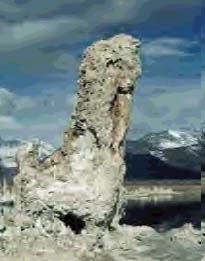
Tufa, pronounced "too-faw," are mysterious towers that can only be seen at Mono Lake. The tufa are a vital part of the Mono Lake ecosystem. Alkaline flies lay their eggs in them, and the flies help create more tufa by accumulating calcium carbonates and depositing it on submerged tufa towers.
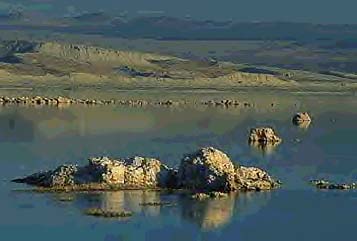
Since freshwater supplies were diverted for urban use more than fifty years ago, the water level of Mono Lake dropped almost forty feet. Because of this, the delicate tufa formations that once existed underwater emerged. We are now able to walk among the tufa towers.
Tufa were created underwater as freshwater springs mixed with the high calcium content in the lake. The reaction with the salts in the lake's water formed calcium carbonate structures. Students noted nicknames for the shapes, including "cemented cauliflower," "the skeletons of a dying lake," and "petrified springs."
Tufa are sometimes mistaken for cave formations because both are calcium carbonates. The difference is that the mixing of lake water and spring water forms the tufa. Sand tufa are smaller, delicate formations made of condensed sand.
Native Americans
Nick Craig
Native Americans have been living off the land at Mono Lake for hundreds of years. They learned how to use their surroundings and adapted to their own lifestyle. When the city of Los Angeles decided to use streams from the area to transport fresh water south, people living around the lake were forced to adapt to major changes.
The student report explained that people used arrowheads to hunt ground animals such as squirrels and snakes. Since no fish live in the lake, they also gathered alkali flies and larvae. Children running through the water stirred larvae from the lake bottom, making them easier to gather in handwoven baskets.
The page described one-room dwellings built from fallen tree branches and shrubs. It also connected the return of stream flow to hopes for restoration around the lake.
Water
Tom Chou
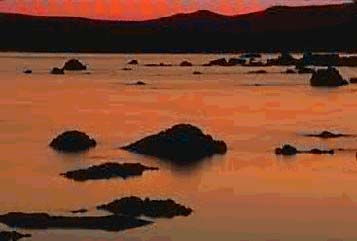
The student page reported Mono Lake's level as 6385.0 feet above sea level and its temperature as 17 degrees Celsius. Mono Lake is a salt lake, and fish cannot live there because the water is too salty.
The report connected lake levels to water policy, conservation in Los Angeles, and the work of the Mono Lake Committee. It described Mono Lake as an oasis in the dry Great Basin and a vital habitat for millions of migratory and nesting birds.
Animals
Greg Brostrom
The animals in and around Mono Lake listed in the student report were:
- California gulls
- Grebes
- Alkali flies
- Brine shrimp
California gulls come to Mono Lake to nest. When the lake level was very low, a land bridge formed between an island and the mainland, allowing coyotes to attack gulls and chicks.
Alkali flies are well adapted to Mono Lake. Waxy hairs create a small air bubble when they go underwater, allowing them to breathe. Brine shrimp also live in the lake in huge numbers, eat algae, and survive in a very salty environment.
Effects
Eric Baskin | Original page title: "Affects"
The student report argued that stream diversions into Mono Lake had serious effects on the ecology. It compared Mono Lake with Owens Lake, which had dried and was being mined for minerals, and warned that Mono Lake might have faced a similar future without restoration efforts.
As Mono Lake shrank, brine shrimp habitat shrank too, reducing food for other animals. Receding water also turned nesting islands into peninsulas, making it easier for coyotes to reach gull nesting areas.
The page also noted that conservation efforts changed life for Californians by asking people to use water less lavishly.